The 9 Best Fish Finders
Updated by · How we research

Nine fish finders compared on sonar type, screen, GPS and mounting, from castable sonar balls to side imaging. The Humminbird Helix 5 CHIRP DI leads. When users buy our independently chosen editorial picks, we may earn commissions to help fund the Wiki.
A fish finder is a sonar: a transducer under the hull sends sound down, and the screen draws the bottom, cover and fish as arches. Where that transducer sits matters as much as the display, and wired units need a 12-volt battery bought separately. This list covers kayaks, small boats and shore anglers casting a sonar ball.


Editor's Notes
November 1, 2026, by Ezvid Wiki Admin:
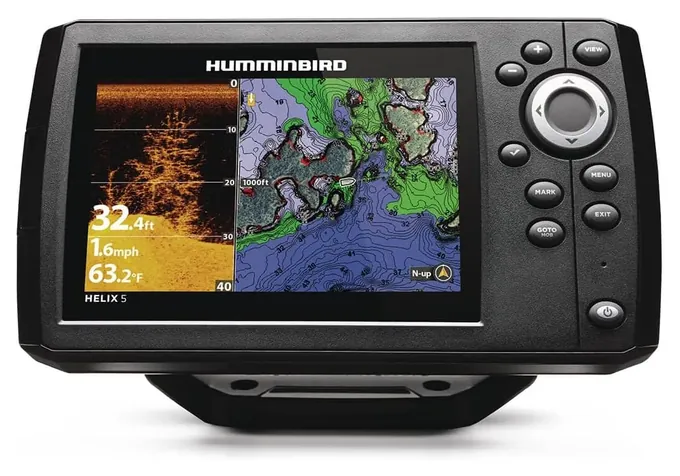
The Humminbird Helix 5 CHIRP DI takes the top spot: it puts a clear picture of the bottom, GPS and self-built lake maps on one screen that fits a small boat. The Garmin Striker 4 is the only holdover, and it's still the pick for the money.
The rest of the old list aged out. The Lowrance HDS-9 Live is a big-boat chartplotter that newer models replaced, the Garmin Striker 7SV and Deeper Smart Sonar have successors, and the Vexilar SP200 and Lowrance Hook2 5 can't be bought new. We also dropped two generic portables with little documentation behind them. New picks add down imaging, side imaging and two castable sonar balls, the Deeper PRO+ 2 and Deeper Start, for anglers without a boat.
For each finalist we compared sonar frequencies, depth ratings, screen resolution and power needs from spec reviews on two specialist fish finder sites, looked for repeated complaints about mounts, connector pins and Wi-Fi drops, and ran all four brands through federal recall records.
December 11, 2020:
Modern fishfinders and depth sounders often come as part of a chartplotter package, as depth-sounding and sonar are equally important for both categories. The choices we made for this list are primarily fishfinders, but some, like the Vexilar SP200 and the Lowrance HDS-9 Live are as useful for navigation as they are for fish-finding, so there is some crossover between these two lists.
The Joywee FF688C 3.5 makes the cut for the value it offers inshore and coastal anglers. The audible depth and fish proximity alarms are not offered on similar models at the same price point. Although it is not a recognizable brand, it comes well-recommended. Its addition came at the cost of the Garmin EchoMap which was removed for availability issues and the fact that there are similar Garmin products at similar prices on the list, such as the Garmin Striker 7SV.
The Venterior Portable replaces its predecessor for availability issues. The new model is superior in every way. Although the original Venterior Handheld is a very popular choice for fishermen the new model has a color screen, better fish identification, and is wireless. The Humminbird 410940-1 replaces the original Helix model for exactly the same reasons.
We added the Lowrance Hook2 5 at the cost of the Lowrance Hook2 7 because the newer model has better features, stronger CHIRP sonar, GPS, and a split-screen, just like the Hook2 7. It also offers better value, even though the screen is two inches smaller. It is also geared more heavily towards fishing than navigation.
April 18, 2019:
Although we had to remove the Lowrance Elite-5 due to availability issues, we added two new models from the brand in its place. The Lowrance HDS-9 Live is an uber-powerful, high-end option that incorporates cutting-edge technology; in particular, users seem to appreciate its fast responsiveness (even with split screens), its ability to read sonar while traveling at high speeds, and its robust mapping capabilities. The Lowrance Hook2 7 doesn’t come with the same amount of bells and whistles, but it’s straightforward to operate, with an accurate GPS system, tons of preloaded lake maps, and reliable CHIRP sonar imaging.
Reports from users of the Garmin EchoMap suggest that it’s an impressive value for its abundance of features, given its simple installation and ability to store and display maps of thousands of lakes in the United States and Canada. People are impressed with its GPS and fish-finding accuracy as well, though some wish it would provide water temperature, too. Either way, we increased its ranking a couple slots.
Removed the Raymarine Dragonfly Pro as it was out of stock. Also decided to phase out the Lucky Portable after finding complaints regarding inaccurate depth readings.
Special Honors
Garmin LiveScope Live forward-facing sonar such as Garmin LiveScope shows fish and lures moving in real time ahead of the boat. It's a separate transducer that needs a larger, compatible Garmin display, so a full setup costs several times more than anything on this list. Some tournaments limit its use, so check the rules first. garmin.com
CHIRP, Down Imaging And Side Imaging
Side imaging looks left and right instead of down, so you can scan a bank or a flat without driving over every fish.
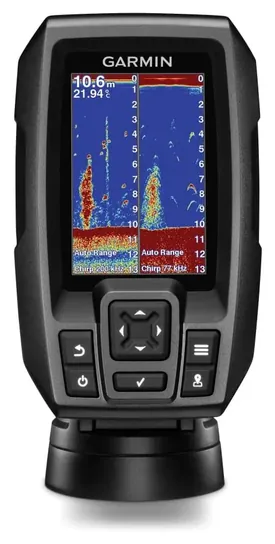
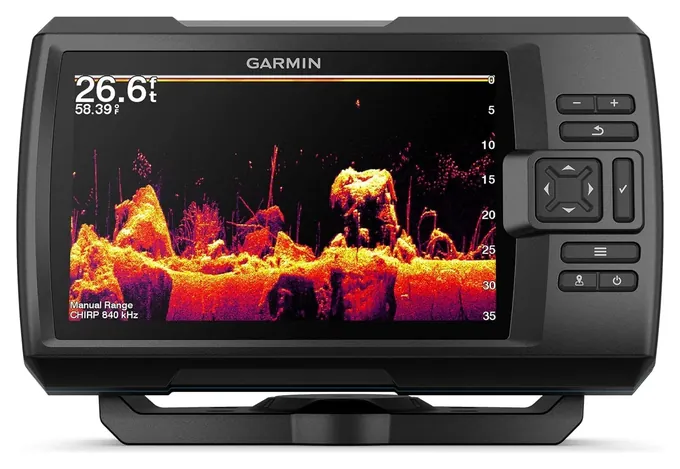
Every unit here starts with traditional sonar, which draws the bottom as a line and fish as arches. CHIRP sonar sweeps a range of frequencies instead of pinging one, which separates fish that hold close together and reaches deep. The Garmin Striker 4 is rated to about 1,600 feet in fresh water and 750 in salt water, and every depth rating drops in salt.
Down imaging uses a thin, high-frequency beam to paint a near-photo of what's straight below: stumps, brush, rock piles. It trades depth for detail. The Helix 5 CHIRP DI reads about 1,200 feet with regular sonar but about 350 feet with down imaging, and its sharper 800 kHz setting turns grainy in stained water, so 455 kHz is the everyday choice.
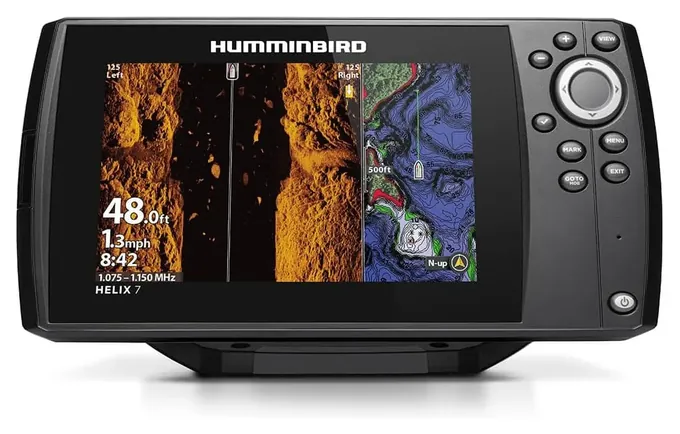
Side imaging looks left and right instead of down, so you can scan a bank or a flat without driving over every fish. The Helix 7 MEGA SI covers about 250 feet to each side in clear water. Side views depend on the transducer hanging level and clear of the motor; a bad angle or prop wash can blank one side.
Screen Size, Power And Mounting
Screen size decides how usable split views are. On a three- to five-inch unit, sonar and a map side by side feel cramped, which is fine for a kayak or jon boat where you mostly watch one view. A seven-inch screen is the point where sonar, down imaging and a map fit at once (fishfinderreviews.net).
None of the mounted units ships with a battery. They run on 12 volts, and draw is low: the Striker 4 pulls about a quarter of an amp (Fishfinder Lab), so a small 7 to 10 amp-hour pack lasts a day on a kayak (fishfinderreviews.net). Fuse the power lead, check the polarity, and keep lithium packs in a dry, secure box. Voltage dips when an outboard starts can reboot some units, so a separate battery or clean wiring helps.
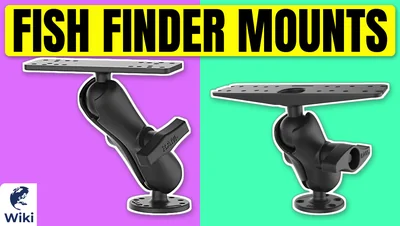
Mount the transducer where water flows smoothly, away from the prop and motor wash. A transom puck that's set too high loses the bottom at planing speed, and stock mounts can vibrate on aluminum hulls. If you want to keep the contour maps a unit builds, add a memory card where it has a slot (fishfinderreviews.net).
Castable Sonar For Shore, Dock And Ice
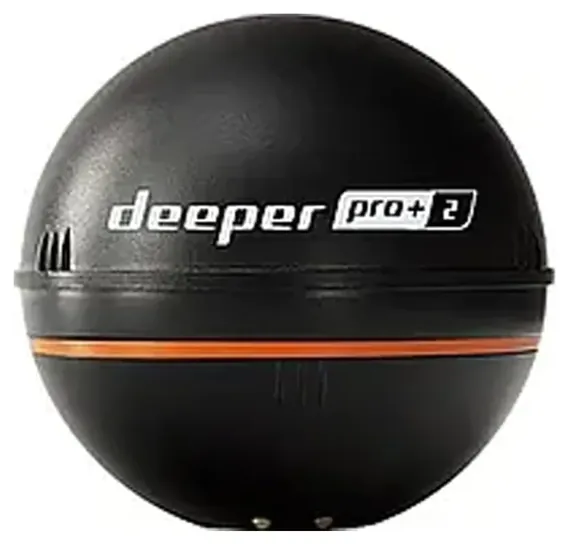
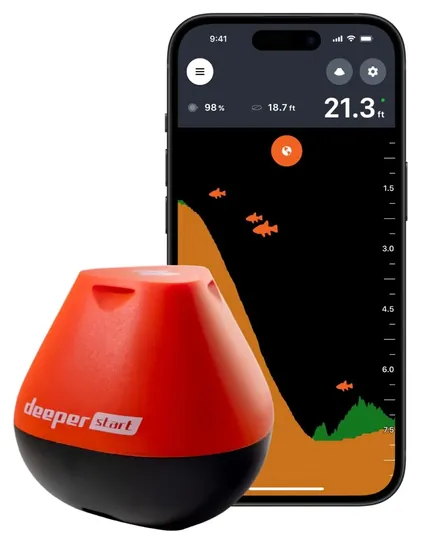
A castable sonar is a floating ball with its own battery that sends readings to your phone over Wi-Fi. You don't need a boat, a battery or any wiring, which suits bank anglers, dock fishing, float tubes and ice holes. The Deeper PRO+ 2 reaches about 100 meters, has its own GPS for mapping without cell service and runs about nine hours. The Deeper Start reaches about 50 meters, uses one beam and relies on the phone's GPS.
Wi-Fi range is the limit, not depth: past it, the picture freezes. Phones that switch to a cell network when the sonar's Wi-Fi has no internet cause most dropouts, so turn off that switching in settings. Tie the ball to a strong line with a good knot or a snap, since a lost ball doesn't come back. After salt water, rinse it and check the O-ring before charging.
For ice fishing, the PRO+ 2 has an ice mode that works like a flasher, and the Garmin Striker 4 has a flasher view for a portable ice setup. Wear a flotation device in any small boat or kayak, and check local and tournament rules before you fish new water.
How we researched this
We compared 17 fish finders from Garmin, Humminbird, Lowrance, Deeper and several generic brands, read published spec reviews from two specialist fish finder sites for the nine finalists, looked for patterns in owner complaints, and checked all four main brands against U.S. Consumer Product Safety Commission recall records, which listed none.
Sources (11)
- Fishfinder Lab: Garmin Striker 4 review
- fishfinderreviews.net: Garmin Striker 4 review
- fishfinderreviews.net: Humminbird Helix 5 CHIRP DI GPS G3 review
- fishfinderreviews.net: Garmin Striker Vivid 4cv review
- fishfinderreviews.net: Garmin Striker Vivid 7cv review
- fishfinderreviews.net: Humminbird Helix 7 review
- fishfinderreviews.net: Lowrance Eagle 4x review
- fishfinderreviews.net: Humminbird PiranhaMAX 4 DI review
- fishfinderreviews.net: Deeper PRO+ 2 review
- fishfinderreviews.net: Deeper Start review
- U.S. Consumer Product Safety Commission: SaferProducts recall search
Frequently asked questions
Is a depth finder the same as a fish finder?
Mostly, yes. Both use sonar to read depth. A fish finder also draws the bottom, cover and fish on its screen, while a basic depth sounder shows only a number.
Do I need GPS on a fish finder?
Only if you want to save spots and find them again, or build contour maps. Units with GPS mark waypoints, and some draw their own lake maps as you drive. Full lake charts usually need a map card.
What's the difference between CHIRP and down imaging?
CHIRP is traditional sonar that sweeps many frequencies, so fish show as clean arches and it reads deep water. Down imaging uses a thin, high-frequency beam to show a picture of structure straight below, but it reaches far less depth.
What's a good fish finder for a kayak?
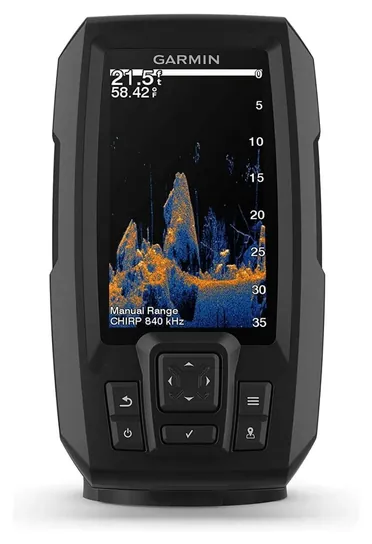
A small, low-power unit like the Garmin Striker 4 or Garmin Striker Vivid 4cv with a 12-volt pack, or a castable Deeper PRO+ 2 if you'd rather not wire anything.
Do fish finders work for ice fishing?
Some do. The Garmin Striker 4 has a flasher view, and the Deeper PRO+ 2 has an ice mode. Both work through a drilled hole.
Does a fish finder come with a battery?
Mounted units don't. They need a separate 12-volt battery, and a small 7 to 10 amp-hour pack is common on kayaks. Castable sonar balls have a built-in rechargeable battery.