The 10 Best LED Grow Lights
Updated by · How we research

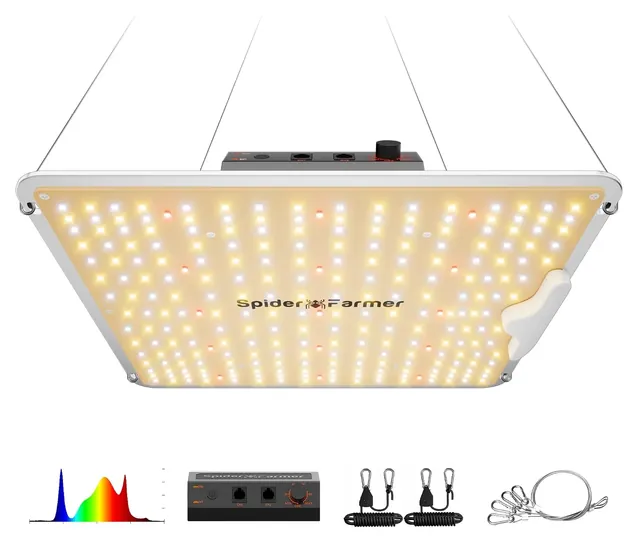
Tent panels, shelf bars, clip lamps and a floor lamp compared on real power draw, coverage and warranty. The Spider Farmer SF1000 leads for small tents. When users buy our independently chosen editorial recommendations, we may earn commissions to help fund the Wiki.
The watt number on a grow light's box is often marketing, not power: one clip lamp sold as a 300-watt light draws about 20 from the wall. Plants care about how much usable light lands on their leaves. This guide is for home growers lighting houseplants, herbs, seed trays and vegetables, plus anyone fitting out a small tent.


Editor's Notes
November 1, 2026, by Ezvid Wiki Admin:
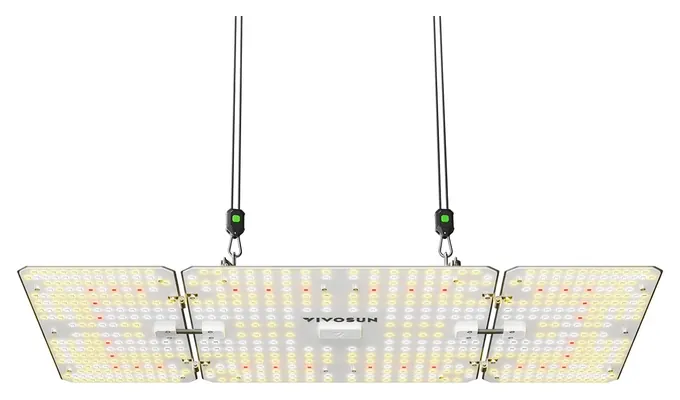
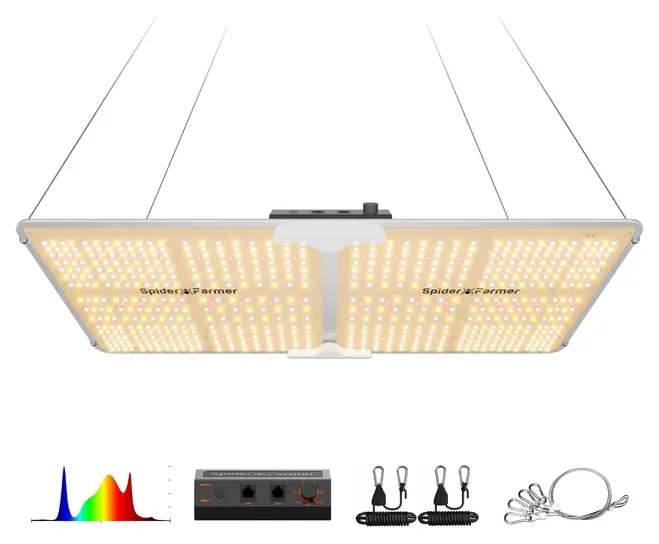
The Spider Farmer SF1000 goes first here: it is silent, dims with a knob and carries a five-year warranty, and it suits the shelf or small tent most home growers actually have. Search data showed that most readers here want light for houseplants, herbs and seed trays, so the list now covers shelf bars, clip lamps and a floor lamp as well as tent panels.
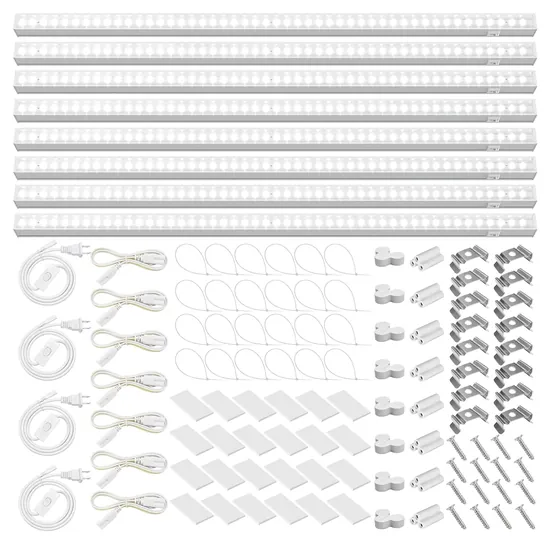
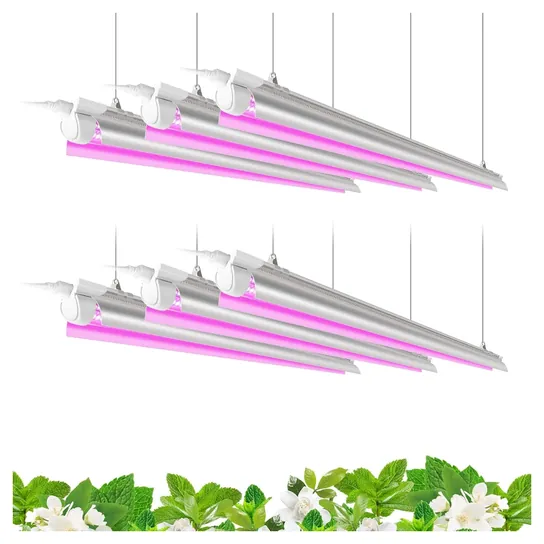
Two picks stay: the Spider Farmer SF2000 and the Barrina T8 V-Shape, both still sold in current versions. The California Lightworks SolarSystem and the Roleadro Galaxyhydro Series 2000W are gone from sale, and the Galaxyhydro's 2000-watt label claimed roughly three times its real draw. The Lightimetunnel Indoor, Aspect 20 Black, Advanced Platinum Series P450, Apollo Horticulture Full Spectrum, Ezorkas Tri Head and Viparspectra 2020 Pro Series are older models that no longer turn up in current searches.
Independent lab light maps don't exist for most of these fixtures, so we compared the makers' own light maps and manuals, checked their wattage claims against real draw, and took the advice on hours and hanging height from university extension services.
August 03, 2020:
During this round of updates, while most of our previous selections proved to still be worthy picks, we did end up replacing the Viparspectra V1200 with the Viparspectra 2020 Pro Series, which, among other improvements, includes a new solid-state cooling system that relies on a large aluminum heat sink in lieu of its four, former cooling fans, which tend to be noisy and are prone to eventual breakdown.
We also added the Spider Farmer SF-2000 — which caught our eye with its Samsung and Mean Well components, as well as the the Ezorkas Tri Head and Barrina V-Shape — two relatively low-powered models that we thought were worth including for the portion of our audience that isn’t interested in launching a commercial cannabis operation, but rather is just looking for a bit of extra light to help speed things up with their indoor herb garden or countertop microgreens.
This can be an extremely confusing category to shop in, especially for users who don’t have any sort of background in electrical fundamentals or indoor gardening. With prices varying so drastically and every company trying to impress you with a different set of numbers, it can be difficult to suss out the good and the bad. With that in mind, here’s some basic terminology to arm yourself with while you shop:
Wattage: Let’s start here. For old-school growers who are used to comparing nominal 400-, 600- and 1,000-watt fixtures, this is going to be a bit of an adjustment, but my advice here is to do your best to forget about wattage. The way some companies advertise their gear – calling a light with 400, five-watt LEDs a 2,000-watt fixture, without taking efficiency into account – can be extremely misleading, and enough to give the uninitiated a headache. As far as wattage goes, for all practical purposes you should only be worried about your input wattage, as it speaks directly to how much this fixture is going to cost you in electricity.
Photosynthetically Active Radiation (PAR): This is the name given to the range of light that plants use for photosynthesis. Just as there are shades of ultraviolet and infrared that are invisible to the human eye, plants can only see light that lands on certain parts of the spectrum, specifically, between 400 and 700 nanometers. Put simply, PAR is the part of the light spectrum that matters to plants.
Photosynthetic Photon Flux (PPF): This is the metric used to measure a given light’s PAR output at the fixture, measured in micromoles per second. Note that this doesn’t describe how much light is getting to your plants, but rather simply how much is being released from the fixture at the point of origin.
Photosynthetic Photon Flux Density (PPFD): Quite possibly, this might be the most important metric to consider when shopping for your new lights. PPFD is a spot measurement that calculates micromoles per second, per square meter. Essentially, this measures how many viable photons are going to reach your plants when they're positioned a certain distance below, and a particular distance from, your lights.
Savvy marketers provide their audience with detailed diagrams, sometimes referred to as PPFD maps, that clearly detail their light’s intensity. These diagrams can be helpful, especially for growers looking to equip large areas and trying to calculate proper spacing, but the notoriously skeptical consumer in me can’t help but wonder about their accuracy. Master growers have been known to keep a light meter on hand, so they can confidently fine tune the spacing in their gardens, to maximize yield.
April 23, 2019:
While the G8LED model that topped our last selection maintained its number one ranking, our previous second best has been unseated by the likes of the Viparspectra V1200. That's more to do with the incredible heat handling capabilities of the V1200 than it is to do with anything necessarily deficient in the California Light Works model now living at number three. A few items left our list entirely, as well, including a less advanced model of the Roleadro Galaxy Series and an older Miaxisun, both of which have been replaced by models far more flexible from the same brands.
We wanted to make sure to keep the rather simple Aspect model around, as well. It's not going to be anybody's go-to for industrial applications, but it's more than sufficient to please a plant or two that's struggling through a grey winter or having to move into a darker room in the house.
Special Honors
California Lightworks A California maker of programmable LED fixtures for serious growers, including the SolarSystem line. Its online knowledge base is one of the clearer explanations of how to read grow light specs. californialightworks.com
Horticulture Lighting Group HLG makes quantum-board panels and says it builds many of them in the U.S. Its fixtures are sold mostly through its own store and hydroponics shops. horticulturelightinggroup.com
Read The Light, Not The Watts
Look for the real power draw in the specs, then for the light figures that matter to plants.
Grow light boxes love big wattage numbers, and many of them are "equivalent" figures with no fixed meaning. A clip lamp sold as 300 watts can draw 20 from the wall, and a panel sold as 2000 watts may pull about 600. Look for the real power draw in the specs, then for the light figures that matter to plants.
Two numbers do the work. PPF is the total plant-usable light a fixture puts out each second, and PPFD is how much of it lands on a square meter at a given height. California Lightworks has a clear explainer on PAR, PPF and PPFD. Lumens measure brightness for human eyes, so they say little about how plants will grow.
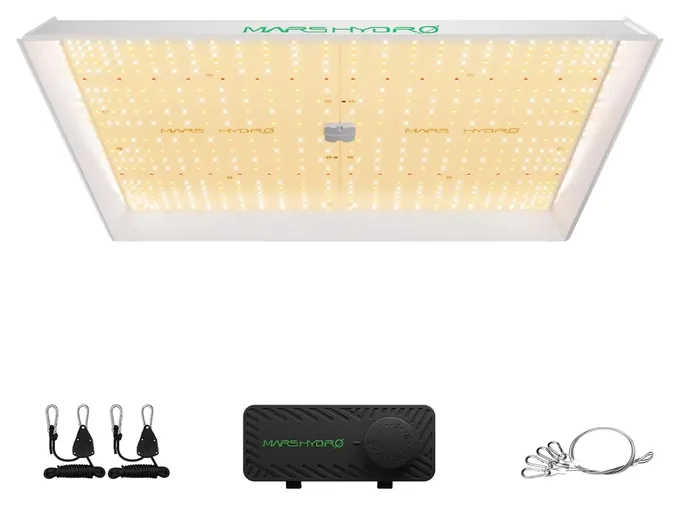
Coverage depends on hanging height, and makers often stretch it. Spider Farmer's own manual for the SF1000 sizes it at about 90 by 90 centimeters for leafy growth and 60 by 60 for flowering, even though it's sold for larger tents. Mars Hydro rates the TSW2000 at 300 watts of true draw for a 4-by-4-foot area during leafy growth. Treat any light map as maker-rated: few consumer fixtures have independent measurements.
Match The Fixture To The Plants
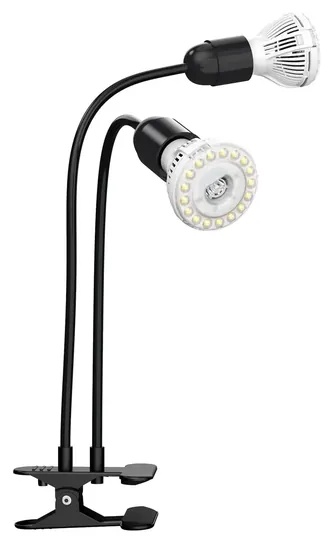
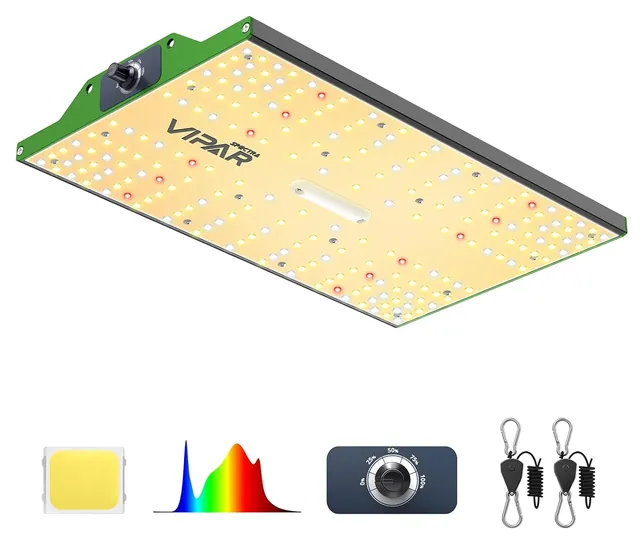
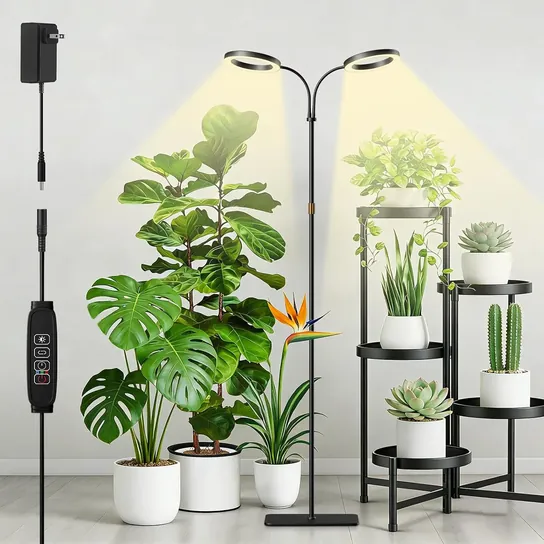
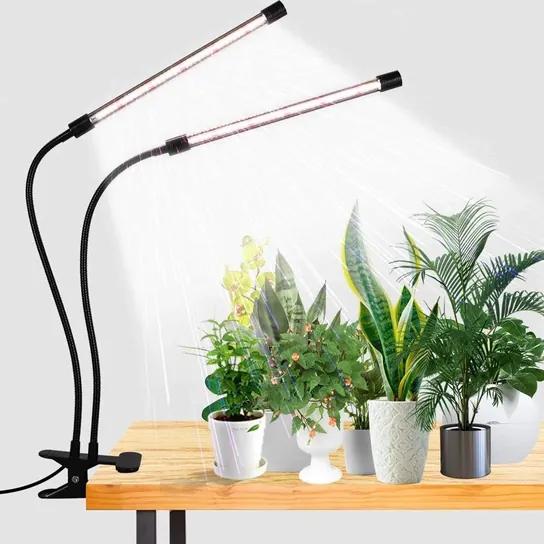
Tent panels, the flat boards of small diodes, suit tents, closets and wide shelves, and they cover the most ground per outlet. Linkable bars like T5 and T8 tubes suit seed trays, plant shelves and racks of microgreens, because they can sit a few inches above the leaves along the whole shelf. Clip lamps on goosenecks handle a few pots on a desk, and floor lamps on telescoping poles reach tall houseplants that have outgrown a window.
Color matters in a living space. White, full-spectrum light around 3000 to 5000 K looks natural and lets you see yellowing or pests, while red-and-blue lamps grow plants well but turn everything purple. Savvy Gardening recommends white light for lights in the house and sets hanging heights of about 12 to 18 inches for many LED fixtures. Urban Agriculture with Mike also favors full-spectrum fixtures that carry plants from seed to harvest, and suggests checking a maker's PPFD and efficiency data before trusting a wattage claim.
Hours, Height And Safety
Plants need a dark period, so don't run lights around the clock. North Dakota State University Extension suggests about 14 to 16 hours a day for seedlings on a timer, with lights 4 to 6 inches above them and raised as they grow. Low-light houseplants do well on about 10 to 12 hours. Hang high-power panels at the maker's recommended height, since the right distance changes with the fixture's strength.
Look for a safety listing from UL or ETL; UL also tests to UL 8800, the standard written for horticultural lighting. Keep drivers and cords dry and off the floor of a tent, leave room around fanless panels so heat can escape, and stay within the maker's limit when linking bars. Most horticultural LEDs are rated low risk for eyes, but HortiDaily notes that staring into bright, blue-heavy panels up close is best avoided. Grow lights are legal to own everywhere; what you grow under them may not be, so check local law.
How we researched this
We compared 25 grow lights, including all 10 from the earlier version of this page, read the makers' spec sheets and light maps for the 10 picks and manuals where published, checked wattage claims against real power draw, followed university extension guidance on hours and hanging height, analyzed owner feedback, and checked every brand against the U.S. Consumer Product Safety Commission's recall database. Updated November 1, 2026 by Ezvid Wiki Admin.
Sources (9)
- North Dakota State University Extension: grow lights for seed starting
- Oklahoma State University Extension: gardening column
- California Lightworks: PAR, PPF and PPFD
- Mars Hydro: TSW2000
- Savvy Gardening: best LED grow lights
- Urban Agriculture with Mike: best LED grow lights
- UL: horticultural lighting
- HortiDaily: the effect of LED grow lights on human health
- U.S. Consumer Product Safety Commission: SaferProducts.gov
Frequently asked questions
Do I need a full-spectrum grow light?
Not strictly, but white full-spectrum light is the better choice for a living space. It looks natural and shows the true color of leaves. Red-and-blue lights grow plants well but tint the room purple.
How many hours a day should a grow light be on?
About 10 to 12 hours for low-light houseplants and 14 to 16 hours for seedlings and flowering plants. Use a timer, and give plants a dark period every day.
How far should a grow light be from plants?
Strip lights and tubes can sit 4 to 6 inches above seedlings and move up as they grow. Panels usually hang 12 to 18 inches or more above the canopy; follow the maker's chart, since stronger fixtures hang higher.
Is a grow light different from a regular LED bulb?
Yes. A grow light puts more of its output into the red and blue light plants use for photosynthesis. A regular bulb is tuned for human eyes, and its lumen rating says little about plant growth.
Will a grow light raise my electric bill?
A little. A panel that truly draws 100 watts, run 12 hours a day, uses about 1.2 kilowatt-hours a day. Multiply by your utility's rate to get the daily cost.
Are LED grow lights safe for my eyes?
Most are rated low risk under eye-safety standards, but don't stare into a bright panel at close range. Some growers wear tinted glasses when working under strong lights.