The 10 Best Outdoor Thermometers
Updated by · How we research

Dials, glass tubes and wireless displays compared for accuracy, readability and placement. The Newentor Q3 leads with humidity, a forecast and a color screen. When users buy our independently chosen editorial choices, we may earn commissions to help fund the Wiki.
Where you hang it matters more than what you buy: a thermometer in afternoon sun can read several degrees high, while one in open shade, away from walls, reads the air the way weather stations do. This list covers dials and tubes for a quick glance outside, plus wireless displays for anyone who would rather read it from the couch.


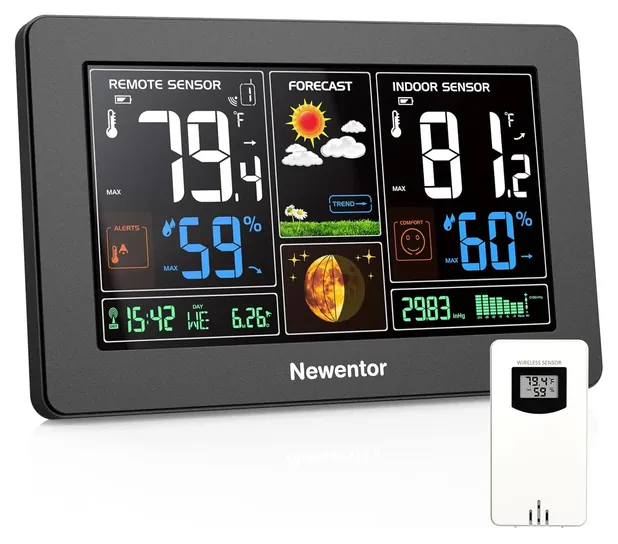
From the manual
- The outdoor sensor reads only from -4 F to 140 F; below that the station shows LL.L instead of a reading. pp. 2, 13
- One sensor comes in the box. Each added sensor needs its own channel, 1 to 3, and the station must be switched to match. p. 14
- Set the time zone before the radio clock syncs, or the received time will be wrong. A signal search can take seven minutes. pp. 7-8
- During that search most buttons stop working and the backlight stays dark, even on the adapter. p. 7
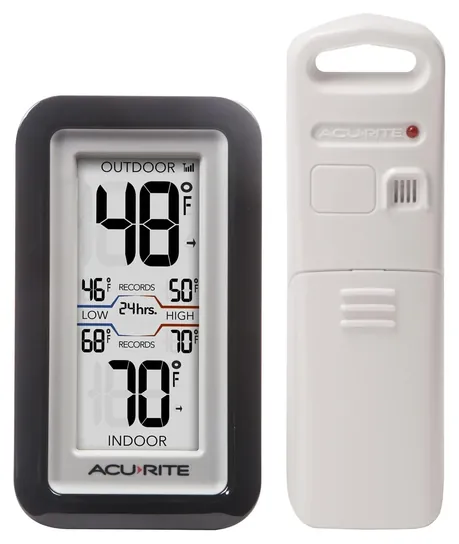
From the manual
- Below -4 F, swap the sensor's alkaline AAs for lithium cells; AcuRite also advises against heavy-duty and rechargeable batteries. p. 4
- The Fahrenheit/Celsius button sits inside the display's battery compartment, not on the front. p. 4
- Hang the sensor 4 to 8 feet up in permanent shade; it resists water but lasts longer under cover. p. 5
- AcuRite only honors the one-year warranty if you register the thermometer online. p. 2
Compare the specs
Swipe the table sideways to see every column.
| Product | Type | Outdoor range (°F) | Wireless reach (ft, open air) | Humidity | Warranty (years) |
|---|---|---|---|---|---|
| 1. Newentor Q3 | Wireless display | -4 to 140 | 200 | Indoor and outdoor | 1 |
| 2. AcuRite 02043A1 | Wireless display | -40 to 158 | 165 | None | 1, must register |
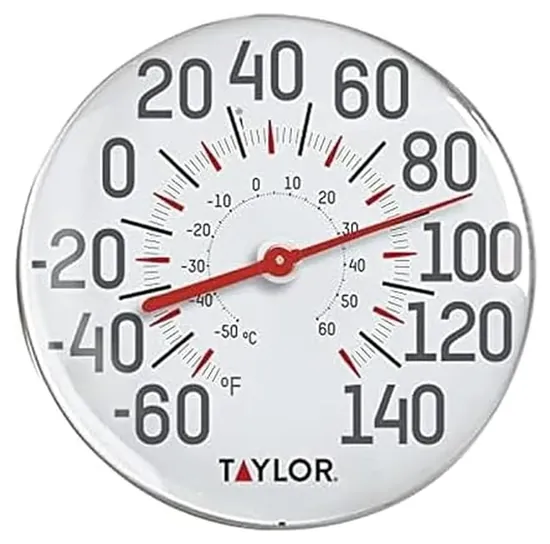
| 3. Taylor Big Read | Metal dial | -60 to 120 | Not wireless | None | 1 |
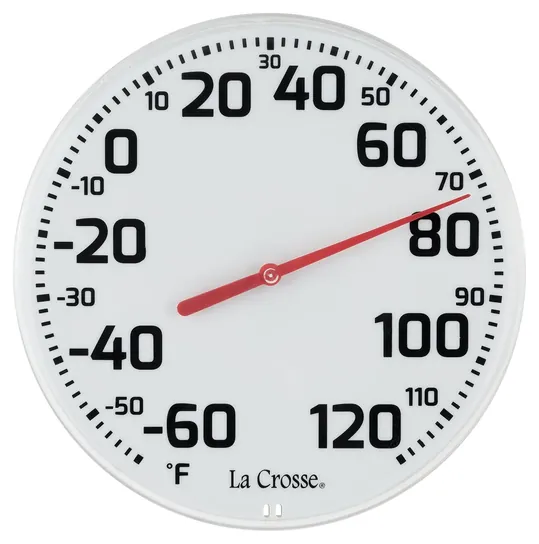
| 4. La Crosse 104-1522 | Plastic dial | -60 to 120 | Not wireless | None | 2 |
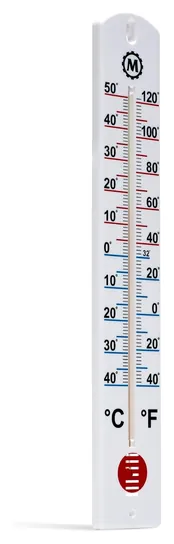
| 5. Marathon Vertical | Liquid tube | — | Not wireless | None | — |
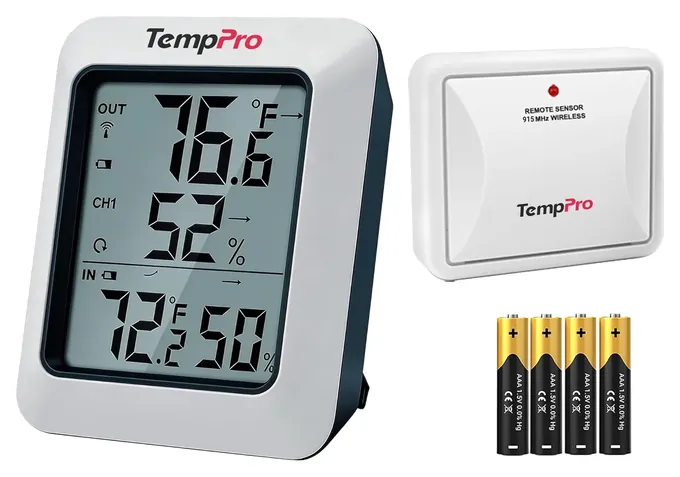
| 6. TempPro TempAir TP60B | Wireless display | -4 to 158 | 500 | Indoor and outdoor | 1 |
| 7. Taylor 1730 | Wireless display | -4 to 140; -40 on lithium | 200 | None | 1 |
| 8. La Crosse WS-9160U-IT | Wireless display | -40 to 140 | 330 | Indoor only | 1; 2 if registered |
| 9. Taylor 5135 | Liquid tube | -60 to 120 | Not wireless | None | 1 |
| 10. AcuRite 00799 | Window digital | -4 to 158 | Not wireless | None | 1, must register |
Ranges are what each sensor or scale is rated to read. Wireless reach is the maker's open-air figure; walls and cold batteries shorten it. The AcuRite 02043 and Taylor 1730 need lithium cells in the sensor for their lowest readings.
Sources
- Newentor Q3 User manual
- AcuRite 02043 product page and specifications 00799 window thermometer manual, web copy
- Taylor 12-inch metal patio thermometer (Big Read) product page 12-inch metal dial instructions (PDF) 1730 instruction manual (PDF) 5135N package card (PDF)
- La Crosse 104-1522 specification sheet (PDF) WS-9160Uv3 set-up guide (PDF)
- Marathon 16-inch vertical thermometer product page
- TempPro TempAir PLUS TP60B instruction manual (PDF)
From the manual
- No wall hardware is included. Taylor calls for a 1-1/2-inch #8 screw left about half an inch out to take the hanger. p. 1
- Mounted correctly it should read the air within 2 F; avoid a heated wall or a spot above a window. p. 1
- Sunlight's ultraviolet can weather the dial early, one more reason to hang it in shade. p. 1
From the manual
- A knob on the back recalibrates it. Check it first by leaving it beside a trusted thermometer indoors for three hours. p. 2
- La Crosse suggests a spot under an eave on a north-facing wall; sun and exhaust vents make it read high. p. 2
- The two-year warranty covers defects, and you pay the postage to send it back. p. 2
From the manual
- The sensor is rainproof only when it hangs upright, with its vent holes facing down. p. 1
- After a battery change in either unit, pair them again by holding CHANNEL/SYNC on the station. pp. 8-9
- Both the 24-hour and all-time records restart whenever you clear them or change batteries. p. 4
- Both units run on AAA cells, and TempPro warns the sensor can stop sending in extreme temperatures. pp. 14-15
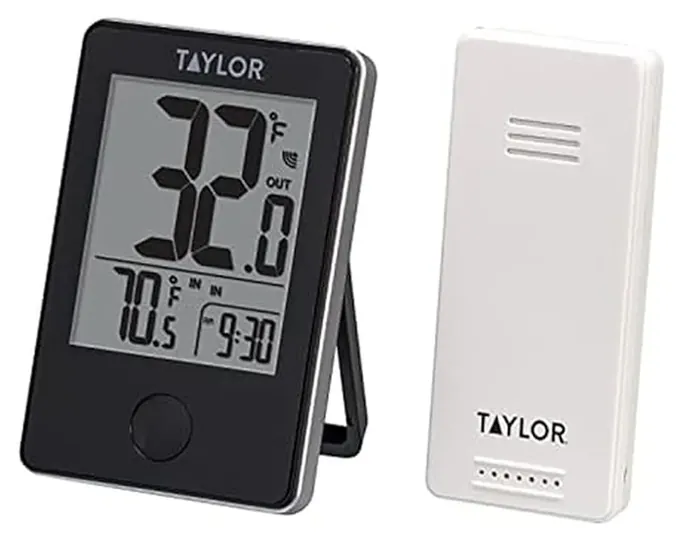
From the manual
- Put batteries in the base unit first, then the sensor, or the two may not link. p. 1
- On alkaline cells the sensor reads down to -4 F; lithium cells extend that to -40 F. p. 3
- The sensor resists weather but isn't waterproof; Taylor suggests mounting it under an eave or other cover. p. 2
- Accuracy is within 2 F only from 32 F to 104 F, so two units side by side can disagree. p. 3
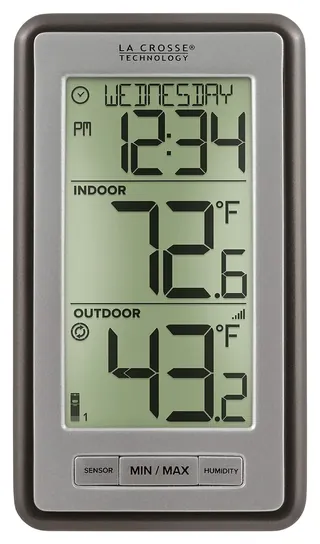
From the manual
- The station can add a rain sensor and two more temperature-humidity sensors, which also brings outdoor humidity to the screen. p. 9
- La Crosse rates battery life at over two years for both the station and the sensor. p. 10
- Register the set and opt in to product emails, and La Crosse doubles the one-year warranty. p. 12
- If the outdoor reading shows dashes, hold SENSOR to search again before trying a full restart. p. 8
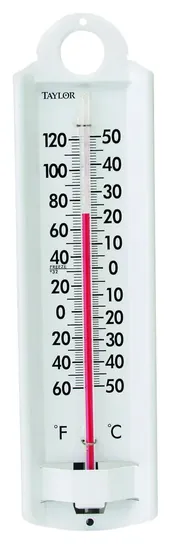
From the manual
- If the red column arrives split, tap the side against your palm, bulb end down, until it rejoins; Taylor says that isn't a defect. p. 1
- Keep it out of direct sun and away from heat sources or a large body of water, which skew the reading. p. 1
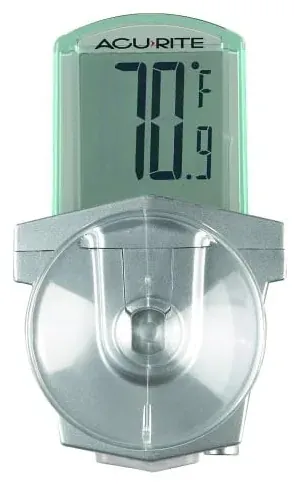
From the manual
- It runs on a pre-installed L1154 button cell. Replacing it means removing two small screws and opening the case. p. 1
- The on/off switch hides under a rubber seal on the bottom; press the seal back firmly after switching on. p. 1
- The suction cup needs clean, smooth glass. AcuRite says not to use it on wood or plaster. p. 1
- Warranty service requires registering the thermometer with AcuRite. p. 1
Editor's Notes
November 17, 2026, by Ezvid Wiki Editors:
This update re-checked every pick: Taylor's own store still lists the Big Read, now as its 12-inch metal patio thermometer, AcuRite still lists the 00799, and the La Crosse WS-9160U-IT costs more than in October but remains a sound pick. We then read the manuals or spec sheets for nine of the ten picks and added a spec table and notes from those manuals. We also corrected the battery details for both AcuRite picks and the Taylor 1730, and the Big Read's lens description. A search of the CPSC recall database found no recall of any pick.
November 16, 2026, by Ezvid Wiki Editors:
One retailer lists the Taylor Big Read as discontinued by Taylor, but new stock is still sold, so it keeps its spot, with Taylor's newer Big & Bold dial as the fallback if it runs out. AcuRite still lists the 00799 on its own site, and the La Crosse WS-9160U-IT costs more than in October but remains a sound pick. A recall search for thermometers and weather stations found nothing relevant.
October 19, 2026, by Ezvid Wiki Editors:
The Newentor Q3 now leads this list. One screen shows indoor and outdoor temperature and humidity, a forecast and the time, and it's the only pick here with a published field check of its sensor's range. That's a change of scope: the earlier version left out wireless indoor/outdoor units, but they're how most people check the weather now, and a sensor you can move into the shade usually beats a dial stuck on a sunny wall.
Classic dials and tubes still have a place, so the Taylor Big Read, La Crosse 104-1522, Marathon Vertical and Taylor 5135 cover them, and the AcuRite 00799 covers window mounting. None of the earlier picks made it. The Conant Vermont and WiHoo Metal are no longer for sale, the Wind & Weather Large is gone, and the Taylor Jumbo's page now describes two different dials. We couldn't find the other decorative models in current stock.
Home thermometers don't get lab tests, so we weighed makers' spec sheets against National Weather Service siting rules, one published field comparison and owner feedback, and favored models that make it easy to read the air rather than the wall.
Earlier notes
April 27, 2020, by Sam Kraft:
This list required a total overhaul; all but one item has been replaced. Most of the legacy listings were no longer available, and the few that could still be purchased were of exceptionally low quality.
We have only included traditional thermometers designed for outdoor use, omitting indoor-outdoor models that require a sensor to be placed outside to feed a digital display screen inside the house. [2026 update: the current list includes wireless indoor/outdoor displays, the #1 pick among them; the October 2026 note explains the change.] Designs vary within the category, which includes old-fashioned vertical models with a liquid gauge and clock-style thermometers with a dial — some of which feature hygrometer markings for measuring humidity as well.
Whereas most of these are built to be mounted in a semi-permanent way (such as on a wall, fence post, or tree), the Sun Company Zip-O-Gage is a small, portable unit that fits easily into a pocket or attaches to your gear via a keyring. This one is great for campers and hikers, and it even includes a helpful chart on the back side to help you determine the wind chill based on the current conditions.
Among the more traditional models, some are mounted via a swiveling arm (the Conant Vermont, for example), and others can be attached to a window or any other glass surface via suction cups (such as the Aspects Classic). The SPI Home 33314 may seem pricey when compared with many of the other options, but we note that it serves as a high-quality decorative piece in addition to providing accurate readouts and long-term durability.
Special Honors
Davis Instruments Davis Instruments makes the weather stations many serious hobbyists and schools use, along with radiation shields, the louvered white housings that keep sun off a temperature sensor while letting air through. For a sensor that has to sit in the open, a shield gives it what the National Weather Service asks of any instrument shelter: free airflow with cover from sun and rain. davisinstruments.com
Ambient Weather Stations Ambient Weather makes Wi-Fi home weather stations that measure temperature, humidity, wind, rain and UV from one outdoor array, and can share readings to its online network and smart-home apps. They cost several times more than any thermometer here, which is why they sit outside the list, but they're the step up for people who want the whole picture. ambientweather.com
Dial, Tube Or Wireless: Which Kind Fits
A round dial works by a coiled metal strip that turns the needle as it warms and cools, so it needs no power and reads from across a yard.
Start with where you'll look. A round dial works by a coiled metal strip that turns the needle as it warms and cools, so it needs no power and reads from across a yard. A tube thermometer is a sealed glass tube of red liquid against a printed scale; it's slim enough for a door frame or post. Both read only the spot where they hang, and both take a while to settle after the sun moves.
A wireless set splits the job: a small sensor goes outside and a display sits indoors. You read it from the couch, and most keep the day's high and low, which a dial can't. Claimed ranges run from about 165 to 500 feet, but walls cut that down; Bob Vila's reviewers measured about 220 feet for a sensor rated at 200. Weather Station Experts puts typical real-world range at 200 to 300 feet and notes that digital units read as accurately as good analog ones.
A window thermometer sticks to the glass and needs no second unit, but sun on the pane can skew it. If you want wind, rain and UV too, that's a full weather station, a bigger purchase covered in the honors below.
Where To Hang It So It Reads True
Most bad readings come from placement, not the instrument. The National Weather Service siting guide calls for shade, open air, grass underfoot and a height of about 4.5 to 6 feet, well away from buildings, pavement, patios and eaves. Few yards allow all of that, so aim for the parts you can control: shade all day, a few feet off the ground, and air moving around it.
Walls are the usual trap. Brick and siding soak up heat by day and give it back at night, so a wall-mounted dial reads warm in the evening. The Royal Meteorological Society treats a north wall as a last resort and advises standing a sensor off the wall rather than flat against it. A fence post on the north or east side of the yard usually beats any wall.
To check a thermometer, set it, or the wireless sensor, in a glass packed with crushed ice and a little water and stir. After a few minutes it should read close to 32 F. Any steady offset is how far off it runs.
Mercury, Batteries And Cold Weather
Many people still search for a mercury outdoor thermometer, but the tube models sold for patios today use a red-dyed liquid instead. Mercury thermometers break into a toxic spill, and the EPA notes that a number of states bar the sale of mercury fever thermometers. If you inherit an old silver-fill outdoor thermometer, handle it gently, and follow the EPA's cleanup steps if it breaks.
Batteries are the weak point of wireless sets in winter. Alkaline cells lose voltage in deep cold, and the sensor can drop out right when you want the overnight low. Taylor rates its 1730 sensor to -40 F only with lithium AAA cells, and AcuRite gives the same advice for the 02043's sensor below -4 F. La Crosse quotes more than two years from a set of sensor batteries, but alkaline cells can still quit on a frigid night.
A few sets, such as the Newentor Q3, also set their clocks from the national radio time signal. If that matters to you, our atomic clocks page covers clocks built around that signal.
How we researched this
We compared 19 outdoor thermometers, from dials and glass tubes to wireless displays and a full weather station. For nine of the ten picks we read the maker's documents: the Newentor Q3 manual and FAQ sheet, AcuRite's 02043 and 00799 manuals, Taylor's 1730 manual and its 12-inch dial and 5135N package instructions, La Crosse's 104-1522 sheet and WS-9160Uv3 set-up guide, and TempPro's TempAir PLUS manual; for the Marathon we had only its product page. Bob Vila's field check of the Newentor's range and the National Weather Service and Royal Meteorological Society siting guides shaped the placement advice, and a November 2026 search of the CPSC recall database found no recall of any pick. The 3D models are built from published dimensions.
Sources (12)
- Bob Vila: The Best Outdoor Thermometers
- Weather Station Experts: Best Outdoor Thermometers
- National Weather Service Raleigh: Weather observations
- Royal Meteorological Society: Simple weather measurements
- EPA: Mercury Thermometers
- U.S. Consumer Product Safety Commission: Recalls
- Newentor Q3 weather station user manual
- AcuRite: Digital Thermometer with Indoor/Outdoor Sensor (02043)
- Taylor 1730 wireless thermometer instruction manual (PDF)
- La Crosse WS-9160Uv3 set-up guide (PDF)
- TempPro TempAir PLUS TP60B instruction manual (PDF)
- La Crosse 104-1522 thermometer sheet (PDF)
Frequently asked questions
What is the most accurate type of outdoor thermometer?
Placement matters more than type. Good digital sensors and good dials both land within a degree or two; a wireless sensor wins in practice because you can move it into shade, away from walls.
Do outdoor tube thermometers have mercury in them?
Not the ones sold for patios now. They use a red-dyed liquid. Marathon states its vertical model is mercury-free, and many states restrict mercury thermometers.
Why does my outdoor thermometer read higher than the forecast?
Usually sun or a wall. Direct sun, warm siding and nearby pavement all push readings up, especially in late afternoon and evening. Move it to full shade and stand it off the wall.
Where should I put an outdoor thermometer?
In shade all day, about 4 to 6 feet up, with air moving around it, ideally on a post on the north or east side, over grass rather than concrete. Keep non-waterproof sensors under cover.
How do I check if my outdoor thermometer is accurate?
Put it, or the wireless sensor, in a glass of crushed ice and a little water and stir. It should settle at about 32 F. The difference is its offset.