The 7 Best Peristaltic Pumps
Updated by · How we research

Benchtop, programmable and bare 12-volt peristaltic pumps compared on flow, control and tube life. The Kamoer KCP PRO2 is the ready-to-run pick for most users. When users buy our independently chosen editorial picks, we may earn commissions to help fund the Wiki.
In a peristaltic pump, the liquid never touches anything but the tube, so the tube decides which chemicals it can handle and how long it lasts. That makes the tubing, not the motor, the real running cost. This guide is for lab staff, reef keepers dosing additives, home brewers and tinkerers wiring a dosing head to a microcontroller.


Editor's Notes
October 23, 2026, by Ezvid Wiki Editors:
The Kamoer KCP PRO2 now leads, because it's the least expensive pick that plugs in and runs out of the box, with a speed knob and a tougher tube than plain silicone. The Golander BT100S stays for lab work, the Gikfun AE1207 stays as the cheap head for microcontroller projects, and the Golander WG600S stays for people moving liters rather than milliliters.
We dropped the Zonepack M90, Inzok IN52N, Intllab BT100, Hygger 4-channel, Yanmis G728 and Aibecy dual-channel because they're unavailable or no longer listed, and the Intllab RS385-635 because it's nearly the same head as the Gikfun. New are three more Kamoer models: the M1-STP for programmed doses, the KPHM600 for cheap high flow and the DIP1500 for big volumes with digital control.
The flow numbers here are the makers' own, measured with water, and thick liquids, long suction lines and worn tubes all cut them. Since only the tube touches the liquid, we leaned on Kamoer's tubing pages and the general engineering record on tube materials to sort out which tube goes with which job. Regulated pharmaceutical production is a different market, and we point to two of its makers below.
Earlier notes
March 2, 2021, by Kaivaan Kermani:
To offer a little more variability to our list, I’ve added some more powerful, high-end pumps with greater flow rates, like the Golander WG600S. As a result, there’s a massive range of great models to choose from depending on the kind of capacity you’re looking for, and we still have many lower-capacity, disposable-type pumps like the Gikfun AE1207, which are great for laboratory use in educational settings, like if you’re titrating.
Also, while we do have a separate list specifically for dosing pumps, I’ve snuck in the Hygger 4-channel here, and I suppose you could also use the Aibecy Dual-Channel or any multi-channel pump for similar purposes, like if you’re looking to add multiple solutions with different minerals/solvents to your aquarium. It’s interesting to note that these pumps do appear to get exponentially more expensive with what seems like only a slight increase in flow rate, though, do remember that you’re putting out a lot more power, as the RPM needs to increase in order to increase the flow rate.
September 18, 2019, by Kaivaan Kermani:
A peristaltic pump operates on a system of internal rollers that ‘push’ liquid entering through a tube from one end out to the other end.
When shopping for a model, you’ve got to be careful not to mistake diaphragm for peristaltic. Both are positive displacement pumps (the other primary type being centrifugal pumps) that are advertised for similar applications; a good rule of thumb is that unless the manufacturer/seller explicitly mentions the word ‘peristaltic’, there's no guarantee that it's not another type of pump.
Compared to diaphragm pumps, peristaltic pumps are generally better at self-priming, less susceptible to flow rate changes due to pressure and better at handling ‘dirty’ fluids or liquids with lots of particles, among other benefits.
While nearly all peristaltic pumps run on a DC motor, most cheaper options come without a transformer/DC power source, and thus an external DC power source or transformer needs to be made available from the consumers end.
You can connect a variable DC source to the motor cables, which can be used to lower the voltage and in turn control the RPM (Rotations Per Minute) of the internal rollers, and therefore the flow rate. Models like the Stenner 85MFH2A1S and Anyilon SDK-101 come with an internal AC transformer and adapter that can be plugged into the mains.
The Anyilon has the built-in advantage of a voltage controller on the dashboard, while the Stenner does not; in that sense, its a great model that combines ease of use with variable rotational speed and a durable, long-lasting build.
The Gikfun AE1207 on the other hand is the best value for money for an end user who's looking for a no-frills model. Other models at a similar price point tend to suffer from overheating and other problems that the AE1207 avoids for the most part.
Special Honors
Watson-Marlow Fluid Technology Solutions Watson-Marlow is a long-established British maker of peristaltic pumps for pharmaceutical, biotech and process plants. Its lineup runs from benchtop lab drives to large hose pumps, with tubing and documentation aimed at regulated production. It's the kind of supplier to call when a pump has to pass an audit, not a hobby budget. wmfts.com
Masterflex Masterflex, part of Avantor, is a familiar name on university and industrial lab benches. It sells peristaltic drives, interchangeable pump heads and a wide range of matched tubing, with single-use assemblies for bioprocessing. Labs that need replacement parts and support for years tend to standardize on it. masterflex.com
Flow, Power And What Else You Have To Buy
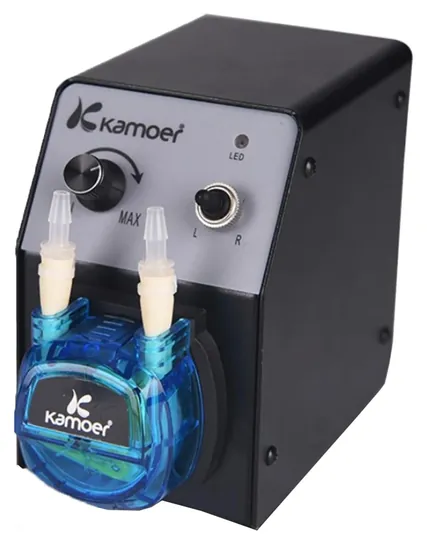
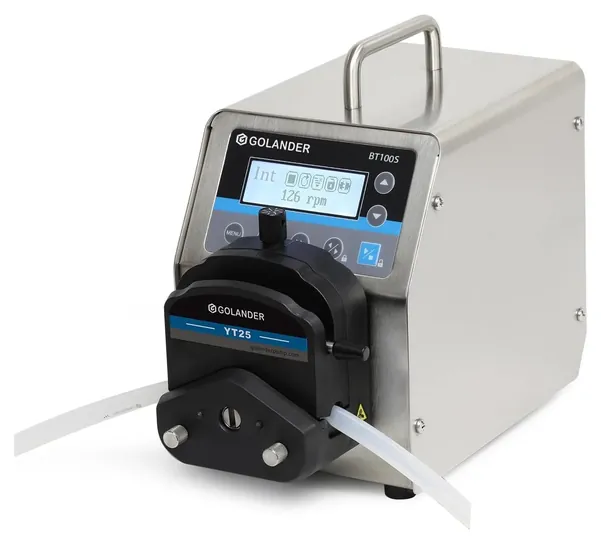
Boxed pumps such as the Kamoer KCP PRO2 and Golander BT100S plug in and run.
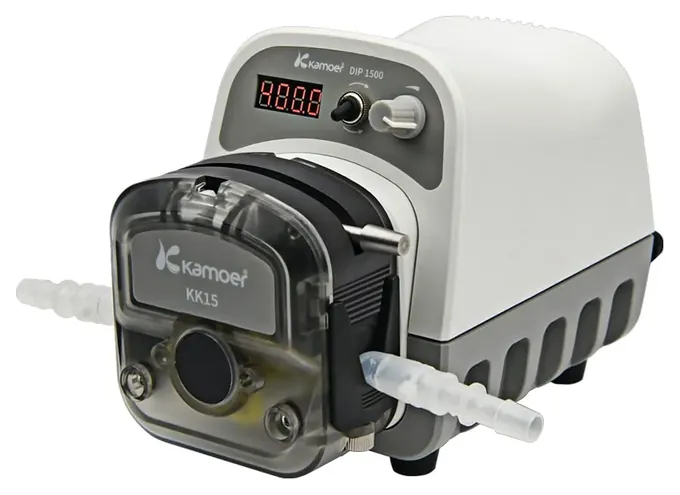
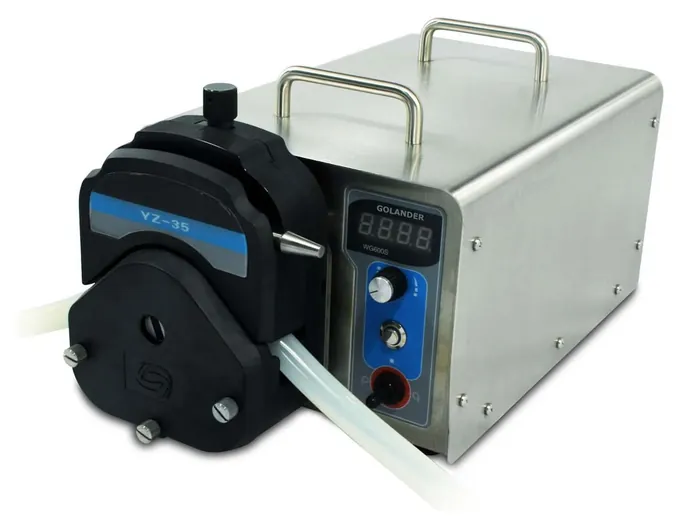
Start with how much liquid you move and how often. Flow is quoted in milliliters per minute with water at room temperature, and it depends on the tube's bore and the motor speed. A reef dosing setup might need a few milliliters a day, while emptying a carboy or filling bottles calls for hundreds of milliliters a minute. The Kamoer DIP1500 covers the high end of hobby and lab work; the Golander WG600S goes to about 13 liters a minute for production lines.
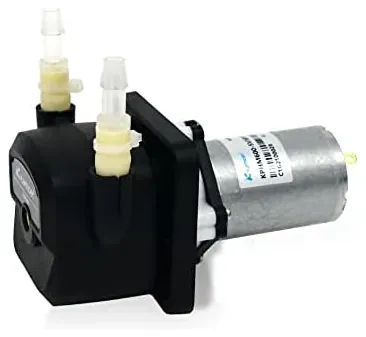
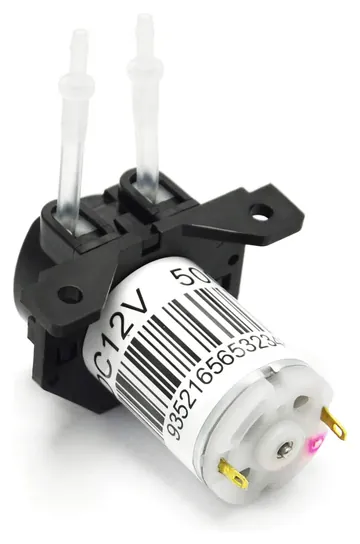
Next, check who supplies the power. Bare 12-volt heads like the Gikfun AE1207 and Kamoer KPHM600 come without a power supply, switch or speed control, so budget for an adapter and a PWM speed board or a relay on a microcontroller. Boxed pumps such as the Kamoer KCP PRO2 and Golander BT100S plug in and run. Programmable models add calibration, dose-by-volume modes, foot-switch ports and RS485 control so other equipment can run them.
Finally, think about duty. Cheap brushed-motor heads are meant for short, occasional runs. Stepper and brushless drives hold their speed better and are built for long shifts. Flow also pulses as each roller passes, most noticeably at low speed, and more rollers smooth it out (Wikipedia).
Tubing: The Part That Touches Everything
In a peristaltic pump the liquid touches only the tube, so the tube material decides what you can pump safely. Silicone is the common default for water-based liquids and the usual choice for on-and-off use, because it recovers well after being squeezed (Wikipedia). Kamoer describes its silicone tube as low-adsorption and abrasion resistant, and its Norprene tube as resistant to disinfectants and UV light. PharMed BPT, which ships on the KPHM600, is sold for acids, alkalis and oxides. Viton handles oils, fuels and many acids but wears out faster under constant squeezing.
The tube has to be elastic to spring back round after every roller pass, which is why rigid plastics such as PTFE can't be used as pump tubing. Tubes are consumables. Kamoer rates the stock silicone tube on the DIP1500 at about 200 hours of running, and squeezing a tube too hard or using more rollers shortens its life.
A few habits help. Check the tube against the liquid before the first run. Flush the line with water after chemicals. Release the tube or pop the head open when the pump will sit unused, so the tube doesn't take a flat set. For anything people eat or drink, use tubing rated food grade.
Calibration, Safety And When To Call A Pro
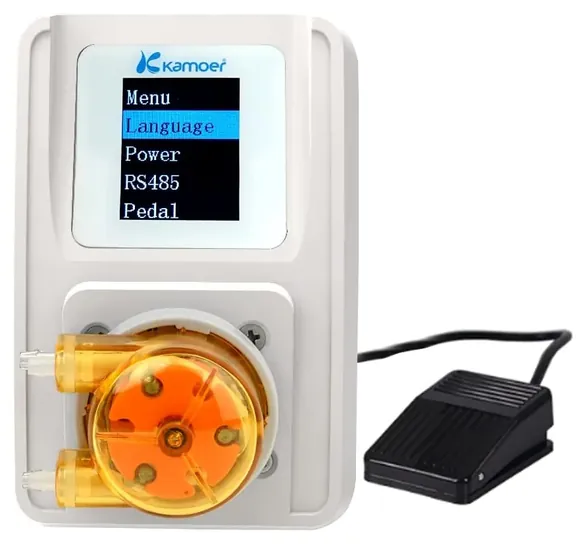
Printed flow figures are a starting point. To calibrate, run the pump for one minute into a cup on a kitchen scale; for water, each gram is about a milliliter. Repeat at the speed you'll actually use, and redo it when you change the tube. The Kamoer M1-STP and DIP1500 can store a calibration, while knob-only pumps need a note of the dial setting.
Keep mains-powered pumps and their adapters above the splash line and plug them into a GFCI-protected outlet near water. In an aquarium, a dosing mistake can harm livestock, so start with small doses, and consider a timer or cutoff as a backup. Wear gloves and eye protection when pumping acids or solvents. None of the picks here are medical devices, and none should be used for infusion or anything that enters the body.
If you're buying for regulated pharmaceutical or food production, you'll need pumps with validation paperwork, certified tubing and service support. Makers such as Watson-Marlow, Masterflex and Verderflex sell into those markets, usually through distributors rather than consumer stores.
How we researched this
We compared 19 peristaltic pumps, from bare 12-volt dosing heads to an industrial transfer drive, read the makers' spec sheets and tubing guides for the 7 finalists, analyzed owner feedback patterns, and checked every brand against U.S. Consumer Product Safety Commission recall records. Flow figures are the makers' own, measured with water. Updated October 23, 2026 by Ezvid Wiki Editors.
Frequently asked questions
Is a peristaltic pump better than a diaphragm pump?
For dosing and dirty or sensitive liquids, often yes. The liquid touches only the tube, there are no valves to clog, it primes itself and it can't siphon backward. A diaphragm pump can give smoother flow and higher pressure, but its valves and seals touch the liquid.
How often should I replace the tube?
It depends on the material, speed and squeeze. Kamoer rates the silicone tube on its DIP1500 at about 200 hours of running. Replace it when flow drops, the tube flattens, or you see cracks or wear.
Why does the flow pulse?
Each roller pushes a pocket of liquid as it passes, so output comes in small surges. The effect is strongest at low speeds. Heads with more rollers, or a longer outlet line, smooth it out.
Can a peristaltic pump lift liquid from a container below it?
Yes, it primes itself. The theoretical limit is about 33 feet of lift, but flow drops well before that, so keep the pump close to and not far above the source.
How do I reverse the flow?
On bare 12-volt heads such as the Gikfun AE1207, swap the two power wires. Boxed pumps like the Kamoer KCP PRO2 have a direction switch, and programmable ones have a reverse button or setting.
What are the best peristaltic pumps for pharmaceutical work?
Regulated pharmaceutical production calls for validated pumps and certified tubing from makers like Watson-Marlow or Masterflex. The picks here suit research benches, teaching labs and hobby dosing, not regulated manufacturing.