The 9 Best Power Strip Towers
Updated by · How we research

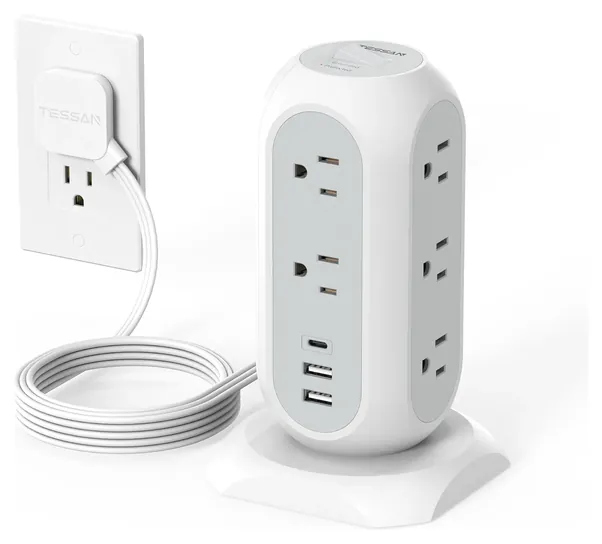
Nine tower power strips compared on outlets, USB-C, surge rating and cord. The Jackyled 12-Outlet leads; the Tessan TPS02-US is the slim flat-plug pick. When users buy our independently chosen editorial recommendations, we may earn commissions to help fund the Wiki.
Few tower power strips sold online claim a UL or ETL safety listing, and most come from small brands, so the label on the base matters more than the outlet count. A tower stacks a dozen or more outlets and USB ports in a small footprint, which suits desks, nightstands and dorm rooms where a flat strip would sprawl.


Editor's Notes
October 23, 2026, by Ezvid Wiki Admin:
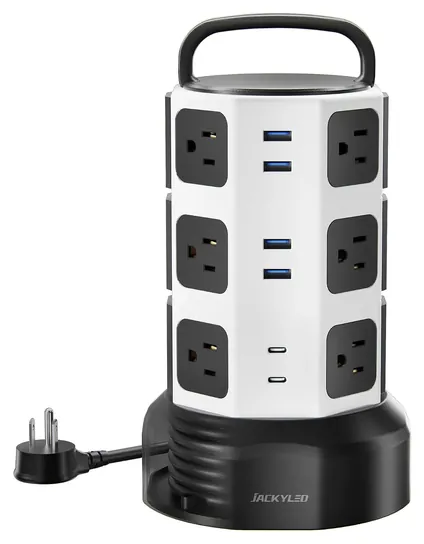
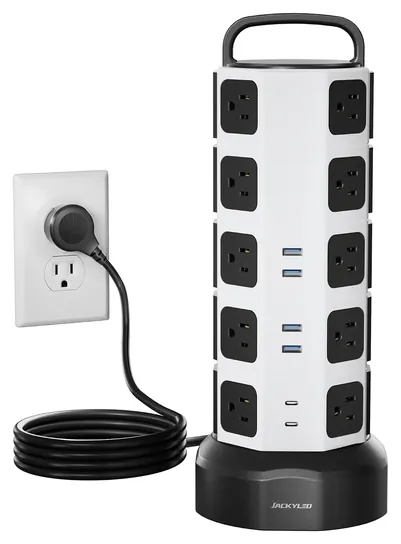
The Jackyled 12-Outlet stays and moves to the top. It's still sold, it's still the tower readers look up by name, and it's the only one here that an independent reviewer has looked at, though its durability is mixed.
Most of the old list was gone. The Bestek 8-Outlet, Aukey PowerHub XL, JackyLED Wireless, Beva Charging Station, iClever 8, Ntonpower Protector and Safemore Multi-Plug have all left the market, while the Tessan Desktop and SmallRT Extension gave way to the Tessan TPS02-US and SmallRT ZYC06. New picks cover a budget tower, fast USB-C charging, a night light, a wireless pad and a 20-outlet giant.
None of these brands posts a manual or a safety certificate we could find, so we leaned on the stated surge ratings, load limits and warranties, a surge protector roundup that scored one Jackyled tower, and the 2025-26 recall notices for no-name power strips. We passed on a 16-outlet Uwiwutei over reports of early failures, and on a cheap tower with a big surge number whose track record is too short to judge.
September 10, 2020:
Power strip towers serve two fundamental purposes: provide extra outlets, and protect electronics.
The first is easy to manage, although we recommend buying more outlets than you think you'll need — devices have a habit of multiplying, and it's always useful to be able to share. Products like the Jackyled Charging Station and Aukey PowerHub XL will have enough flexibility for most desktops.
Surge protection is a trickier topic. Products are rated in joules, providing a cumulative total of how much energy they can absorb before passing spikes through to electronics. That rating applies to a single large surge, or to a series of small ones. That means that power strips will deteriorate over time, and that towers with higher ratings will last longer. Unfortunately, outside of a lab there's no way to test how much protection remains.
Surges due to lightning strikes are relatively infrequent, but power supplies are rarely uniform, and some grids are better than others. If you live in an area with frequent blackouts or brownouts, we recommend replacing surge protectors every few years to mitigate some risk. If long-lasting surge protection is your top priority, a traditional surge protector or smart power strip will still outperform most towers.
For buyers who plan on charging their phones and tablets through a tower, it's worth checking the amperage of the USB ports. Most modern products will provide at least 2 amps, and many offer 2.4. The higher the number, the faster your devices will be able to charge. If you charge multiple devices simultaneously, pay attention to the total amperage — rows of USB ports usually draw from the same well, and plugging in many devices can dilute the current. The Bestek 8-Outlet provides up to 8A total, which is enough to quickly charge several gadgets.
Finally, make sure that you don't exceed the recommended Watts of your chosen tower. This will likely only be a problem in garages, kitchens, or tool benches, but plugging in too many high-Watt appliances can overload a strip and require a reset.
What A Surge Rating Does And Doesn't Tell You
UL 1449 testing assigns it in steps such as 330, 400 and 500 volts, and lower is better.
Most towers print a joule number on the box. It describes how much surge energy the protection parts can absorb before they wear out, and the parts do wear out: each spike uses up some of their capacity, and after a big one they may protect nothing while the outlets keep working (Wikipedia). That's why a protector with a working indicator light is worth having, and why a tower that has been through a lightning storm is worth replacing.
More joules is better up to a point. TechGearLab considers 1,000 to 2,000 joules enough for most home electronics, and every rated tower here falls in that band, from 1,050 joules on the Jackyled 12-Outlet to 1,800 on the Passus XT-U3011. Wikipedia notes that some makers add up the ratings of individual parts, which overstates what the whole unit can handle.
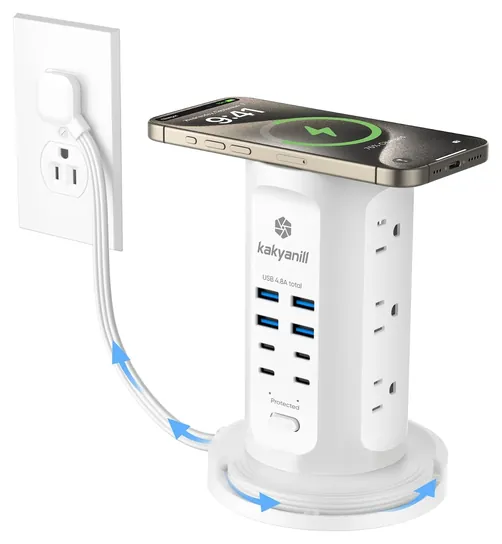
The number that matters more is the clamping voltage, the point at which the protection kicks in. UL 1449 testing assigns it in steps such as 330, 400 and 500 volts, and lower is better. None of these sellers lists it. Two picks, the SmallRT ZYC06 and Kakyanill TS5, give no joule rating at all, so treat them as outlet extenders.
Count Watts, Not Outlets
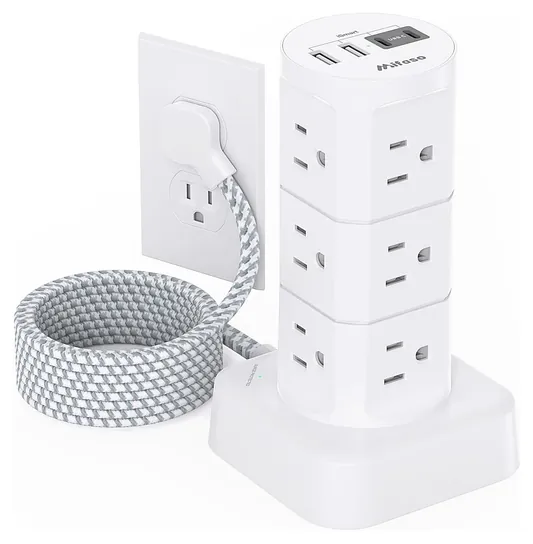
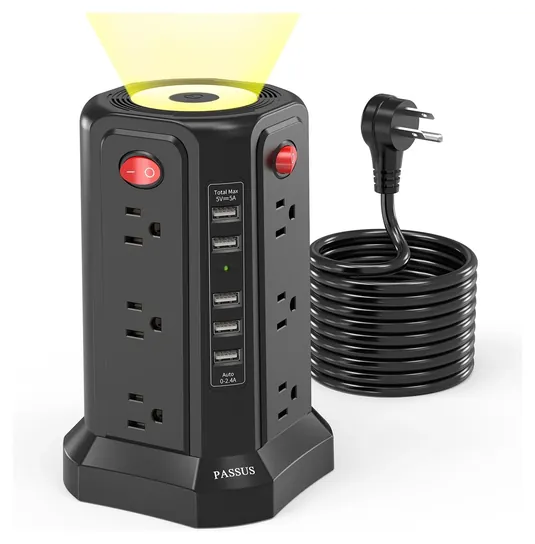
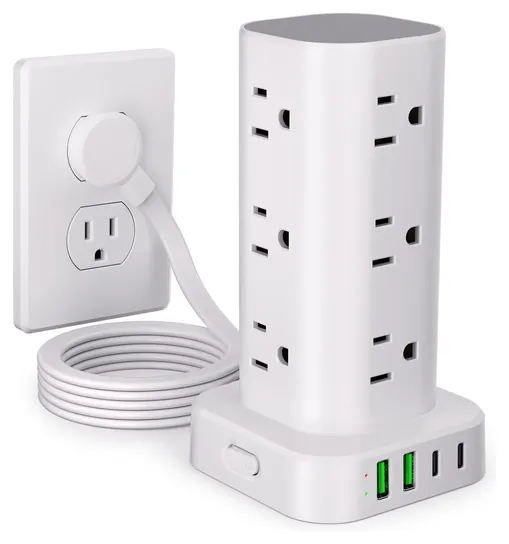
A tower can hold 12 or 20 plugs, but it can't deliver more power than the wall outlet behind it. A standard 15-amp household circuit tops out around 1,800 watts, and towers are rated lower still: 10 amps for the Passus XT-U3011 and SmallRT ZYC06, 13 for the Jackyled and Tessan towers, 15 for the Mifaso, TenTrend and Kakyanill. A breaker or reset switch cuts power when you go over, which is a safety net, not a plan.
Chargers, lamps, monitors and routers draw little. Space heaters, hair dryers, toaster ovens, coffee makers and microwaves draw a lot and should go straight into a wall outlet, never into any power strip. The Electrical Safety Foundation International and the CPSC give the same advice, and add two more rules: don't plug a strip into an extension cord or another strip, and don't run its cord under a rug.
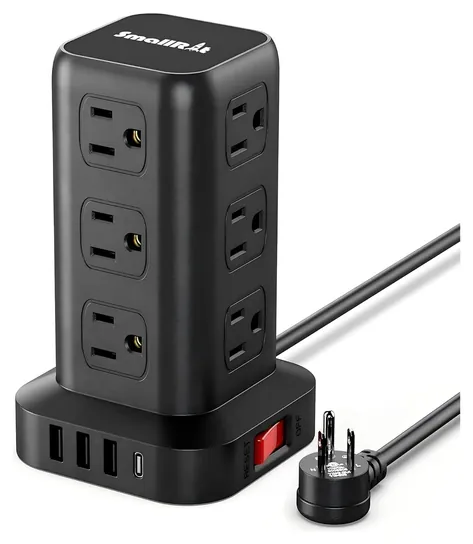
USB ports share power too. The TenTrend Z17 splits 40 watts across eight ports, and the SmallRT ZYC06 splits 3.4 amps across four, so a phone charges slower when every port is busy. A laptop that charges over USB-C usually needs its own wall charger plugged into an AC outlet.
Safety Marks, Recalls And A Steady Base
The marks that count are on the tower itself: UL, ETL or CSA, each from a lab that tests power strips to the same UL standards. Few tower listings claim one. The Kakyanill TS5's seller claims UL certification and Passus says its cord passed UL testing; we could not confirm either. Check the label on the base when it arrives and return a tower that has none.
Recent recalls show why. In 2025 and 2026 the CPSC recalled ANNQUAN and CCCEI power strips that lacked overcurrent protection and could start fires, and HEZI strips with an ungrounded metal case that could shock users. None of them are towers or brands on this page, and a check of the CPSC database turned up no recalls for any brand here.
Towers are tall and light, so a yank on a cord can tip one over. The Uwiwutei HD-Q16 is the one owners most often mention falling. Set a tower on a hard, flat surface, keep its vents clear and run the cord along the wall. A tower that gets warm to the touch, smells of hot plastic or has a dark protection light should be unplugged and replaced.
How we researched this
We compared 18 tower power strips, read the makers' stated specs for the 11 finalists, studied an independent surge protector review that scored a Jackyled tower, analyzed owner feedback for patterns such as failed USB ports and tipping, and checked every brand against U.S. Consumer Product Safety Commission recalls.
Frequently asked questions
Is a power strip tower a surge protector?
Only if it says so and gives a joule rating. A plain power strip just adds outlets. Most towers include surge protection, but the SmallRT ZYC06 and Kakyanill TS5 list no rating.
How many joules does a tower need?
About 1,000 to 2,000 joules is enough for most home electronics. Every rated tower on this list falls in that range. Replace any protector after a major surge or when its protection light goes out.
Can I plug a space heater into a power strip tower?
No. Heaters, hair dryers, microwaves and other heating appliances draw too much current for any power strip. Plug them straight into a wall outlet.
Can I plug a tower into an extension cord or another strip?
No. Daisy-chaining strips can overload the circuit and is a common fire hazard. Plug the tower directly into a wall outlet.
Why do my devices charge slowly from the tower's USB ports?
The ports share one power supply. Charge several devices at once and each gets less. For fast charging, use a USB-C port rated for it, or a wall charger in an AC outlet.
Does a tower keep my computer running in a power outage?
No. A tower has no battery. For backup power, you need an uninterruptible power supply (UPS).