The 9 Best Scroll Saws
Updated by · How we research

Nine scroll saws compared by reach, vibration, blade type and warranty, from clamp-on craft saws to 22-inch shop machines. The DeWalt DW788 is our top pick. When users buy our independently chosen editorial recommendations, we may earn commissions to help fund the Wiki.
A scroll saw's throat, the distance from the blade to the back of the arm, sets how wide a panel you can turn, and you can cut about twice that width by rotating the work. Most hobbyists do fine with a 16-inch saw bolted to a sturdy bench. Bigger, heavier saws pay off for people who cut fretwork, signs or puzzles every week.


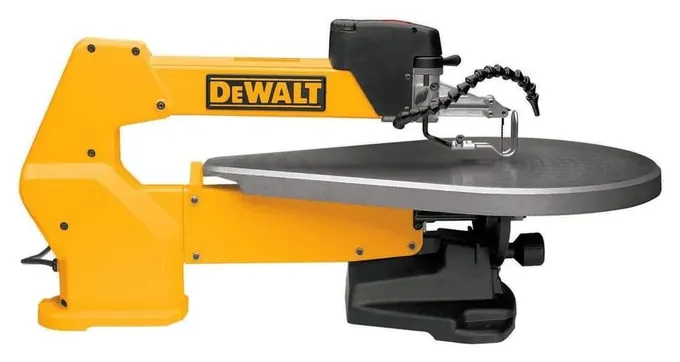
From the manual
- The manual calls for 5-inch plain-end blades only, so the pinned blades common in hardware stores are out. p. 8
- Before beveling to 45 degrees, check clearance at the lower thumbscrew; it and the setscrew may need to swap places. p. 6
- Never lift the saw by its upper arm; DeWalt warns this damages it. p. 7
- A 3-amp fast-acting overload fuse sits behind a press-release cap; if the saw stops under load, check it first. p. 7
Why the DeWalt DW788 is our top pick
Our pick handles bigger work and bevels both ways, which the runner-up, the WEN 3921, can't match. Its throat is 20 inches to the 3921's 16,3,4 and its cast-iron table bevels 45 degrees left and right, while the WEN's tilts left only, so some bevels mean flipping the work.1,4,5
It is also about twice as heavy, at roughly 56 pounds to the WEN's 27.5,2,4 and its parallel-link arm keeps the blade square to the work.3 Bob Vila tester Glenda Taylor saw little to no vibration at any speed and found it heavy enough to stay put unbolted.5 Fine Woodworking named it Best Overall among five midrange saws and rated its smoothness of cut excellent.6 Its maker backs it for three years; WEN's warranty runs two.3,4
The runner-up wins on blades and cost. It takes pinned blades and pinless ones through hook-on holders,4 while our pick takes plain-end blades only.1 Our pick's upper arm also won't stay raised while you thread a blade for an inside cut; Taylor braced it with a board.5 For anyone who scrolls most weekends, the extra reach, two-way bevel and steadier cut are worth those chores.
| DeWalt DW788 | WEN 3921 | |
|---|---|---|
| Throat depth | 20 in | 16 in |
| Table bevel | 45° left and right | 45° left only |
| Weight | About 56 lb | 27.5 lb |
| Blades | Plain-end only | Pinned and pinless |
| Warranty | 3 years | 2 years |
Sources
- DeWalt DW788 1Instruction manual, US edition (PDF), pp. 6, 8 2Instruction manual, EU edition (PDF), p. 15 3Product page
- WEN 3921 4Instruction manual (PDF), pp. 2, 13–14, 22
- 5Bob Vila: DeWalt DW788 review by Glenda Taylor
- 6Fine Woodworking: DeWalt DW788 review (2005)
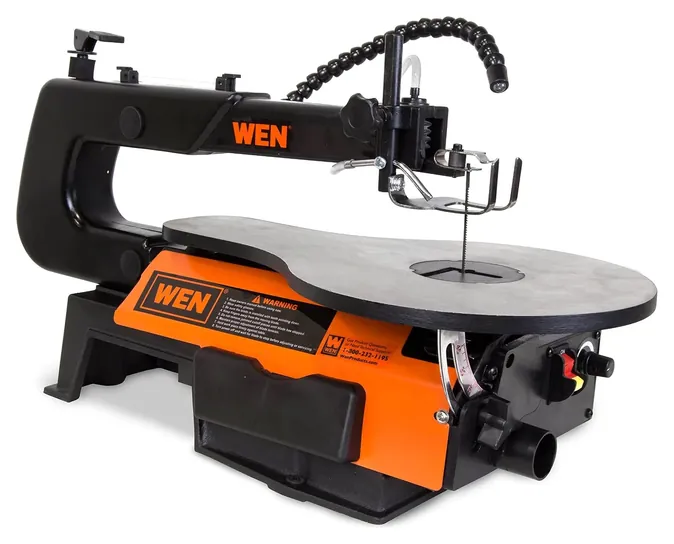
From the manual
- WEN says the saw must be bolted to a bench before use; a foam pad underneath, not supplied, cuts noise and vibration. p. 10
- Pinned blades fit either of two slots, turning the blade 90 degrees to handle a wider range of workpieces. p. 14
- Oil the arm bearings with SAE 20 oil every 50 hours and let it soak in overnight, one side at a time. p. 19
- The two-year warranty drops to 90 days for professional use and is void if you buy from a secondhand seller. p. 22
Compare the specs
Swipe the table sideways to see every column.
| Product | Throat depth (in) | Bevel tilt | Blades | Weight (lb) | Warranty (years) |
|---|---|---|---|---|---|
| 1. DeWalt DW788 | 20 | Table, 45° both ways | Pinless only | 56 | 3 |
| 2. WEN 3921 | 16 | Table, 45° left | Pinned and pinless | 27.5 | 2 |
| 3. WEN LL2156 | 21 | Table, 45° left, 30° right | Pinless only | 53.8 | 2 |
| 4. SKIL SS9503-00 | 16 | Table, 45° left | Pinned and pinless | — | 3 if registered, else 1 |
| 5. Bucktool SSA18BVF | 18 | Arm, 45° both ways | Pinned and pinless | — | 2 |
| 6. JET JWSS-22B | 22-3/8 | Arm, 45° both ways | Pinless only | 68.2 | 5 (2 if commercial) |
| 7. Rikon 10-600VS | 15-3/4 | Table, 45° left | Pinned and pinless | 26 | 5 |
| 8. Shop Fox W1872 | 16 | Table, 45° left | Pinned; pinless w/ adapters | 27 | 2 |
| 9. Dremel MS20-01 Moto-Saw | 9.84 | None | Moto-Saw blades only | 2.4 | 2 |
On arm-tilt saws the table stays flat during a bevel. Bucktool's product page lists both 18 and 21 inches of throat; 18 matches the saw's name and manual. The DW788's weight is DeWalt's 25.4 kg, converted. Warranty terms are for home use.
Sources
- DeWalt DW788 Instruction manual, US edition (PDF) Instruction manual, EU edition (PDF) Product page
- WEN 3921 instruction manual (PDF) LL2156 instruction manual (PDF)
- SKIL SS9503-00 Owner's manual (PDF)
- Bucktool 18-inch SSA18V product page
- JET JWSS-22B Operating instructions (PDF)
- Rikon 10-600VS 2023 catalog, p. 13 (PDF)
- Shop Fox W1872 Owner's manual (PDF)
- Dremel MS20-01 Operating instructions (PDF) Product page
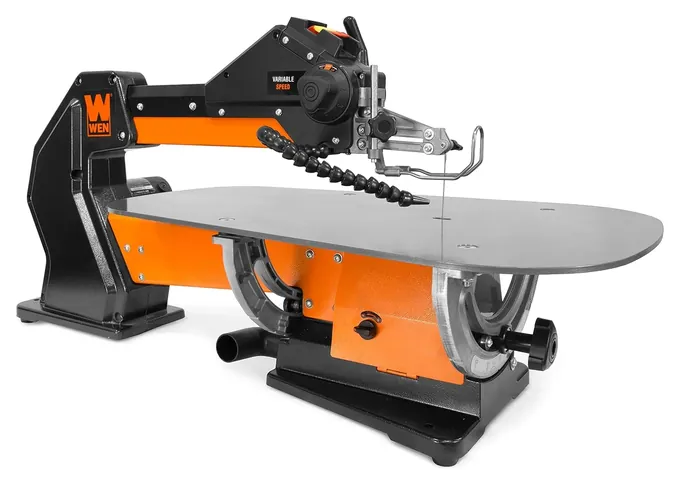
From the manual
- A release knob locks the upper arm raised while you thread the blade through the workpiece for an inside cut. p. 16
- It takes 5-inch pinless blades only; open the right side panel to reach the top and bottom locking knobs. p. 13
- A well-tensioned blade rings at a high C when plucked; the tension knob's numbers 1 to 5 are only a rough guide. p. 13
- The table has stops at 0, 22.5, 30 and 45 degrees, but tilts right only to 30. pp. 3, 16
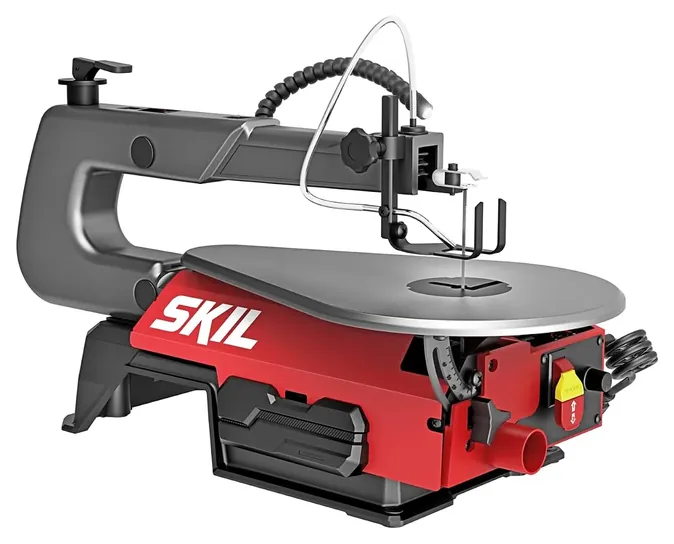
From the manual
- The three-year warranty needs registration within 30 days of purchase; otherwise you get SKIL's one-year home-use warranty. p. 35
- Plain-end blades need the included adaptors, set to length with a 2.5 mm L wrench and the blade gauge. p. 24
- The foot pedal only starts and stops the saw; speed stays on the dial. p. 28
- Oil the arm bearings after the first 10 hours, then every 50 hours or whenever they squeak. p. 32
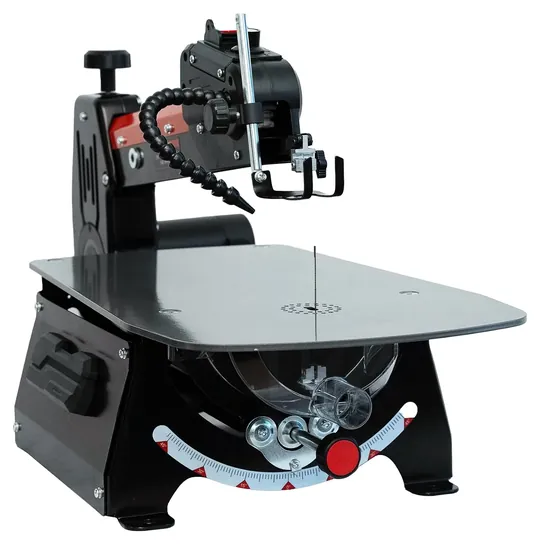
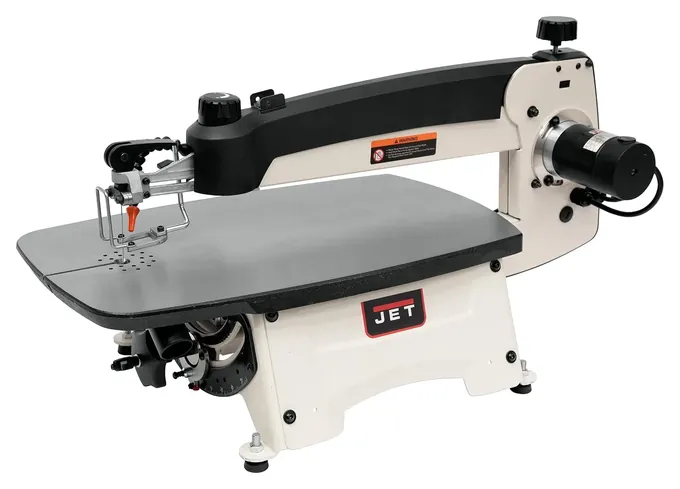
From the manual
- The arm, not the table, tilts up to 45 degrees each way, with preset stops at 22.5, 30 and 45. p. 12
- Without the foot pedal, the blade restarts by itself when power returns after an outage, so switch off right away. p. 15
- If the raised arm won't stay up, loosen a 14 mm hex nut and turn the adjustment screw until it holds. p. 15
- The five-year warranty drops to two years if the saw is used commercially. p. 30
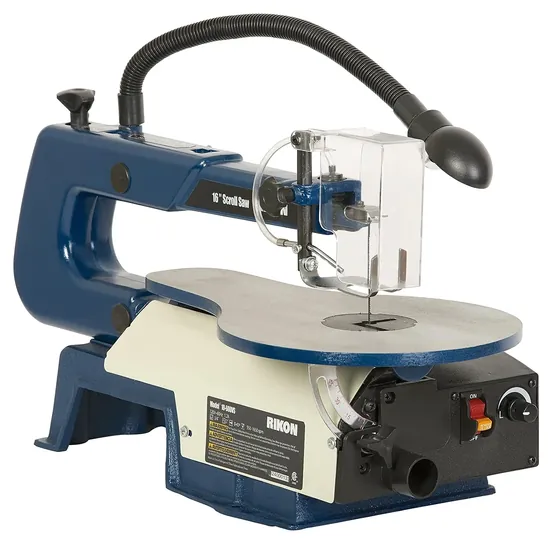
From the manual
- A pair of pinless blade holders and one pinless blade come in the box; extra holders sell singly. p. 13
- An optional flex shaft attaches to the motor shaft for rotary sanding and carving. p. 13
- The machined aluminum table sits on a cast-iron base and tilts left only, to 45 degrees. p. 13
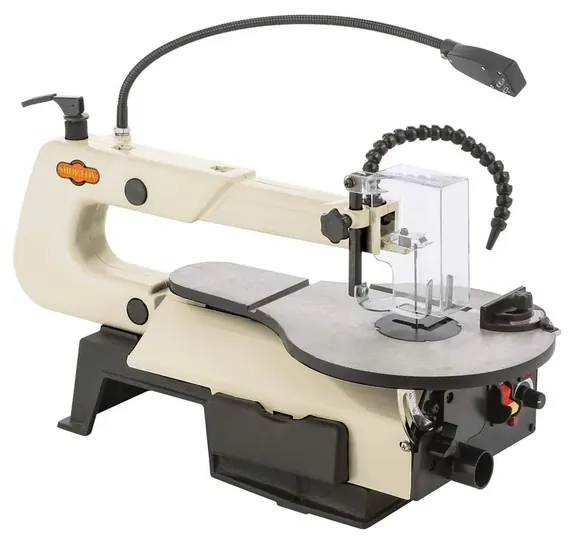
From the manual
- The foot pedal turns the saw and the rotary tool on and off; speed is set on the dial. p. 6
- The blade holders are made for pinned blades; plain-end blades need the included adapters and a 2.5 mm hex wrench. p. 26
- If the flex-shaft tool stops turning, the timing belt may have broken; replace it before further use. p. 31
- Bolting through the bench with three 3/8-inch bolts is the manual's strongest mounting option. p. 14
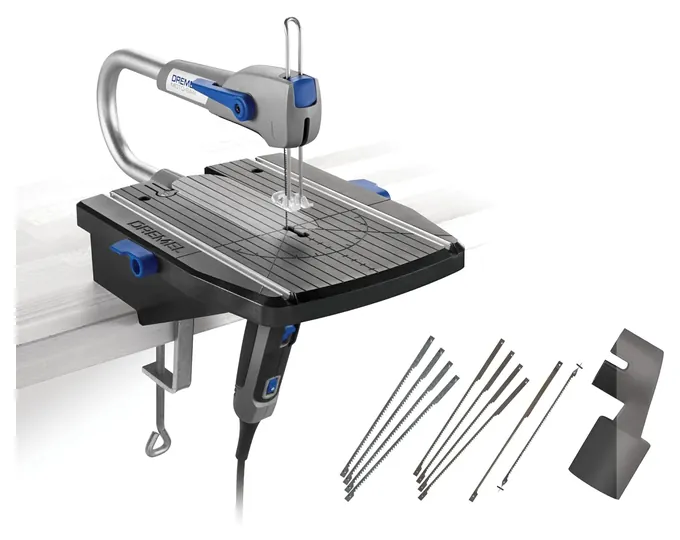
From the manual
- Hand-held, it is for wood only; docked in its base it also cuts plastic and soft sheet metal. pp. 13-14
- Only Dremel Moto-Saw blades fit, and Dremel expects each to stay sharp for half an hour to two hours of cutting. p. 17
- For plastic or sheet metal, set the work on cardboard to damp vibration and cut through both. p. 14
- The speed chart gives 3/4 inch as the recommended thickness for plywood, pine and poplar. p. 18
Editor's Notes
November 16, 2026, by Ezvid Wiki Editors:
DeWalt's Lowe's-only DXVS4502, a licensed 18-inch saw launched in mid-2025, still has little owner feedback, so the DW788 keeps the top spot. We also weighed the WEN 3923, a near-twin of the 3921 with an easier blade change, and the Ryobi SC165VS, which has a three-year warranty but a thin track record. We then read the makers' manuals or spec sheets for eight picks, added a spec table and manual notes, and corrected the Shop Fox's stroke, which is a standard three-quarter inch, and the SKIL's warranty, which needs registering.
October 22, 2026, by Ezvid Wiki Editors:
The DeWalt DW788 keeps the top spot, and it's still the saw serious hobbyists measure others against. Almost everything around it changed. The WEN 3921 takes over from its near-twin, the WEN 3922, because far more owners have shared how it holds up, and the SKIL SS9503-00, WEN LL2156, Bucktool SSA18BVF and Rikon 10-600VS are new. The JET JWSS-22B is the current version of the Jet saw listed before.
The General International EX-16, Delta 40-694 and Rockwell RK7315 are gone because we couldn't confirm they're still sold new, and the Harbor Freight saw had too little evidence behind it. The 16-inch Bucktool gave way to the brand's tilting-arm model.
What moved the order most was a woodworking shop's side-by-side noise and vibration comparison of three starter saws, plus years of scroll-saw forum threads about blade changes on the DeWalt. Whatever you buy, bolt it to something heavy. That matters more than most specs.
Earlier notes
November 27, 2020, by Chris Gillespie:
Thanks to their thin blades, scroll saws are the ideal tool for cutting intricate shapes, profiles, or patterns into wood, metal, and plastics, and give increased accuracy and control over a jigsaw or a band saw. It is somewhat of a specialty tool and derives its name from its traditional use in making scrollwork on ornaments or furniture.
In this update to the ranking, we have replaced several options with the latest version, and improvements mainly focus on blade changing methods. The latest iteration from Shop Fox is the Shop Fox W1872, which is a good all-round model that now includes a rotary tool attachment with a flexible shaft. This can be used with drill bits or grinding and sanding tools, allowing the workpiece to be refined and modified without moving location. We removed the General International BT8007 over concerns about its durability, and in its place selected the Bucktool 16-inch. It features a heavy-duty cast-iron table that gives it weight and helps to reduce vibrations during use, and a quick blade changing system with easy access through a side panel. Similarly, the Wen 3922 features a special side panel that folds open for easy cleanup and blade changes, along with an improved, tool-free adapter that accepts pinned, pinless and spiral blades.
While all the models in this ranking perform well and have similar-sized work tables and cutting depths, a definite advantage is a foot pedal that adjusts the speed of the saw blades, as it allows for a greater level of control and accuracy. The Jet 727200K, the Bucktool 16-inch, and the Shop Fox W1872 all feature this as standard and it is available as an optional extra for the General International EX-16. Interestingly, the General International EX-16 also features a tilting head rather than a tilting base, which allows the workpiece to remain level, allowing for improved visibility. [2026 update: the foot pedals on today's JET JWSS-22B, Shop Fox W1872 and SKIL SS9503-00 only start and stop the saw; speed is set on a dial. Today's list also runs from a compact clamp-on saw to 22-inch machines.]
August 13, 2019, by Quincy Miller:
Being able to see what you're working on is important, and several models (like the Wen 3921) have flexible LED lamps that allow you to illuminate your workspace. This is undoubtedly convenient, but you may find yourself spending a lot of time fiddling with the light, especially since they tend to cast relatively narrow beams. A unit with all-metal housing, like the Jet 727200K, may be a better choice in that regard, as they allow you to slap on multiple magnetic lights wherever you need them.
One recurring theme we noticed during the ranking process was the ease of changing blades. Many of the options listed here are fantastic as long as everything is working properly, but can become difficult once you need to change a blade. The DeWalt DW788 makes the process easy, which is a big reason why it earned the top spot. [2026 update: its thumbscrew clamps are quick, but the upper arm doesn't stay raised while you thread a blade for an inside cut.]
Dust removal was another tricky subject. Many models come with blowers or vacuums to remove dirt and debris, but they're not always reliable, especially on budget models. It may be worth it to invest in a dust collection system, especially if you plan on doing a lot of woodworking. Not only will this help keep your shop or garage clean, but it will also allow you to see what you're doing at all times.
Special Honors
Hegner Multimax-22V Made in Germany and sold in the U.S. through Advanced Machinery, the Multimax-22V is a long-time favorite of professional scrollers. It has a 22-inch throat, variable speed, a quick blade-tension release and a seven-year warranty on mechanical parts. advmachinery.com
Pegas 21-Inch Scroll Saw Designed in Switzerland, the Pegas has a head that tilts both ways for bevels and an upper arm that lifts for fast blade changes. It's sold through woodworking dealers, with Grobet USA as the U.S. importer, and the stand costs extra. grobetusa.com
Throat Depth, Arm Design And Vibration
Throat depth is the distance from the blade to the rear of the arm, and it sets the widest piece you can work.
Throat depth is the distance from the blade to the rear of the arm, and it sets the widest piece you can work. Because you can spin the board, the widest cut is roughly twice the throat. Bob Vila's scroll saw roundup puts 16 to 18 inches as plenty for most home projects; 20- to 22-inch saws suit large signs, clocks and wall art.
Arm design matters as much as reach. A one-piece C-shaped arm rocks the blade slightly forward and back as it cuts. Parallel-arm saws such as the DeWalt DW788 keep the blade closer to straight up and down, which gives a smoother cut and less vibration. Fine Woodworking named the DW788 Best Overall among five midrange saws in its 2005 review and rated its smoothness of cut excellent, and the design hasn't changed much since. The Delta 40-694 is a close cousin.
Weight helps too. The 16-inch saws here with published weights come in under 30 pounds and need bolting down to stay steady, while the DW788 and JET JWSS-22B weigh more than 50. Bolting any saw to a bench or stand cuts vibration sharply, which Scroll Saw Village's review of the WEN 3921 stresses for starter saws, and most makers' manuals call for it.
Pinned Or Pinless Blades, Stroke And Speed
Scroll saw blades are about 5 inches long and come in two kinds. Pinned blades have a small cross pin at each end, snap in quickly and are sold at most hardware stores, but the pin needs a big entry hole, so they're poor for fine fretwork. Pinless (plain-end) blades come in far more sizes and thread through a tiny drilled hole. The DW788 takes only pinless blades; most 16-inch saws take both, with an adapter (Family Handyman).
Stroke length is how far the blade travels each cycle. A longer stroke, about 3/4 inch, uses more of each blade's teeth and clears sawdust better than a 9/16-inch stroke, so blades last longer. Sawinery's side-by-side comparison (a woodworking retailer) found all three of its 16- and 18-inch saws could cut 2-inch white oak, and the SKIL ran quietest at about 80 decibels.
Every saw here has variable speed. The bench saws start at 400 or 550 strokes a minute and top out between 1,550 and 1,750; the Dremel runs faster on a much shorter stroke. DeWalt's manual recommends slower speeds for metal, plastic, harder woods and very thin stock. SKIL's blade chart runs fine blades slowly for tight turns in thin stock and coarse blades faster for general cutting in thicker wood. If you're doing marquetry or very fine work, pick a saw that takes pinless blades and runs smoothly at low speed.
Blade Changes, Stands, Dust And Safety
Changing blades is the most common complaint, and you'll do it a lot: every inside cut means releasing the blade, threading it through a hole and re-clamping it. Look for tool-free clamps, an upper arm that lifts and stays up, and easy access to the lower clamp. The DW788's arm doesn't lock up. Glenda Taylor, a product tester who co-owns a general contracting company, wrote in a 2024 Bob Vila review of the saw that its heavy arm kept wanting to drop, so she braced it with a board while threading blades. The WEN LL2156's upper arm locks in the raised position.
Most saws are bench-top. A stand puts the table at a comfortable height and adds mass, and DeWalt, JET and Hegner sell matching stands separately. Serious scrollers often move up to saws sold through woodworking dealers rather than general stores, such as Excalibur, Pegas, Seyco and Hegner; in one Scroll Saw Village thread, longtime DW788 owners describe moving up to Seyco and Excalibur saws.
Unplug the saw before changing a blade, and follow your manual for the blade guard and hold-down foot. Scroll saws are loud enough at full speed that hearing protection makes sense, and fine dust calls for a dust mask and a shop vacuum on the dust port. Let the blade do the cutting; forcing the wood snaps blades. We found no scroll saw recalls from these brands in the U.S. Consumer Product Safety Commission's database.
How we researched this
We compared 19 scroll saws and read the makers' documents for eight of the nine picks: DeWalt's DW788 instruction manual, WEN's 3921 and LL2156 manuals, SKIL's SS9503-00 owner's manual, JET's JWSS-22B operating instructions, the Shop Fox W1872 owner's manual, Dremel's Moto-Saw instructions and the 10-600VS spec page in Rikon's 2023 catalog, plus Bucktool's product page for its saw. Glenda Taylor's Bob Vila review of the DW788, Fine Woodworking's 2005 five-saw test, Sawinery's side-by-side test of three starter saws and Scroll Saw Village threads shaped the order. The only scroll saw recall we found in U.S. Consumer Product Safety Commission records is a 1985 recall of repaired Craftsman saws, and Health Canada's recall database lists none. The 3D models are built from published dimensions.
Sources (12)
- DeWalt: DW788 20-inch variable-speed scroll saw
- Bob Vila: The Best Scroll Saws
- Bob Vila: DeWalt DW788 review by Glenda Taylor
- Family Handyman: Best Scroll Saws
- Fine Woodworking: DeWalt DW788 review
- Sawinery: Best Scroll Saws
- Scroll Saw Village: WEN 3921 review
- Scroll Saw Village forum: Pegas vs Seyco
- Advanced Machinery: Hegner scroll saws
- Grobet USA: Pegas 21-inch scroll saw
- U.S. Consumer Product Safety Commission: recalls
- Health Canada: recalls and safety alerts
Frequently asked questions
How thick a board can a scroll saw cut?
Most bench saws are rated for about 2 inches of wood. In practice, thick hardwood cuts slowly and wears blades fast, so most scrolling is done in stock under 1 inch. Compact saws like the Dremel Moto-Saw handle only about 3/4 inch.
Pinned or pinless blades: which should I use?
Pinned blades are easier to install and easy to find, but the pins need a large entry hole. Pinless blades come in more sizes and thread through a tiny hole, so they're the choice for fretwork and inlay. Most 16-inch saws take both; the DeWalt DW788 takes only pinless.
Is a 16-inch scroll saw big enough?
For ornaments, puzzles, small signs and most hobby work, yes. A 16-inch saw cuts to the center of a piece about 32 inches wide. Step up to 20 or 22 inches if you make large wall art or clocks.
Do I need a stand?
No, but the saw must be held down. Bolt or clamp it to a heavy bench, or buy the maker's stand. Either cuts vibration, which makes following a line much easier.
What scroll saws do professionals use?
Many full-time scrollers use Hegner, Pegas, Seyco or Excalibur saws, which are sold through woodworking dealers rather than general stores. The DeWalt DW788 and JET JWSS-22B are the common choices below that.
Is a scroll saw the same as a jigsaw?
No. A jigsaw is handheld and cuts rougher curves in sheet goods. A scroll saw sits on a bench with a thin blade held at both ends, so it makes much tighter turns and clean inside cuts.