The 9 Best Toilet Safety Rails
Updated by · How we research

Freestanding frames, seat-mounted arms and flip-up rails compared on toilet fit, weight limit and setup. The Vaunn Foldable Frame leads, no tools needed. When users buy our independently chosen editorial choices, we may earn commissions to help fund the Wiki.
Most toilet safety rails never touch a wall. They either stand on the floor around the bowl or borrow the two bolts that hold the seat on, so no drilling is needed. That suits renters, people home from hip or knee surgery and visiting parents. Before buying a bolt-on model, check the gap between the seat bolts and the tank.


Editor's Notes
October 26, 2026, by Ezvid Wiki Admin:
The Vaunn Foldable Frame leads this list. It gives two solid arms without a single tool, then folds flat for trips. This page is about arms beside the toilet. If the real problem is a seat that sits too low, see our toilet seat risers; plenty of homes end up with one of each.
Only the Moen DN7015 and the Drive Medical RTL12087 stay from the old list. The Drive Medical freestanding frame and the Medline Guardian are no longer sold, so the Medline MDS86100RF takes Medline's place, and the older Vive rail gives way to the Vive LVA1055. We dropped the Royal Medical Solutions frame, which costs about twice as much for the same folding design, the nearly sold-out Carex FGB36900, and the WochiTV, PCP and DMI bars, which had little current information behind them. We stopped at nine because the next candidates were copies of frames already here.
Fit decided more than anything else. A bolt-on rail that needs two inches behind the seat hinges is useless on a curved tank, so we matched each one's mounting rules against common toilets, then weighed makers' weight ratings and warranties, Healthline's editorial picks and the recurring complaints about wobble and sliding. No toilet rail shows up in federal recall records; the recent Medline, Carex, Vive and Vaunn recalls involve adult bed rails, a different thing entirely.
February 27, 2020:
Toilet safety rails generally come in two varieties, those that bolt on (whether to the wall or toilet itself) and freestanding models. Since they each offer their own benefits and potential downfalls, we thought it best to include both options so you can choose the one that best fits your personal needs.
Freestanding models, like the Royal Medical Solutions Folding, Drive Medical RTL12079, Carex Health Brands FGB36900, and PCP 7007 can be very convenient. They don't have to be bolted to anything, so moving them out of the way for cleaning or when a fully able-bodied person wants to use the toilet is quick and easy. They can also double as stability aids when standing at the sink. Some, like the Royal Medical Solutions Folding and Carex Health Brands FGB36900 collapse in seconds, allowing them to be kept out of the way when not in use without requiring a lot of storage space. The Drive Medical RTL12079 even boasts a magazine rack to keep your favorite reading materials close at hand when doing your business.
Bolt-on models have the potential to offer more stability, especially for someone who can't control their motor functions very well. While this shouldn't happen with a good-quality freestanding model, it is possible that one could tip if a user leans too hard against one side or the other. Bolt-on rails, like the Moen Home Care DN7015, WochiTV Handicap Grab Bar, Medline Guardian G30300H, Drive Medical RTL12087, and DMI Safety Frame eliminate that risk. However, they tend to have less versatility when it comes to which toilets they fit. For example, the DMI Safety Frame only works with toilets that have a flat water tank and the Drive Medical RTL12087 doesn't fit elongated seats very well. If you want a bolt-on model and are worried about it not fitting your toilet, we recommend the Medline Guardian G30300H or WochiTV Handicap Grab Bar. The former has two full-length legs in the front, so it doesn't need to connect to the front of the toilet seat, and the latter mounts directly to the wall.
The Vive Raised LVA1011 and PCP 7007 bear special mention for offering the benefits of safety rails and toilet seat risers, giving you two helpful items in one handy purchase.
Freestanding Frame, Seat-Mounted Arms Or A Wall Bar
Nothing gets fixed in place, so it suits renters, short recoveries and trips, and many fold.
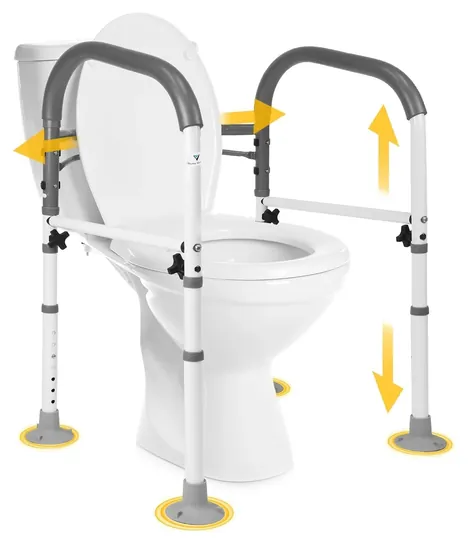
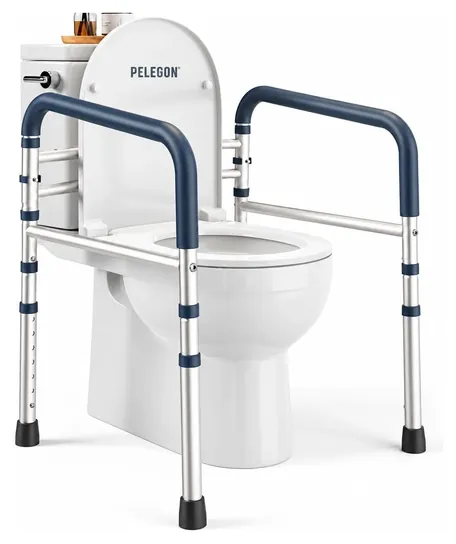
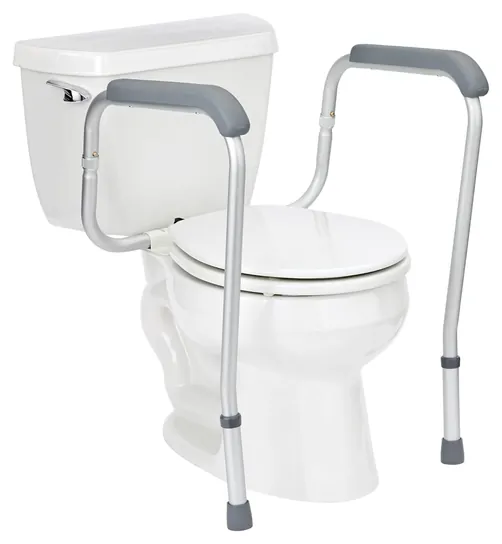
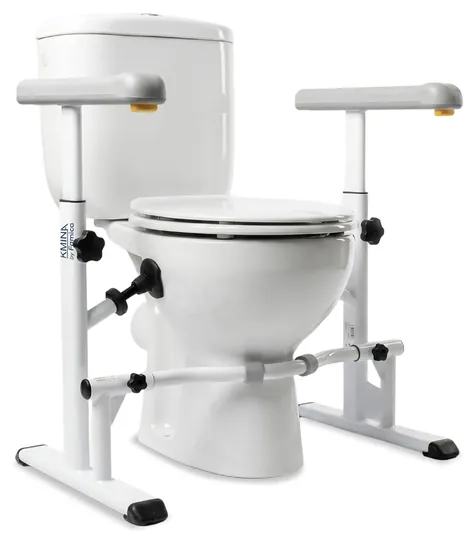
A freestanding frame stands on four feet around the bowl. Nothing gets fixed in place, so it suits renters, short recoveries and trips, and many fold. The trade-off is floor space and stability under a sideways pull. Pelegon, which sells both kinds, says stand-alone frames are the easiest to set up while toilet-mounted ones feel more secure (Pelegon).
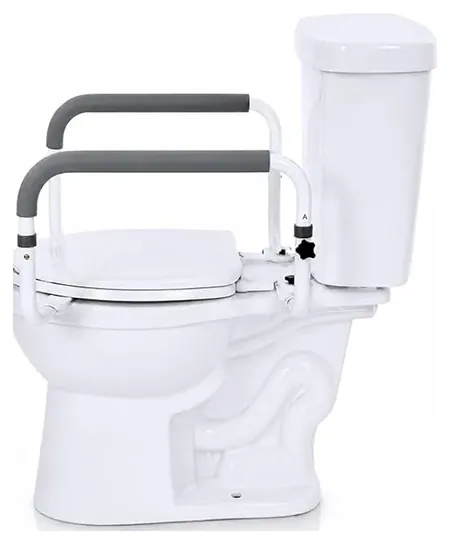
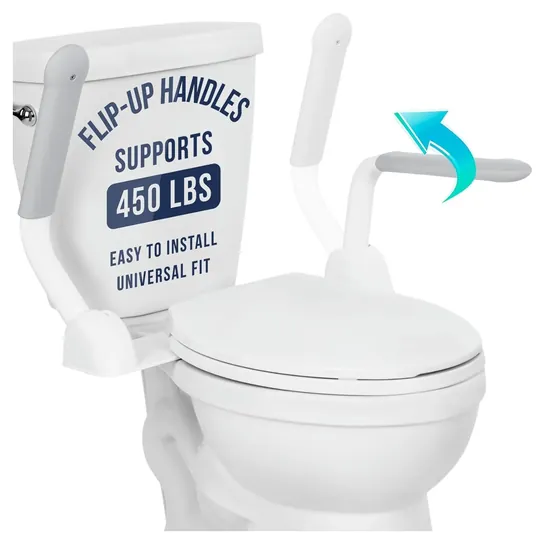
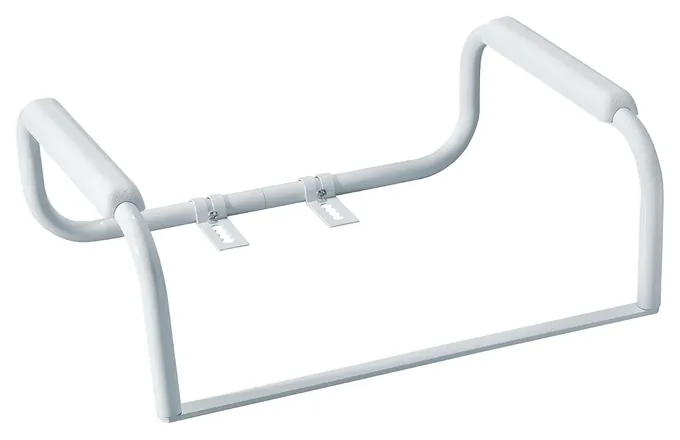
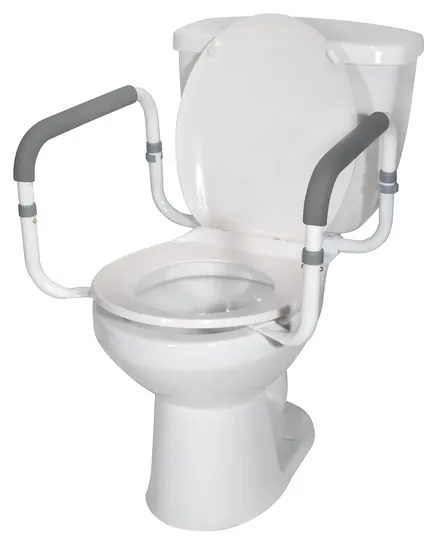
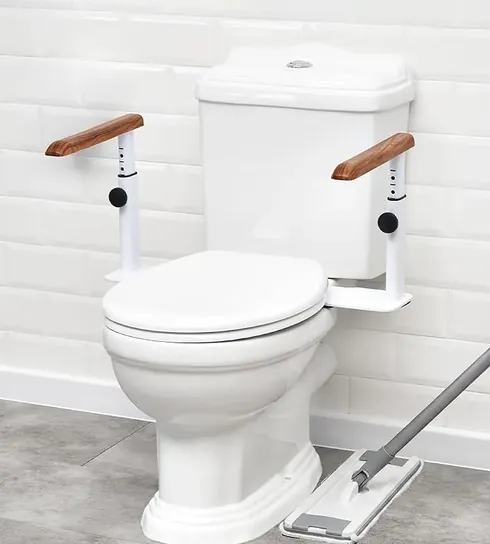
Seat-mounted arms slip under the toilet seat and share its two hinge bolts. They take up almost no room, and some have no legs at all, which makes mopping easier. Healthline's picks show the weak spot of this style: a few owners of bolt-on rails describe them as wobbly (Healthline). Flip-up versions fold their arms against the tank when someone else uses the bathroom.
A grab bar screwed into wall studs is the most solid option of all, but it needs drilling and a wall within reach of the toilet. In public restrooms, the 2010 ADA Standards put grab bars 33 to 36 inches above the floor, a useful starting point at home too (U.S. Access Board). Many people pair arms with a raised seat; we cover those in toilet seat risers.
Will It Fit Your Toilet?
Fit rules are strict, so measure before you buy. Bolt-on rails need a seat held on by two visible bolts and room between those bolts and the tank. Vive asks for at least 2 inches and rules out curved tanks and quick-release hinges on both of its rails (Vive Health). Lunderg also excludes smart and bidet toilets, hidden-bolt bowls and skirted toilets whose base is enclosed. Healthline adds that some bolt-on rails don't suit low-profile toilets (Healthline).
Freestanding frames have their own checks. Measure the width of the bowl and compare it with the frame's narrowest setting, and check the room on each side: Kmina wants the toilet's center line at least 15 inches from walls on both sides. Handrail height matters too. Set the arms where you can push up comfortably from a seated position; most frames adjust over several inches.
Round and elongated bowls both work with most models here, but a bowl paired with a raised seat changes the height you need. Set the arms after the riser goes on, not before.
Weight Limits, Upkeep And Paying For It
Weight ratings run from 250 to 450 pounds on this list, and every figure comes from the maker. There's no shared test standard for these frames, so a heavier user should pick a rating well above their weight and treat the rails as an aid for balance and pushing up, not something to hang from. Push straight down with hands centered on the grips; pulling forward is how a stand-alone frame tips or slides.
Check the clamps and bolts every few weeks, since daily pushing loosens them, and keep rubber feet on a dry floor (Pelegon). If falls keep happening, a doctor or an occupational therapist can assess the whole bathroom, which a rail alone can't fix. MedlinePlus suggests setting up bathroom aids before hip or knee surgery rather than after (MedlinePlus).
Several of these rails are sold as FSA and HSA eligible, which means pre-tax money can cover them. Medicare and private plans vary on bathroom aids, so ask your plan before counting on coverage. We found no recalls of toilet rails at the CPSC; bed rail recalls from some of the same brands are a separate product.
How we researched this
We compared 20 toilet safety rails and frames across freestanding, bolt-on, flip-up, legless, wall and floor-mounted styles, read the makers' fit rules, weight ratings and warranty terms for the nine finalists, weighed Healthline's editorial picks and recurring owner complaints, and checked every brand for recalls with the U.S. Consumer Product Safety Commission.
Frequently asked questions
What's the difference between toilet safety rails and a raised toilet seat?
Rails give you something to push on while you sit and stand. A raised seat makes the drop shorter. They solve different problems, and many people use both. See our toilet seat risers for the second kind.
Will a bolt-on toilet rail fit my toilet?
Only if the seat is held by two bolts you can reach and there's room between those bolts and the tank, often about 2 inches. Curved tanks, quick-release seats, smart and bidet toilets and skirted bowls usually rule them out.
Is a freestanding toilet safety frame steadier than a bolt-on rail?
A bolt-on rail feels more attached, but its arms can wobble on the seat bolts. A freestanding frame spreads its feet wider but can slide on wet floors or tip if you pull forward. Push straight down on either.
How much weight can a toilet safety rail hold?
Most are rated for 250 to 350 pounds, and heavy-duty models claim 400 to 450. These are makers' own ratings, so leave a margin.
How do I install a toilet safety frame?
A freestanding frame needs no install: assemble it, set the height, center it around the bowl and press it down. Bolt-on rails go on by removing the seat, laying the rail over the bolt holes and refitting the seat on top.
Does Medicare pay for toilet safety rails?
Coverage for bathroom aids varies, so check with your plan first. Several rails here are sold as FSA and HSA eligible.