The 10 Best 5.1 Speakers
Updated by · How we research

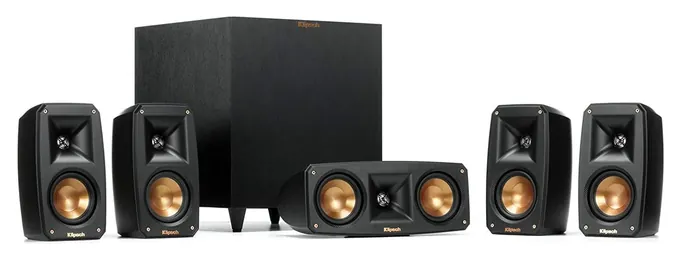
Ten 5.1 systems compared, from speaker packs that need a receiver to soundbar sets and PC speakers. Our pick for most rooms: the Klipsch Reference Theater Pack. When users buy our independently chosen editorial selections, we may earn commissions to help fund the Wiki.
Most 5.1 speaker packs are passive: they need an AV receiver to decode the soundtrack and power them, and a good one can cost as much as the speakers. This list is for anyone setting up a movie room, with packs for an existing receiver, kits that include one, soundbar sets with real rear speakers and a desktop set for PC games.


Editor's Notes
October 23, 2026, by Ezvid Wiki Admin:
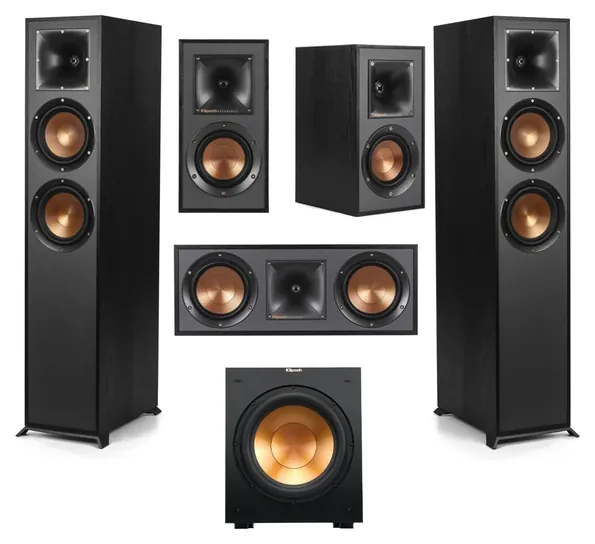
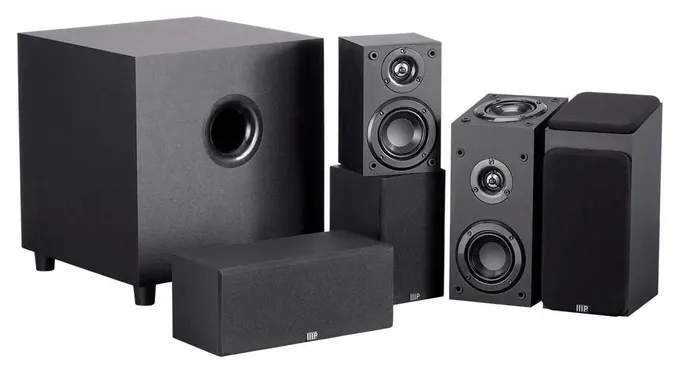
The Klipsch Reference Theater Pack takes the top spot because it gets the basics right for a fair price: lively horn tweeters, a subwoofer with no cable to run and satellites that hang on a wall. Nearly everything on the old list had disappeared from stores, including the Klipsch RP-6000F, the Elac Debut 2.0 and the Fluance Signature set, so most picks here are new.
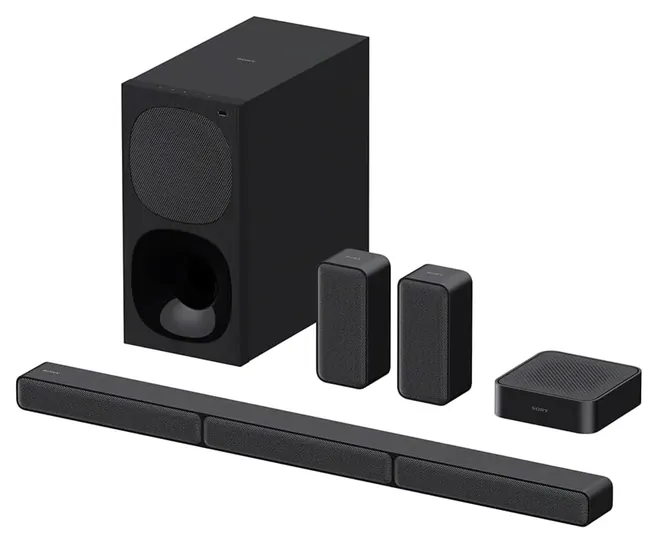
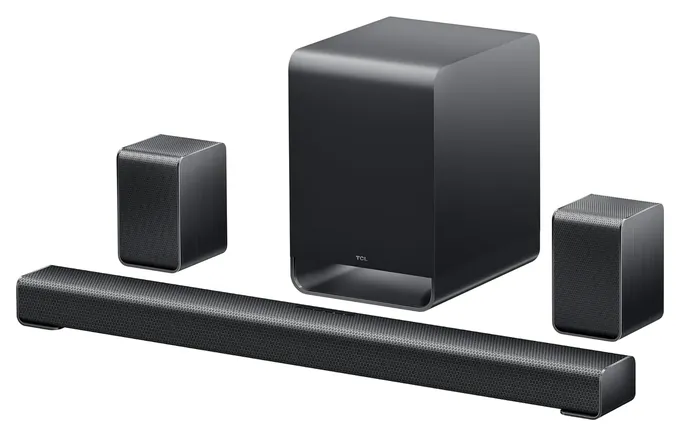
One surprise: several soundbars sold as 5.1 systems have no rear speakers at all and fake the effect with side-firing drivers. We left those out. The Sony HT-S40R and the TCL S65K both put real speakers behind you.
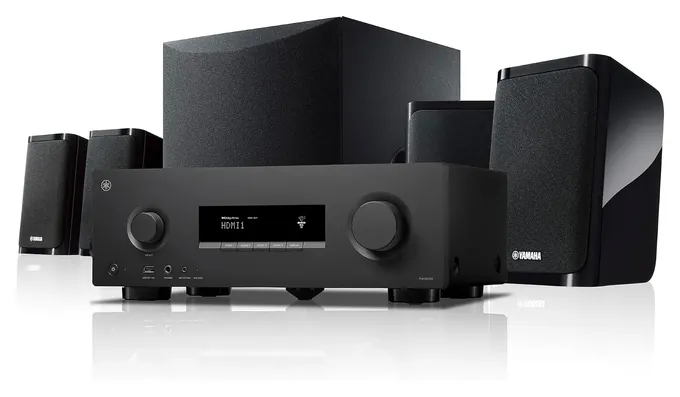
Yamaha's YHT-4970U replaces the YHT-5950 as the kit with a receiver in the box. The SVS Prime system, a favorite of the old list, is now sold mainly by SVS, so it moved to special honors. Our evidence was CNET's review of the Klipsch Reference Cinema system, The Master Switch's listening comparison of 5.1 packages and the makers' spec sheets; outside tests of the soundbar sets were scarce.
December 03, 2020:
With speakers constantly evolving, we made a fair amount of changes to the list. We removed the Klipsch Reference RP-250S because we felt the price might be too high for some. In its place, we added the Klipsch Rp-6000F, which features many of the same internals as the Reference Rp-250s but comes in at a lower price. Earning the top spot, the Klipsch Rp-6000F is truly engineered with incredible detail, providing sound that should satisfy even the pickiest audiophile.
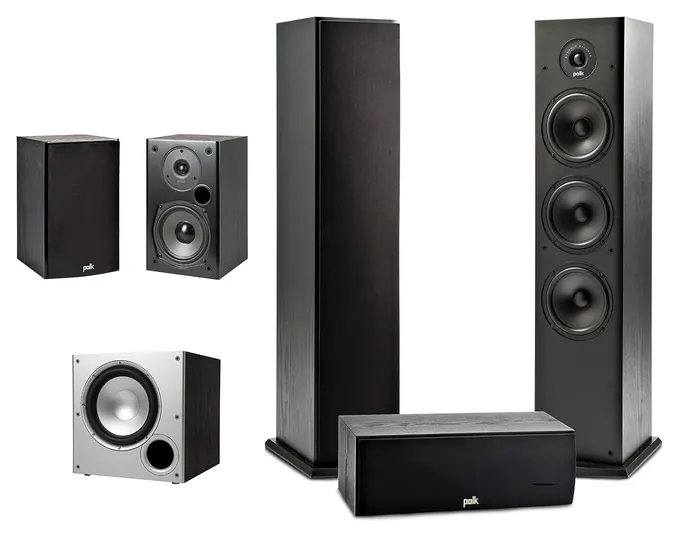
We added the Polk Audio Home Theater System for those seeking a good deal. To a certain extent, when it comes to speakers, you get what you pay for. However, at this price point, the quality should meet the needs of most ears while providing more sound than similarly-priced options. If you're looking for affordable speaker towers but don't want to sacrifice a good amount of fidelity, this is about as good of a deal as it gets.
The Jamo S 809 Bundle is a new item on the list and is the choice for those who put a premium on looks. With that said, one of the things that makes the Jamo S 809 Bundle stand out is its patent-pending tower design. The company separately sells Dolby Atmos-certified modules that rest on top of the floor-standing cabinet included in the bundle. The module connects to the speaker cabinet via metal fasteners and the height channels are connected to the base of the floor-standing cabinet. This creates a flush, minimalist look free of wiring.
December 17, 2019:
While soundbars have become increasingly popular in recent years, we found that only the Sonos Playbase Home Theater offered sufficient drivers angled properly enough to work effectively for center, front left, and front right channels. The rest of the options in our ranking rely on dedicated center channel speakers, as well as bookshelf or tower units to provide the left and right front channels.
Some of the higher-ranked items on our list earned their spots, at least in part, thanks to wireless capabilities, whether that means the whole system is wireless or just the sub. Ultimately, a wholly wireless system is an installation convenience, but you will have to make sure they're consistently powered to survive the length of a long film, TV binge marathon, or gaming session.
Ultimately, you're always going to get better sound out of bigger speakers, but bigger speakers aren't always going to be right for every theater space. Users should seriously take the floor plan of their screening room into account before signing up for something like the Klipsch Reference RP-250S, which is phenomenal, but rather large, and the Elac Cinema 5 Home Theater, which is tiny and effective, despite lacking bass response in bigger rooms.
Special Honors
SVS Prime Satellite 5.1 System SVS, a speaker maker known for its subwoofers, sells the Prime Satellite 5.1 System mainly from its own site. It pairs five Prime Satellite speakers with the SB-1000 Pro subwoofer and its 12-inch driver, and The Master Switch named it the best 5.1 package overall. SVS offers a 45-day in-home trial and a five-year speaker warranty, and three finishes, including gloss white. svsound.com
Speaker Pack, All-In-One Kit Or Soundbar Set
The speakers are small, so these kits suit small and medium rooms.
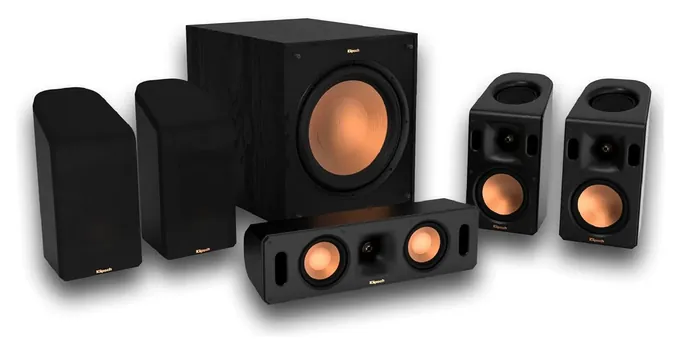
Start with what drives the speakers. A passive speaker pack, like the Klipsch Reference Theater Pack or the Polk Audio T-Series system, has no amplifier of its own. It needs an AV receiver, which decodes the Dolby Digital or DTS soundtrack and sends power to each speaker. Budget for one: CNET pairs the Klipsch Reference Cinema system with the Onkyo TX-NR6100 receiver (CNET), and The Master Switch names a receiver next to every package it recommends (The Master Switch). Check that the receiver is rated for your speakers' impedance, usually 6 or 8 ohms.
An all-in-one kit puts the receiver in the box. Yamaha's YHT-4970U pairs its RX300A receiver, rated at 70 watts per channel, with five small speakers and an 8-inch subwoofer, and it passes 4K video at 120 frames per second (StereoNet). The speakers are small, so these kits suit small and medium rooms.
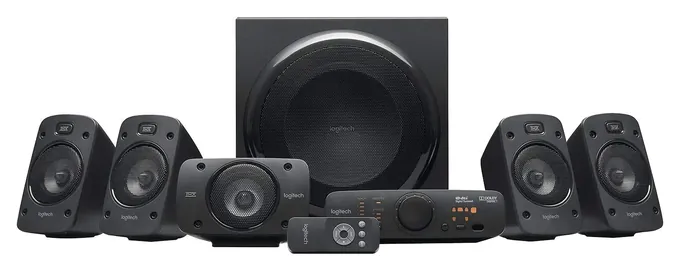
A soundbar set is the simplest route: one HDMI cable to the TV, a wireless subwoofer and two rear speakers. Read the parts list before buying. Some soundbars sold as 5.1 have no rear speakers at all and simulate them with drivers that fire sideways, which can't place sound behind you. A desktop set like the Logitech Z906 has its own decoder and amplifier, which suits a PC, but it has no HDMI input.
What 5.1, 5.1.2 And 5.1.4 Mean
The 5 counts the main speakers: left, center and right in front, plus left and right surrounds beside or behind you. The .1 is the subwoofer, which handles only the lowest bass, so it gets a separate count (Wikipedia). The center speaker carries most of the dialogue, so a weak one makes voices hard to follow.
A third number counts height channels for Dolby Atmos. A 5.1.2 system adds two, and a 5.1.4 system adds four, usually as drivers on top of the speakers that bounce sound off the ceiling. Each height channel needs its own amplifier channel, so a 5.1.2 setup needs a receiver with at least seven powered channels and a 5.1.4 setup needs nine. A flat ceiling at normal height works best for the bounce.
Plain 5.1 still covers most movies and TV, because the soundtrack's surround channels play in full. Height speakers add rain, aircraft and other overhead effects in films mixed for Atmos. A receiver or soundbar that decodes Atmos can still play it on plain 5.1 speakers; the height layer is then simulated or folded into the other speakers.
Placing Five Speakers And A Subwoofer
Put the center speaker just above or below the screen, aimed at your ears. Dolby's guidance sets the left and right fronts 44 to 60 degrees apart as seen from the main seat, or about 22 to 30 degrees either side of the center, and places the surrounds 90 to 110 degrees from the front, beside or a little behind the seat (Acoustic Frontiers). Surrounds usually sound best a foot or two above ear height, angled toward the listener.
The subwoofer is the most flexible piece because low bass is hard to locate. Start it near the front of the room, then try a corner, which boosts output, or move it until the bass sounds even at the main seat. Wireless subwoofers and rear kits still need a power outlet, and most use the 2.4 GHz band, the same one many Wi-Fi routers use, so keep them a few feet from the router.
Room size matters more than wattage. The Master Switch suggests small satellite packs for rooms up to about 250 square feet and towers for bigger spaces (The Master Switch). Use ordinary speaker wire for runs along the floor, but anything run inside a wall should be rated for in-wall use, marked CL2 or CL3.
How we researched this
We compared 24 current 5.1 speaker packs, home theater kits and soundbar sets, read the makers' specifications and launch details for the 10 picks, weighed the independent reviews from CNET and The Master Switch where they exist, analyzed owner feedback patterns, and checked every brand against U.S. Consumer Product Safety Commission recall records.
Sources (7)
- CNET: Best home theater systems
- The Master Switch: Best 5.1 home theater systems
- StereoNet: Yamaha introduces RX300A-based YHT-4970U
- Acoustic Frontiers: 5.1 and 7.1 layout recommendations from Dolby, THX and ITU
- Wikipedia: 5.1 surround sound
- SVS: Prime Satellite 5.1 System
- U.S. Consumer Product Safety Commission: recalls
Frequently asked questions
What does 5.1 mean?
Five main speakers (left, center, right, and two surrounds) plus one subwoofer for deep bass. The .1 is the subwoofer, which plays only the lowest notes.
Do 5.1 speakers need a receiver?
Passive speaker packs do: an AV receiver decodes the soundtrack and powers each speaker. Home theater kits like the Yamaha YHT-4970U include one, and soundbar sets and the Logitech Z906 have their own amplifiers.
Is 5.1 or Dolby Atmos better?
Atmos adds height speakers on top of a 5.1 layout, written as 5.1.2 or 5.1.4. It adds overhead effects in films mixed for it, but needs a receiver with more channels. A good plain 5.1 set beats a weak Atmos one.
Are wireless rear speakers really wireless?
Only the signal is. Wireless rears and subwoofers still plug into a power outlet, and some rear speakers connect by cable to a small wireless box.
What is the best 5.1 system for a small room or a PC?
Compact satellite packs or a kit like the Yamaha YHT-4970U suit small rooms. For a PC, the Logitech Z906 takes optical, coaxial and analog inputs and needs no receiver.