The 10 Best Car Amplifiers
Updated by · How we research

Continuous power at a stated speaker load matters more than peak watts. Of 10 four-channel and subwoofer car amps, the Taramps TS 800X4 ranks first. When users buy our independently chosen editorial recommendations, we may earn commissions to help fund the Wiki.
The big number on a car amp's box is often a peak figure, so the rating to read is continuous power at a stated speaker load and voltage. An amp takes the signal from your radio and drives speakers or a subwoofer with far more clean power than the radio's small built-in chip. Four-channel amps run door and dash speakers, and mono amps run subwoofers.


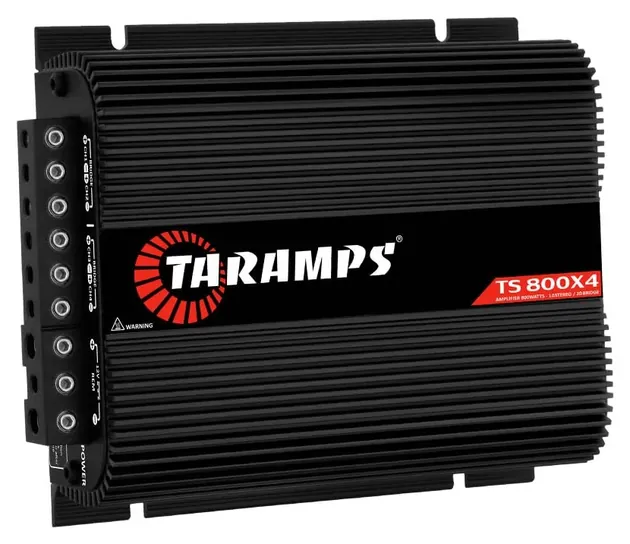
From the manual
- The speaker-wire input turns the amp on from the radio's signal, but some radios won't trigger it; then wire the remote lead. p. 3
- Its 200-watt 2-ohm rating allows up to 10 percent distortion at 14.4 volts, case under 50 C; no limit is printed for 4 ohms. p. 6
- Taramps calls for 7-gauge power and ground wire and a 40-amp fuse for runs up to 4 meters; longer runs need thicker cable. p. 5
- The 12-month warranty excludes damage from improper installation and is void if the warranty seal is torn. p. 1
Why the Taramps TS 800X4 is our top pick
Our pick wins on fit and hookup, not on clean power. It takes a factory radio's speaker wires directly and switches itself on from that signal,1 while our runner-up, the Alpine S-A32F, needs a separate speaker-to-RCA cable for the same job.2 It is also smaller and less than half the weight,1,2 so it is easier to tuck under a seat, while Alpine's manual points its amp to a spot with free airflow, such as the trunk.2
On paper the TS 800X4 also has more than twice the power into typical 4-ohm door speakers, 136 watts a channel against 55.1,2 Read that with care. Taramps prints no distortion limit for the 4-ohm figure and allows up to 10 percent for its headline 2-ohm rating,1 while the Alpine stays at or under 0.08 percent at its rated power.2 The real gap in clean power is likely smaller than the numbers suggest.
The runner-up is the better choice for a carefully tuned system: one knob sets its crossover anywhere from 50 to 400 Hz,2 where ours offers a single fixed 90 Hz point.1 Both carry a one-year warranty.1,3 We still rank the TS 800X4 first for the common job of adding an amp to a factory radio in a tight space, and one big retailer now lists the S-A32F as discontinued.4
| Taramps TS 800X4 | Alpine S-A32F | |
|---|---|---|
| Factory-radio input | Built in, turns itself on | Needs adapter cable |
| Rated power at 4 ohms | 136 W x 4 | 55 W x 4 |
| Distortion limit stated | None at 4 ohms; 10% at 2 ohms | 0.08% or less |
| Crossover | Fixed at 90 Hz | Variable, 50-400 Hz |
| Footprint | 138 x 175 mm | 204 x 204 mm |
Sources
- Taramps TS 800X4 1Instruction manual, English (PDF), pp. 1, 3, 6
- Alpine S-A32F 2Owner's manual, English (PDF), pp. 3–EN, 9–EN, 10–EN, 21–EN 3Crutchfield listing 4Sonic Electronix listing
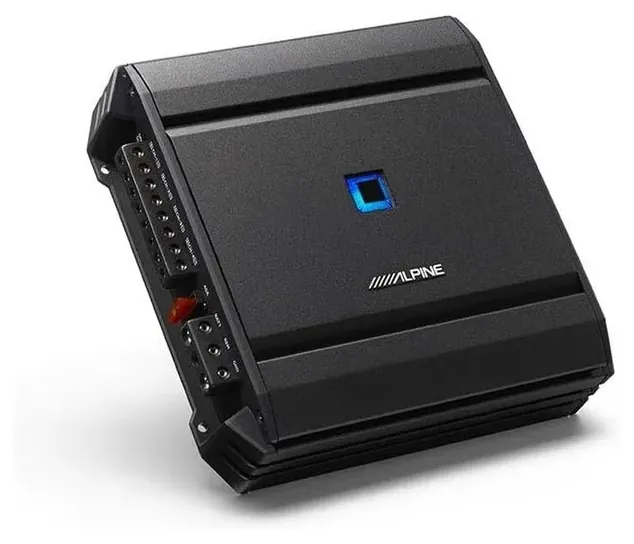
From the manual
- Hooking up a factory radio takes Alpine's speaker-to-RCA cable, sold separately, with the input switch set to HI. p. 9-EN
- Its self-sensing turn-on may not work with every source; if not, run the remote lead to an accessory-power feed. p. 18-EN
- Alpine wants it mounted where air circulates freely, such as the trunk, because it makes considerable heat. p. 3-EN
- A blinking red light means it's running hot; solid red flags a short, overheating or too-high supply voltage. p. 11-EN
Compare the specs
Swipe the table sideways to see every column.
| Product | Power at 4 ohms (W RMS) | Rated distortion (%, at most) | Speaker-wire input | Fuse (A) | Warranty (years) |
|---|---|---|---|---|---|
| 1. Taramps TS 800X4 | 136 x 4 | 10 at 2 ohms; none at 4 | Yes, auto turn-on | 40 | 1 |
| 2. Alpine S-A32F | 55 x 4 | 0.08 | Adapter cable needed | 40 | 1 |
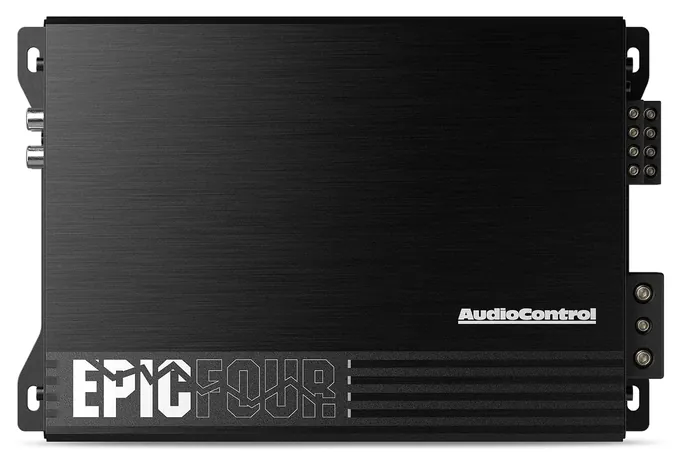
| 3. AudioControl EPICFOUR | 100 x 4 | 1 | No | 80 | 1 |
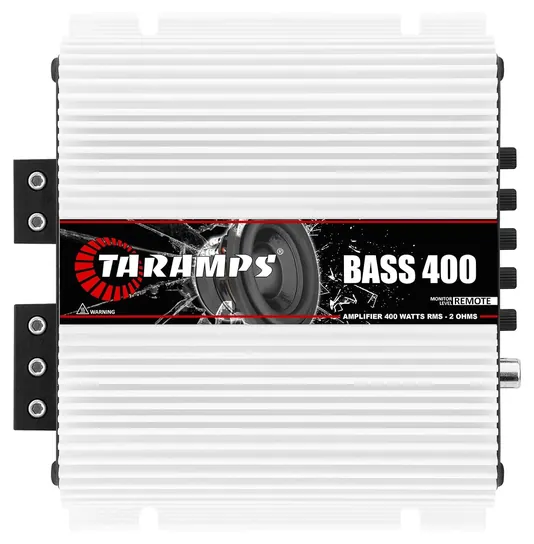
| 4. Taramps BASS 400 | 214 x 1 | 10 at 2 ohms; none at 4 | Yes, auto turn-on | 40 | 1 |
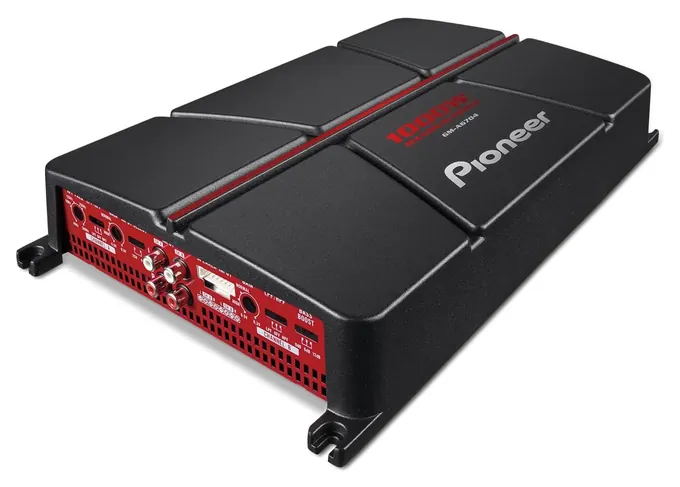
| 5. Pioneer GM-A6704 | 60 x 4 | 1 | Yes | 25 x 2 | — |
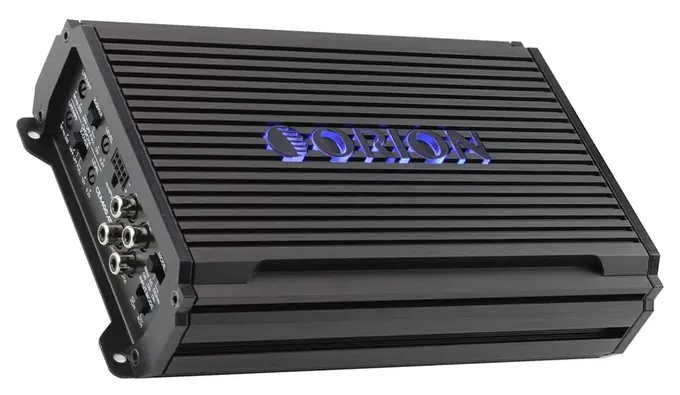
| 6. Orion CEA400.4D | 60 x 4 | — | No | 60 | 1 |
| 7. Boss Audio R1100M | — | — | Yes | 30 | 1; 6 via approved sellers |
| 8. MTX Thunder1000.1 | 350 x 1 | — | No | 100 | 1 |
| 9. Rockford Fosgate R2-500X1 | 300 x 1 | 1, CEA-2006 | Yes | 80 | 1 |
| 10. Taramps TS 400X4 | 63 x 4 | 10 at 2 ohms; none at 4 | No | 20 | 1 |
Power is the maker's continuous rating per channel at 4 ohms, at 14.4 volts where the maker states a voltage (Orion doesn't); mono amps show their single channel. Rated distortion is the most the maker allows in its rated-power test: Taramps states a limit only for its 2-ohm ratings, Rockford rates to the CEA-2006 standard, which allows 1 percent, and Alpine's figure is its stated distortion at rated power. Fuse is the in-line fuse each maker recommends, except Pioneer and Boss, whose manuals list the amp's own fuses. The Boss manual gives only a 1,100-watt maximum at 2 ohms. The BASS 400 row uses the 2-ohm version's manual; Taramps' newer revision is rated differently. MTX's 1,000-watt headline figure is into 1 ohm.
Sources
- Taramps TS 800X4 instruction manual (PDF) BASS 400 manual, 2-ohm version (PDF) TS 400X4 instruction manual, RCA version (PDF)
- Alpine S-A32F owner's manual, English (PDF) S-A32F warranty, Crutchfield listing
- AudioControl EPICFOUR quick start guide (PDF)
- Pioneer GM-A6704 owner's manual (ManualsLib copy)
- Orion Cobalt Elite amplifiers manual (PDF) CEA400.4D product page
- Boss Audio Riot amplifiers user's manual (PDF) Extended warranty terms (PDF)
- MTX Thunder Series owner's manual (PDF) Thunder1000.1 product page
- Rockford Fosgate R2 amplifiers owner's manual (PDF) R2-500X1 product page
- BestCarAudio.com: The Challenge of Amplifier Power Ratings (on CEA-2006's 1% limit)
From the manual
- The warranty is void unless you register the amp online within 15 days, and only authorized-dealer purchases are covered. p. 15
- Connect the ground first and never remove it while the 12-volt wire is attached; damage from doing so isn't covered. p. 8
- The external fuse goes within 12 inches of the battery; AudioControl specifies 4-gauge wire and an 80-amp fuse. pp. 9, 13
- A range button multiplies either filter dial by ten, stretching it from 50-500 Hz to as high as 5,000 Hz for tweeters. p. 6
From the manual
- The bass boost is tunable: pick a center note from 35 to 55 Hz and add up to 12 dB. p. 9
- Thermal protection cuts the sound when the heatsink gets hot; Taramps says that won't happen in a well-ventilated spot. p. 10
- Taramps calls for a 40-amp fuse or breaker on the power lead, as close to the battery as possible. p. 10
- On speaker wires it turns on only above a low radio volume, and stays on about 30 seconds after the sound stops. p. 9
From the manual
- The gain works backward from what many expect: if output stays low with the radio turned up, set it to a lower level. p. 6
- With the speaker-wire input, the amp always runs in four-channel mode, whatever the input switch says. p. 6
- Only channel A's high-pass filter tunes, from 40 to 500 Hz; channel B's is fixed at 80 Hz, and bass boost is B-only. pp. 6, 16
From the manual
- The manual lists only low-level RCA inputs, so a factory radio without preamp outputs needs a line output converter. p. 16
- Thermal shutdown is at 185 F and trunks can reach 155 F in summer, so leave an inch of air above the heatsink. p. 15
- The one-year warranty covers only U.S. purchases from an authorized Orion dealer; Orion asks you to contact it, not the retailer. pp. 2, 22
- Fitting a bigger fuse than specified, or bypassing it, gets any warranty claim denied. p. 18
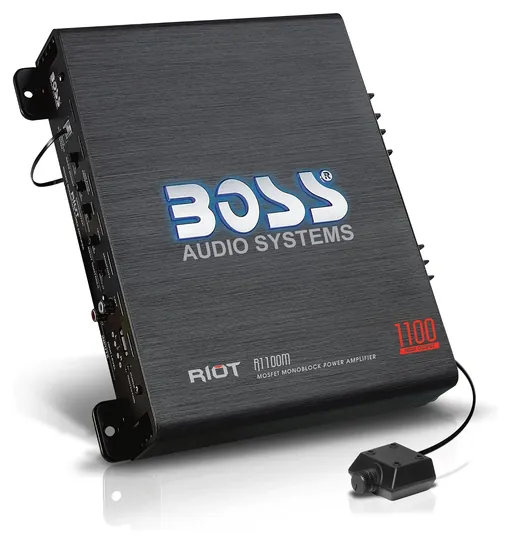
From the manual
- Use the speaker-wire input only if your radio lacks RCA outputs, and never connect both inputs at once. pp. 7-8
- A 2-ohm load raises output and current draw by about half, so the charging system has to keep up. p. 3
- The spec table lists only a maximum of 1,100 watts at 2 ohms, with a 30-amp fuse. p. 14
- The six-year warranty needs a purchase from BossAudio.com or an approved online dealer, or a pro install; other sellers get one year. warranty terms, p. 1
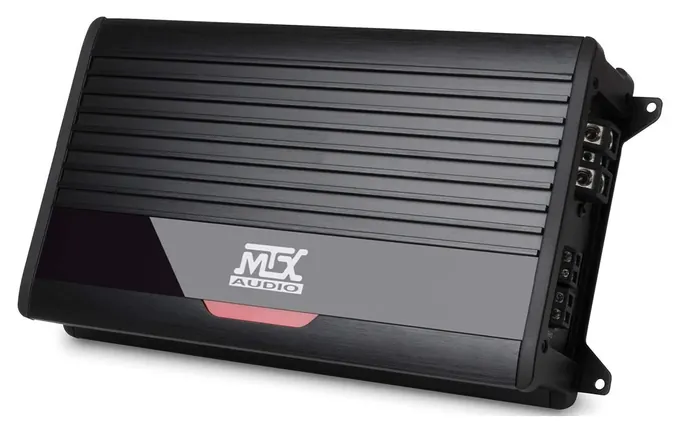
From the manual
- The 1,000-watt rating needs a 1-ohm load; MTX rates it at 600 watts at 2 ohms and 350 at 4. p. 7
- The only inputs are RCA jacks, which need a source putting out at least 200 mV. p. 2
- Use the subsonic filter only with a ported box, and ground to bare chassis metal, never the battery's ground terminal. p. 2
- MTX calls for a 100-amp in-line fuse within 18 inches of the battery; install damage isn't covered by the warranty. pp. 5-6
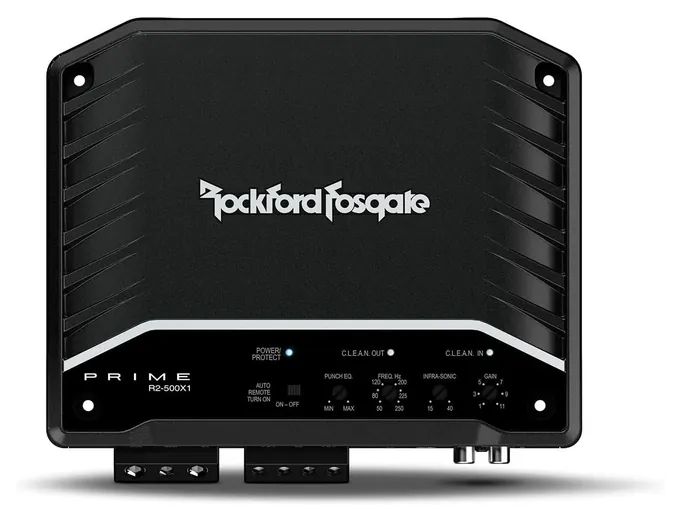
From the manual
- Automatic turn-on senses the radio's front-left speaker lead, so it works only with the speaker-wire inputs; otherwise wire the remote lead. pp. 5-6
- Rockford specifies an 80-amp fuse, not supplied, within 18 inches of the battery, and a ground lead shorter than 30 inches. pp. 3, 9
- Under a seat it needs at least an inch of air around the heatsink; mounting it in the engine bay voids the warranty. p. 8
- The one-year warranty covers only U.S. authorized-dealer purchases; Rockford adds a year when you install it with its matching wiring kit. p. 32; product page
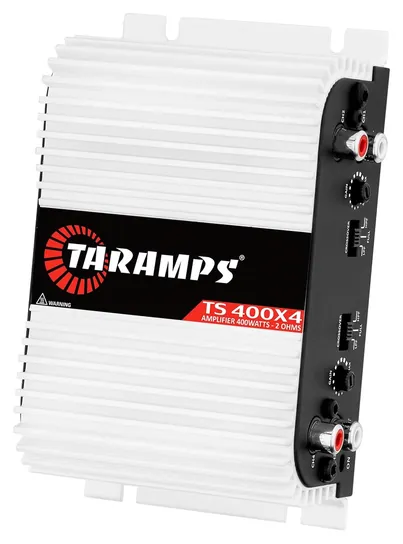
From the manual
- This version has RCA inputs only; with a two-output radio, Taramps says to split the signal with Y-adapters to feed all four inputs. pp. 3, 5
- Taramps calls for a 20-amp fuse near the battery and 11-gauge power wire for runs up to 4 meters. p. 5
- The 100-watt 2-ohm rating allows up to 10 percent distortion; the 63-watt 4-ohm figure carries no stated limit. p. 6
- The 12-month warranty excludes installation damage and is void if the warranty seal is torn. p. 7
Editor's Notes
November 17, 2026, by Ezvid Wiki Editors:
Rockford Fosgate discontinued the R500X1D, so its named successor, the R2-500X1, takes its place. The black Taramps TS 400X4 is no longer offered, so the pick now points to the white version, whose manual lists RCA inputs only. We rechecked the other eight picks, found them still sold at similar prices, and found no recalls for any of the ten. We also read Rockford's R2 manual, stopped applying Taramps' 10 percent distortion limit to 4-ohm ratings that carry none, and fixed the Boss warranty terms and the bridging advice.
November 16, 2026, by Ezvid Wiki Editors:
Rockford Fosgate has discontinued the R500X1D, so its maker's named successor, the R2-500X1, takes its place with the same power ratings under the industry standard. The black Taramps TS 400X4 is no longer offered, and the pick now points to the same amp in white, whose seller lists only RCA inputs. We rechecked the other eight picks, found them still sold at similar prices, and found no recalls for any of the ten.
November 5, 2026, by Ezvid Wiki Editors:
This November pass read the makers' manuals for nine of the ten picks and added a spec table, manual notes and a section on why the TS 800X4 leads. It corrected the Orion's power rating, the Alpine's warranty, a bass-processor port the EPICFOUR doesn't have, the MTX's rated load and the BASS 400's rating claim. It also notes that Taramps rates its amps at up to 10 percent distortion.
October 18, 2026, by Ezvid Wiki Editors:
Small size, factory-radio inputs and continuous ratings that hold up on paper even at 4 ohms put the Taramps TS 800X4 at the top. [2026 update: Taramps' manual rates the amp's headline 2-ohm power at up to 10 percent distortion, a looser bar than the 1 percent or less that every rival stating a limit uses, and prints no limit for the 4-ohm figure, so the power lead is smaller than the numbers suggest.] The old list needed a lot of work. The JL Audio RD-900 and Boss Audio PF2600 Phantom listings no longer return a product, the Pioneer GM-D9701 and Sony XM-GS6DSP aren't available, and the Rockford Fosgate PBR400X4D is listed as unavailable by its own maker. We also dropped the Blaupunkt AMP1504, which is sold as a 1,500-watt amp but is rated at about 150 watts of continuous power in total [2026 update: retail listings give the 150 watts per channel, about 600 in all, still far below the box figure], and the Rockville dBcomp4, a competition amp whose power claims lean on marketing.
New are the Alpine S-A32F, the AudioControl EPICFOUR, the Pioneer GM-A6704 and the Orion CEA400.4D on the speaker side, and the Taramps BASS 400 and Boss Audio R1100M for subwoofers.
The MTX Thunder1000.1 stays for big bass systems. The Rockford Fosgate R500X1D stays too, but its maker has discontinued it, so it may drop off when stock runs out. [2026 update: it has since been replaced by its maker's successor, the R2-500X1.]
One thing to know going in: every power figure here is the maker's own. We found no independent bench tests of these exact models, so we favored amps with continuous ratings at a stated speaker load and voltage, and we call out the ones that only print peak numbers.
Earlier notes
January 8, 2021, by Luke Mitchell:
There have been four additions to our list in this latest update, starting with the Boss Audio PF2600 Phantom, which has garnered enough praise in its relatively short lifespan to attract our attention. Standout features are its affordability, surprising volume, and, of course, its ghostly illumination, from which we presume it gets its name. Next, we replaced the Rockford Fosgate Punch with the Rockford Fosgate PBR400X4D; a newer model, based on the same tried-and-tested architecture, but with updated components and improved efficiency.
We decided to add two powerhouses to the ranking, including the JL Audio RD-900, which can be used as a standalone unit, or can be daisy-chained with several other amplifiers to create a formidable system. It is loaded with three-way protection to support this, and is designed with effective heat dissipation in mind. And lastly, we added the Rockville dBcomp4, which is powerful enough at 3000 watts RMS to be used for competitive car audio purposes, and which will afford you plenty of headroom, provided your speakers are up to the job.
May 14, 2019, by Daniel Goldstein:
Everyday music listeners and audiophiles will gravitate towards very different products on our list. While an everyday consumer's kind of amp, like the Sound Ordnance M75, will turn a mediocre-sounding system into a good one, it simply can't excel in the way a unit like the Rockford Fosgate Punch can. The price difference between the two isn't all that great, but if anything, this demonstrates what a worthwhile purchase an amp is, as for a relatively small investment, you can transform the sonic landscape of your car. Stock stereo systems are notoriously mediocre, and often downright bad, but a good amplifier can change this by optimizing the output of your speakers.
Now, with that said, imagine what a really high-quality amp can do. If you're willing to upgrade to something like the Pioneer GM Digital or the JL Audio XD700, you should either have some aftermarket speakers or, at the very least, a plan to get some in the near future. With these amps powering your system, it'd be a shame to not maximize their potential by matching them with capable speakers.
If you're just looking for a monoblock (single channel) amp to drive your subwoofer, the MTX Audio Thunder is amongst the best in class. However, buying a dedicated monoblock usually isn't necessary. Using a multi-channel unit with a dedicated sub channel is perfectly acceptable, and is, in fact, the norm.
Special Honors
JL Audio JL Audio, based in Miramar, Florida, makes car amplifiers above the price range of this list, mostly sold through authorized dealers who can install and tune them. Its VXi amplifiers have built-in digital signal processing for time alignment and equalization, set up with a computer. They're a good fit for a full system build where tuning matters more than cost. jlaudio.com
RMS Watts, Peak Watts And Speaker Load
An amp makes more power into 2 ohms than into 4, so a headline 2-ohm number can mislead if your speakers are 4-ohm models, as most door speakers are.
The biggest number on an amp box is usually a peak or "max" figure, and it tells you little. Compare continuous (RMS) power instead. The CEA-2006 standard, now called CTA-2006, measures continuous power at 14.4 volts with distortion under 1%; Kenwood's spec sheet for the X301-4 shows a rating done that way, with the larger maximum figure listed separately. Rockford Fosgate rates the R2-500X1 the same way: 300 watts into 4 ohms and 500 into 2 ohms.
The speaker load matters as much as the watts. An amp makes more power into 2 ohms than into 4, so a headline 2-ohm number can mislead if your speakers are 4-ohm models, as most door speakers are. Taramps rates the TS 800X4 at 200 watts per channel into 2 ohms but about 136 into 4 ohms. MTX's manual says the Thunder1000.1 makes its 1,000 watts only into 1 ohm and rates it at 350 into 4 ohms.
The distortion limit counts too. Taramps rates the headline 2-ohm power of its TS-series amps at up to 10% distortion and prints no limit for their 4-ohm figures, as the TS 800X4 manual shows, so their watts aren't directly comparable with 1% ratings. Dave MacKinnon, editor-in-chief of BestCarAudio.com and a trained electronics technician who bench-tests amps, wrote in December 2020 that even 1% distortion on a test tone "is very audible," and that a 180-watt amp is only about 1.1 dB louder than a 140-watt one. Modest power gaps matter less than they look.
For most door and dash speakers, 50 to 75 watts RMS per channel at 4 ohms is plenty. Match the amp's rating to the speaker's continuous power handling, not its peak. For subwoofers, check the sub's impedance and how its voice coils are wired before you pick a mono amp's rating.
Four Channels Or One, And Class AB Or D
A four-channel amp drives front and rear speakers, or two speakers plus a subwoofer on two bridged channels. Bridging joins two channels into one stronger output, but each channel then works as if the speaker had half its impedance, so makers set a higher minimum for bridged loads: the TS 800X4 manual allows 2 ohms per channel in stereo but 4 ohms bridged. A mono amp, also called a monoblock, has one channel built for subwoofers. It usually has a low-pass filter, a bass boost and often a subsonic filter that cuts notes too low to hear.
Class AB amps are the older design. They make more heat and need more space; the Pioneer GM-A6704 is about 14 inches long for 60 watts per channel. Class D amps are far more efficient, so they run cooler, draw less current and fit under a seat. The old rule that Class D is only for bass no longer holds, and today's full-range Class D models are made for speakers too (Audio Intensity).
Check the filters. A high-pass filter keeps deep bass out of small door speakers, which lets them play louder and cleaner. A wide, variable range, such as 40 to 500 hertz, gives more room to tune than a fixed switch.
Wiring, Fuses And Factory Radios
Most amp problems start with the install, not the amp. Disconnect the battery before you start. The power cable needs an inline fuse close to the battery, usually within about 18 inches, because that fuse protects the wire and the car, not the amp. Size the wire to the amp's current and the length of the run. Crutchfield's chart lists the largest fuse each wire size can take, and each amp's manual names the fuse it wants. Copper-clad aluminum wire needs to go one or two sizes thicker than pure copper to carry the same current (Audio Intensity). Pass the cable through a rubber grommet in the firewall, never over a bare metal edge, and keep the ground wire short and bolted to bare metal.
If you keep a factory radio, choose an amp with speaker-wire (high-level) inputs and automatic turn-on, or add a line-output converter. Amps with only RCA (line-level) inputs, such as the AudioControl EPICFOUR, suit aftermarket radios with preamp outputs. Hum and whine usually come from a poor ground or RCA cables run beside the power wire. Finally, loud systems can damage hearing, and many towns have noise rules for car audio, so check local law.
How we researched this
We compared 20 car amplifiers, including every model from the previous version of this list, and read the makers' documents for all ten picks: Taramps' TS 800X4, TS 400X4 and BASS 400 manuals, Alpine's S-A32F owner's manual, AudioControl's EPICFOUR quick start guide, Pioneer's GM-A6704 owner's manual, Orion's Cobalt Elite manual, Boss's Riot manual and its extended-warranty terms, MTX's Thunder manual, and Rockford Fosgate's R2 owner's manual. We took each amp's rated load, distortion limit, inputs, fuse and warranty from those documents where they state them; we found no independent bench tests of these exact models, so every power figure is the maker's own, read against Dave MacKinnon's BestCarAudio.com column on how ratings are measured. Web searches of U.S. and Canadian recall notices found none for these ten models; the amplifier recalls that did come up, such as Alpine's 2015 recall of its PDR series, cover other models.
Sources (27)
- Taramps: TS 800X4 2 ohms support article
- Taramps: four-channel amplifiers
- Taramps: BASS 400
- Pioneer: GM-A6704
- Rockford Fosgate: R2-500X1
- Kenwood: X301-4 specifications
- Audio Intensity: choosing an amplifier for car speakers
- Crutchfield: amplifier power wire and fuses
- Audio Intensity: car audio wiring guide
- Taramps: TS 800X4 instruction manual (PDF)
- Taramps: TS 400X4 instruction manual, RCA version (PDF)
- Taramps: BASS 400 manual, 2-ohm version (PDF)
- Alpine: S-A60M/S-A32F/S-A55V owner's manual (PDF)
- Crutchfield: Alpine S-A32F listing
- AudioControl: EPICFOUR quick start guide (PDF)
- AudioControl: EPICFOUR
- Pioneer: GM-A6704 owner's manual (ManualsLib copy)
- Orion: Cobalt Elite amplifiers manual (PDF)
- Orion: CEA400.4D
- Boss Audio: Riot amplifiers user's manual (PDF)
- Boss Audio: R1100M-S
- Boss Audio: extended warranty terms (PDF)
- MTX: Thunder Series amplifiers owner's manual (PDF)
- MTX: Thunder1000.1
- Rockford Fosgate: R2 amplifiers owner's manual (PDF)
- BestCarAudio.com: The Challenge of Amplifier Power Ratings (Dave MacKinnon, 2020)
- Health Canada: Alpine PDR amplifier recall (2015)
Frequently asked questions
How many watts do I need for a car amplifier?
For most door and dash speakers, 50 to 75 watts RMS per channel at 4 ohms is enough. Match the amp to the speakers' continuous power handling. A single subwoofer usually wants 200 to 500 watts RMS at its rated load.
What does "max watts" mean on a car amp?
It's a peak figure that the amp can only reach in brief bursts, and makers measure it in different ways. Compare RMS, or continuous, power at a stated speaker load and voltage instead.
Do I need a mono or a four-channel amp?
A mono amp is for subwoofers. A four-channel amp powers four speakers, or two speakers plus a sub on bridged channels. Some people run one of each.
Is a Class D amp good for speakers, or only for bass?
Modern full-range Class D amps work well for speakers. They run cooler and fit in smaller spaces than Class AB amps, which some listeners still prefer for speakers.
What are the best car amplifier brands?
Rockford Fosgate, Alpine, Pioneer, AudioControl, JL Audio, Kicker, Kenwood and MTX all have long track records. Taramps is popular for high rated power at a low price, though it rates its headline power at up to 10% distortion. Judge each model by its continuous rating and the conditions behind it, not the brand alone.
Can I use an amp with my factory radio?
Yes, if the amp has speaker-wire inputs with automatic turn-on, or if you add a line-output converter. Amps with only RCA inputs need an aftermarket radio with preamp outputs.