The 8 Best Drywall Anchors
Updated by · How we research

Snap toggles, self-drilling anchors and toggle bolts compared by rated load, wall fit and removal. The Toggler SnapToggle BB leads for heavy hollow-wall jobs. When users buy our independently chosen editorial choices, we may earn commissions to help fund the Wiki.
The weight printed on a box of drywall anchors is the load that breaks it in a straight pull, not what it should carry, and one leading maker tells installers to use a quarter of that figure or less. A shelf bracket also levers the anchor outward. This guide is for anyone hanging shelves, mirrors or rods where no stud lines up.


From the manual
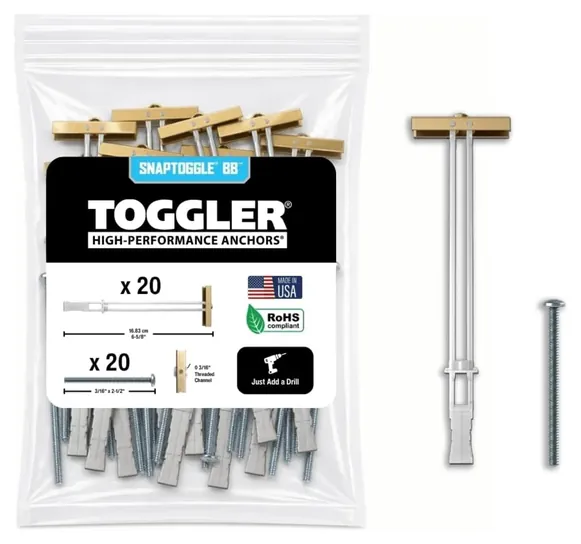
- Start the bolt by hand for at least one thread before reaching for a screw gun, or it can cross-thread in the channel. p. 2
- A hole drilled larger than specified weakens the hold, and the channel needs nearly 2 inches of clear space behind the board. p. 2
- For the most shear strength, set the channel vertical to the floor, and use hardened or stainless bolts to reach the top ratings. p. 2
- To remove it, take out the bolt and knock the channel off its straps behind the wall with a sharp screwdriver blow. p. 2
Why the Toggler SnapToggle BB is our top pick
The SnapToggle BB carries a heavy load on its own, and its maker publishes the figures: 265 pounds of straight pull and 241 pounds of shear in half-inch drywall before failure.1 Our runner-up, the E-Z Ancor Twist-N-Lock, is rated at 75 pounds for the whole job, not per anchor, and only for items hung flush; a shelf that sticks out gets less.3 Its maker's catalog calls that a lab average and says to apply safety factors,4 and the BB's bulletin cites the industry rule of planning on a quarter of the breaking figure.1
The two also differ on where they can go. Our pick is rated for walls, ceilings and floors,1,2 while the runner-up's maker rules out ceilings and TVs.3 The BB's steel channel stays behind the board when the bolt comes out, so a fixture can come down and go back up in the same hole.1 In one published shelf test, it held until the test drywall peeled off the studs.5
The runner-up wins on effort. It needs no drilling, turns in with a Phillips screwdriver and clicks once when it has set,3 where the BB needs a half-inch hole, nearly 2 inches of space behind the board, and a bolt started by hand so it doesn't cross-thread.1 For a mirror or a towel bar, that trade favors the runner-up; for anything heavy, it doesn't.
| Toggler SnapToggle BB | E-Z Ancor Twist-N-Lock | |
|---|---|---|
| Rated pull, 1/2 in drywall | 265 lb per anchor | 75 lb per job, flush |
| Ceilings | Rated for ceilings | Ruled out by maker |
| Hole to drill | 1/2 in | None |
| Removal | Bolt out, channel stays | Anchor unscrews |
Sources
- Toggler SnapToggle 1Technical bulletin (PDF), pp. 1, 2 2Product page
- E-Z Ancor Twist-N-Lock 3Product page and instructions 4ITW Buildex 2026 catalog (PDF), p. 29
- 5Your Best Digs: The Best Drywall Anchors
From the manual
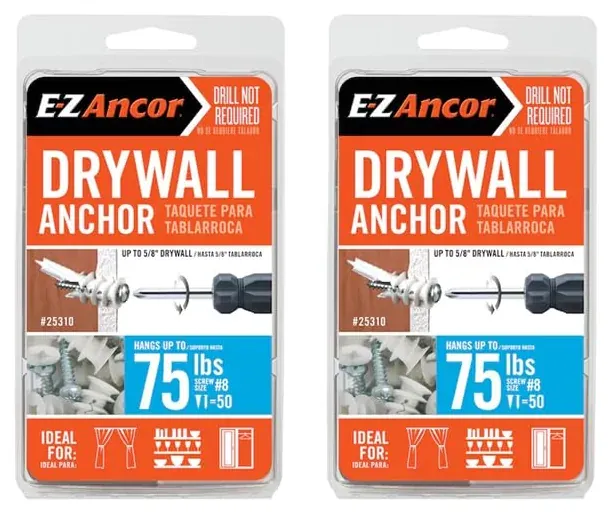
- The maker's lab averages rise with board thickness: 65 pounds in 3/8-inch drywall, 75 in half-inch and 80 in 5/8-inch. p. 29
- The catalog warns against mounting a TV with any of its screw-in anchors, this one included. p. 29
- It drives with a Phillips screwdriver or a square bit; turn it until the head sits flush, then stop. pp. 28-29
- The supplied screw suits fixtures up to a quarter inch thick; thicker pieces need a screw 1 inch longer than the fixture. maker page
From the manual
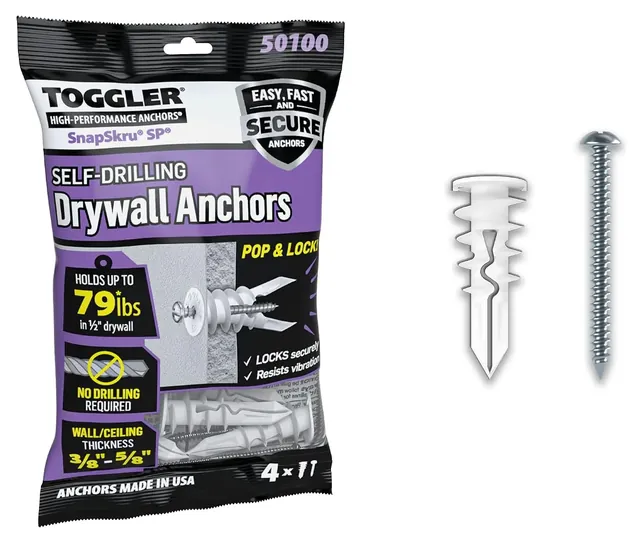
- Toggler allows a screw gun or a drill with a clutch, and a built-in stop keeps the anchor from driving through the board. p. 1
- An audible pop tells you the anchor has opened and locked behind the board. p. 1
- For double-layer drywall, drill a small pilot hole first and the regular anchor still works. p. 2
- Toggler backs it with a 100 percent money-back satisfaction guarantee. p. 4
From the manual
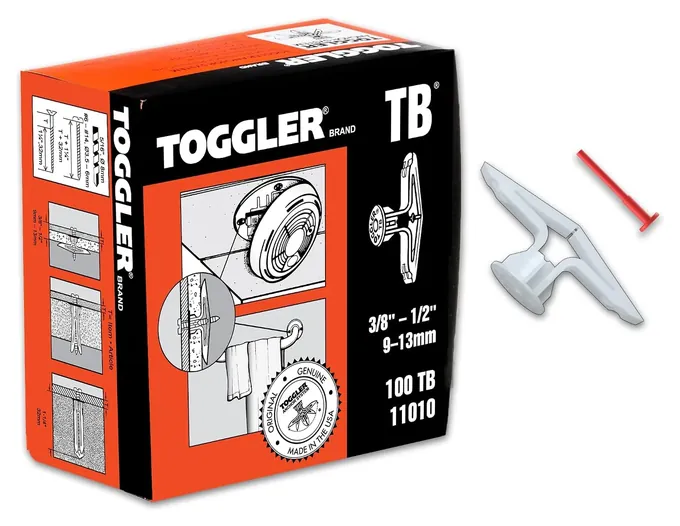
- If the red key won't pop the arms open, the wall is solid or too thick; never hammer the key. p. 2
- It needs only 3/4 inch of space behind the board and takes #6 to #14 screws, which you supply. pp. 1, 5
- Stop when the screw head sits snug on the fixture; Toggler says not to keep turning past that point. p. 2
- With no drill handy, a quarter-inch flat screwdriver turned in drywall will bore the hole it needs. p. 2
From the manual
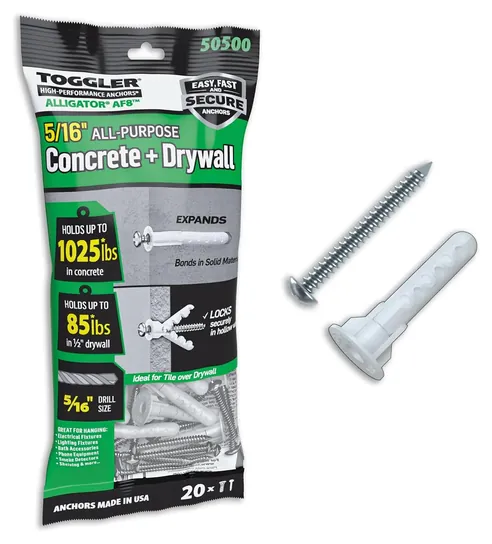
- Drill a hole the same width as the anchor and about twice its length, then tap it flush. pp. 2-3
- Drive the screw in one steady motion without pausing, since the plastic reshapes itself under the pressure. p. 3
- In concrete or other high-strength masonry, keep it at least 1.5 inches from an unsupported edge. p. 2
- Toggler doesn't recommend it for hollow ceilings and points to its plastic toggle or SnapToggle there. maker page
Editor's Notes
November 19, 2026, by Ezvid Wiki Editors:
We read Toggler's technical bulletins and data sheet and E-Z Ancor's catalog and instructions for the top five, explained why the SnapToggle BB leads, and added notes from those documents under each pick. We also noted that Toggler allows a clutch drill for the SnapSkru, dropped the October note's claim that only the snap toggle outlasted the test drywall, and fixed install details for several other picks. A fresh CPSC recall search found nothing for any brand on the list.
November 16, 2026, by Ezvid Wiki Editors:
The two-size Toggler SnapSkru kit and the 20-pack of Toggle TB plastic toggles could no longer be bought, so those picks now point to a SnapSkru four-pack and a Toggle TB box of 100 that comes without screws. They are the same anchors with the same maker ratings, and a fresh recall search turned up nothing for any pick on the list.
October 19, 2026, by Ezvid Wiki Editors:
A snap toggle leads this new list because it outlasted the drywall around it in a published shelf test. The Toggler SnapToggle BB also carries the highest stated rating we found, and its bolt can come out and go back in without losing the anchor.
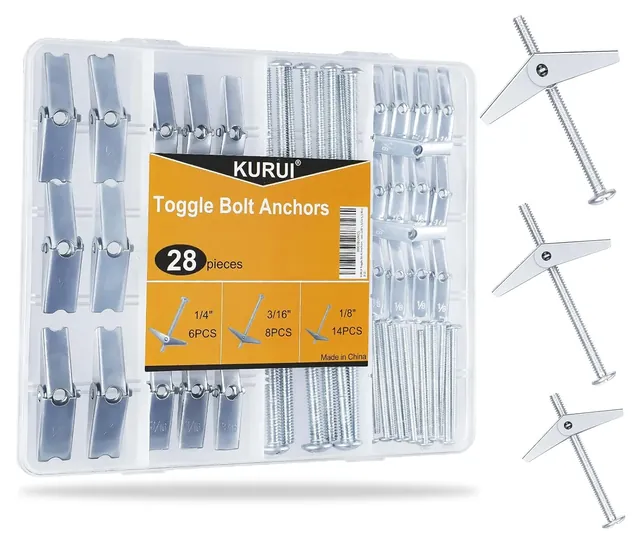
The rest of the list covers the jobs most people actually have. The E-Z Ancor Twist-N-Lock and the Toggler SnapSkru screw straight into the wall for mirrors and shelves, the Toggler Toggle TB and the KURUI Toggle Bolt Kit handle hollow walls with a drilled hole, and the Toggler Alligator AF8 works in brick as well as drywall.
The E-Z Ancor Toggle Lock, the favorite of two shelf tests, was unavailable when we checked, so it sits in Special Honors. We left out Toggler's SnapToggle BA because it's the same anchor with a thinner bolt, and we skipped several look-alike kits sold under different brand names.
Our evidence was Toggler's and E-Z Ancor's published ratings and install guides, two home-site tests that hung weights from shelf brackets until something gave, and a federal recall search for every brand. None of it replaces a stud. TVs, cabinets and grab bars belong on framing.
Special Honors
E-Z Ancor Toggle Lock This metal-tipped toggle drills its own hole, then flips a bar behind the board, and E-Z Ancor rates it at 100 pounds. It was the favorite in two published shelf tests, but it was out of stock at our usual retailer when we checked. Look for it at home centers. easyanchors.com
Matching The Anchor To The Load
Most ratings on an anchor box are ultimate loads: the pull that breaks it, measured straight out of half-inch drywall.
Most ratings on an anchor box are ultimate loads: the pull that breaks it, measured straight out of half-inch drywall. Toggler, which makes the SnapToggle, SnapSkru and Alligator lines, says to plan on a quarter of that number or less for a safe working load (Toggler). E-Z Ancor's 75-pound rating for the Twist-N-Lock covers the whole job, not each anchor.
Typical ranges by type run roughly 10 to 20 pounds for a plastic expansion plug, 25 to 50 for a self-drilling anchor, 50 to 150 for a spring toggle bolt and 80 to 265 for a snap or strap toggle, and those are typical breaking loads, not recommended ones (Wikipedia). Molly bolts, the expanding metal sleeves, fall in the self-drilling range for more work, which is why none made this list.
A shelf is harder on an anchor than a picture. The bracket acts as a lever, so the top screws get pulled out much harder than the weight on the shelf. In Your Best Digs' shelf test, an E-Z Ancor toggle rated at 100 pounds held about 70 with the load 10 inches out, a SnapSkru let go at 55, and the SnapToggle held until the drywall peeled off the studs. Toggler also sells the SnapToggle as the BA with a thinner 3/16-24 bolt and a 238-pound rating, which suits fixtures with small bolt holes.
Installing Without Stripping The Wall
Start with a stud finder. If a stud lines up, a wood screw into it beats any anchor, and Family Handyman notes that drywall alone won't hold more than a few pounds. Check for pipes and wiring before you drill or drive, especially with metal anchors.
Self-drilling anchors go in with a hand Phillips screwdriver. Plastic ones can snap on the way in, and a power drill broke SnapSkru anchors in one review (Bob Vila). Toggler allows a screw gun or a drill with a clutch for the SnapSkru (Toggler), but stop as soon as the head sits flush.
Know your board. Most walls are half-inch drywall, while many ceilings and garages use five-eighths. The Toggler Toggle TB fits only up to half-inch board, and the Alligator AF8 needs at least half an inch (Toggler, Toggler). Spring toggle bolts are the odd ones out: the bolt has to pass through your bracket before the wings go into the wall, so hold the item in place while you tighten. A snap toggle is set first, then the bolt and fixture go on, which makes it a one-person job (Toggler).
Studs, Grab Bars, TVs And Ceilings
Some things shouldn't hang on drywall anchors at all. Grab bars, handrails and anything a person leans on need studs, solid blocking, or the specific anchor the bar's maker sells and rates for it. The federal accessibility standards require a grab bar and its mounting to withstand 250 pounds of force (U.S. Access Board).
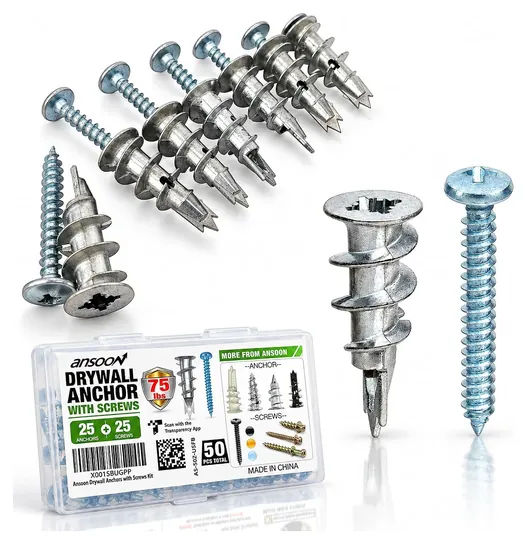
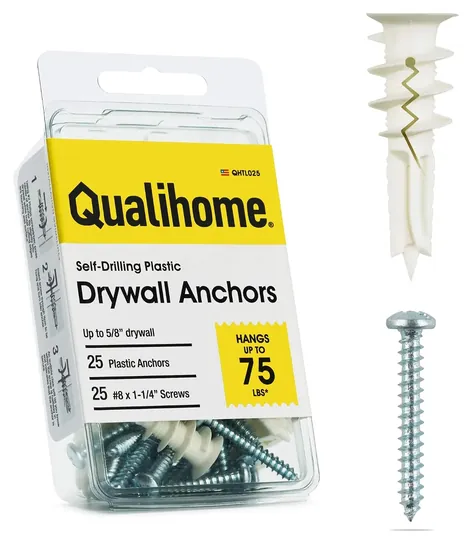
TV mounts belong on studs. KURUI warns against using its toggle kit for TVs, and E-Z Ancor rules out TV mounts and ceilings for the Twist-N-Lock. Tip-over straps for dressers and bookcases should also go into a stud or a rated toggle. For ceilings, use only an anchor its maker approves for ceilings, such as the SnapToggle or SnapSkru, and keep loads light. Light fixtures and fans need an electrical box rated for them.
Plan for removal too. A SnapToggle's bolt comes out and the channel stays, so you can rehang. Plastic toggles and self-drilling anchors stay in the wall when the screw comes out; unscrew the anchor or cut it flush and patch. A spring toggle's wings fall inside the wall for good. The bigger the hole, the bigger the patch, so the small hole of a self-drilling anchor is the easiest to hide.
How we researched this
We compared 18 drywall anchors and kits across five anchor types and narrowed them to eight. We read Toggler's technical bulletins for the SnapToggle, SnapSkru and Alligator anchors and its plastic toggle data sheet, plus E-Z Ancor's Twist-N-Lock instructions and its maker ITW Buildex's 2026 catalog; we found no maker instructions for the Ansoon, KURUI and Qualihome kits, so what we say of them rests on their sellers' descriptions and published roundups. Beyond the makers' lab figures, the published load tests mattered most: Your Best Digs loaded a shelf bracket until something gave, and Bob Vila hung weights from each anchor. A U.S. Consumer Product Safety Commission recall search in November 2026 found no recalls for any of the five brands or for drywall anchors in general.
Sources (19)
- Toggler: SnapToggle heavy-duty toggle bolt
- Toggler: SnapSkru self-drilling anchor
- Toggler: plastic toggle anchor
- Toggler: Alligator all-purpose anchor
- E-Z Ancor
- Your Best Digs: The Best Drywall Anchors
- Bob Vila: Best Drywall Anchors
- This Old House: Best Drywall Anchors
- A Butterfly House: Wall Anchor Types
- Family Handyman: Drywall Anchors
- Wikipedia: Drywall anchor
- U.S. Access Board: ADA Standards, grab bars
- CPSC recalls
- Toggler: SnapToggle technical bulletin (PDF)
- Toggler: SnapSkru technical bulletin (PDF)
- Toggler: plastic toggle anchors data sheet (PDF)
- Toggler: Alligator technical bulletin (PDF)
- E-Z Ancor: Twist-N-Lock anchor
- ITW Buildex: 2026 product catalog (PDF)
Frequently asked questions
How much weight can a drywall anchor hold?
The number on the box is the load that breaks it in a straight pull from half-inch drywall. Toggler says to use a quarter of that or less as a safe working load. Shelves pull harder than the weight on them, because the bracket levers the anchor out.
What is the strongest drywall anchor?
Snap or strap toggles, such as the Toggler SnapToggle, carry the highest ratings and held until the drywall itself failed in a published shelf test. Spring toggle bolts come next, then self-drilling anchors, then plastic plugs.
Can I hang a TV with drywall anchors?
Mount a TV on studs. Some toggle makers list TV mounts as a use, but many anchor makers, including E-Z Ancor for the Twist-N-Lock and KURUI for its toggle kit, rule them out.
Do drywall anchors work in a ceiling?
Only the ones their maker approves for ceilings, such as Toggler's SnapToggle and SnapSkru. Keep the load light, and use a rated electrical box for light fixtures and fans.
How do you remove a drywall anchor?
Back the screw out first. Self-drilling anchors usually unscrew with a Phillips screwdriver. Plastic plugs and toggles can be pushed through or cut flush, then patched. A spring toggle's wings fall into the wall.
What screws should I use with drywall anchors?
Use the screws in the box, since the rating assumes them. The SnapSkru takes #6 to #10 screws, and the Alligator AF8 takes #8 to #14. The Toggle TB box has no screws, so pick #6 to #14 screws long enough to pass through the fixture and the board.