The 9 Best Robotic Window Cleaners
Updated by · How we research

Nine window-cleaning robots compared on suction, safety backups, edge sensing and pane limits. The Ecovacs Winbot W2 Pro Omni leads with cordless battery runs. When users buy our independently chosen editorial selections, we may earn commissions to help fund the Wiki.
A window-cleaning robot holds on by suction, so the tether is the real safety gear: its backup battery lasts only 20 to 30 minutes after a power cut. These machines clear dust, smudges and rain spots, not dried mud, and they work slower than a person. They suit high or awkward windows and anyone who'd rather skip the ladder.


From the manual
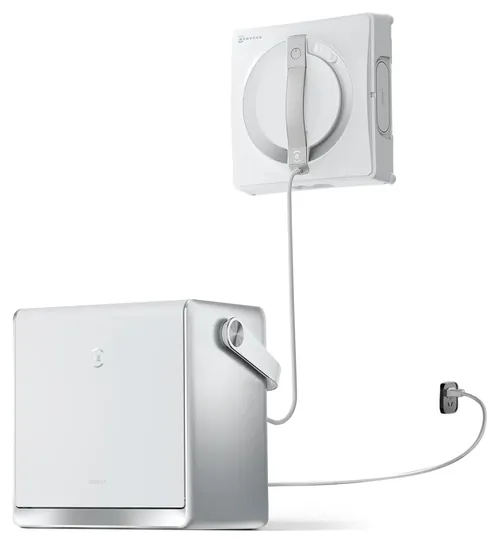
- Set the station on a smooth, seamless floor, never a desk, shelf or carpet; its suction cup won't lock over gaps. p. 17
- Plugged in while the robot works, the station recharges slowly, taking more than six hours; idle, a full charge takes about three. pp. 21-22
- The manual recommends plain tap water, and a full tank sprays for about an hour. p. 15
- Brush the Velcro under the pad clean rather than washing it, since water can get into the robot. p. 23
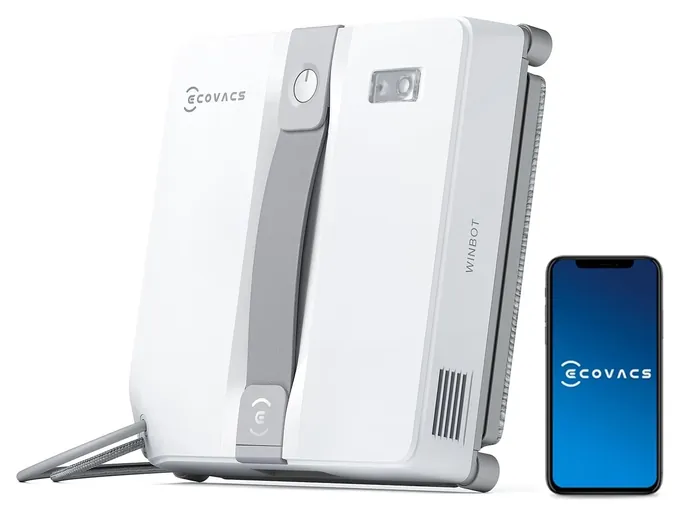
Why the Ecovacs Winbot W2 Pro Omni is our top pick
Our pick can clean where there's no outlet. Its station holds a battery rated for up to 110 minutes,2 or it can stay plugged in while that battery slowly recharges,1 and a Swiss tester got 60 to 70 minutes of cleaning per charge.5 Our runner-up, the Ecovacs Winbot Mini, has to stay plugged in the whole time; its small battery only keeps it from falling if the power fails.3
The station also does the carrying and anchoring. It stores the robot, reels in an 18-foot cable that covers windows up to about 13 feet wide and 8 feet high,1 and locks itself to a smooth floor with a suction cup while its rope ties to furniture.1 The Mini's maker warns it may not finish a window taller than about 8 feet or longer than about 10.3 In a side-by-side test, our pick cleaned a 7-by-6-foot window in seven minutes against the Mini's 8 minutes 45 seconds, and ran almost eight decibels quieter.5
The runner-up wins on size: it works on panes from about 9 by 10 inches, where ours needs about 12 by 16, and it weighs less.4,2 The same tester saw no difference in how clean the glass came out.5 For a few small windows near outlets, the Mini does the job; for many windows, or glass far from power, the W2 Pro Omni is the better buy.
| Ecovacs Winbot W2 Pro Omni | Ecovacs Winbot Mini | |
|---|---|---|
| Power while cleaning | Station battery or plug | Plug only |
| Rated battery run | Up to 110 min | None; backup only |
| Largest window | About 13 x 8 ft | May not finish past 10 x 8 ft |
| Smallest pane | About 12 x 16 in | About 9 x 10 in |
| Quick mode, 7 x 6 ft window | 7 min | 8 min 45 s |
Sources
- Ecovacs Winbot W2 Pro Omni 1Instruction manual, model WG851-11 (PDF), pp. 13, 17, 15, 17, 20–21 2Product page with specs (Ecovacs Belgium, Dutch)
- Ecovacs Winbot Mini 3Instruction manual, model WG841-01 (PDF), pp. 2, 9 4Product page with specs (Ecovacs Belgium, Dutch)
- 5Galaxus: Window cleaning robots compared, which Winbot wins?
From the manual
- It must stay plugged in while cleaning; the backup battery only holds it on the glass if the power fails. p. 2
- Ecovacs asks for its own Winbot solution; tap water is a stopgap, and purified or filtered water is out. p. 12
- On frameless glass, start it more than 10 cm (4 inches) from the edge. p. 14
- Not for framed windows whose frame is under 5 mm (0.2 inch), or for air above 65 percent humidity. p. 2
Compare the specs
Swipe the table sideways to see every column.
| Product | Runs without an outlet (min) | Holds on after a power cut (min) | Smallest pane (in) | Robot water tank (ml) |
|---|---|---|---|---|
| 1. Ecovacs Winbot W2 Pro Omni | Yes, up to 110 | 30 | 12 x 16 | 60 |
| 2. Ecovacs Winbot Mini | No | 30 | 9 x 10 | 60 |
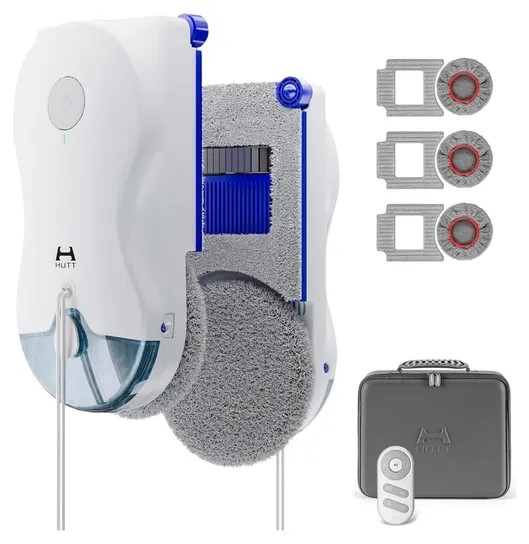
| 3. HUTT H10 | No | 30 | 12 wide | 80 |
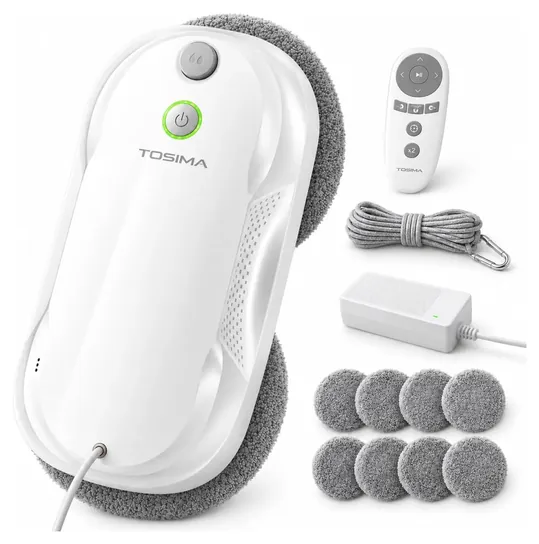
| 4. Tosima W5 | No | 20 to 25 | 12 x 12 | — |
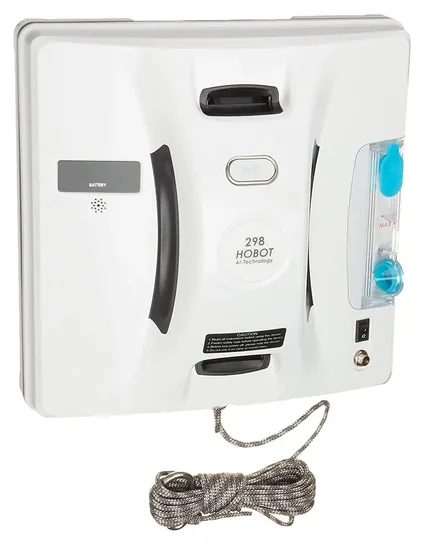
| 5. Hobot 298 | No | 20 | Over 16 x 16 | 40 to 50 |
| 6. Ecovacs Winbot W3 Omni | Yes, 70 to 130 | Over 30 | 12 x 16 | 80 |
| 7. Mamibot W120-DP | No | 20 to 30 | 24 x 16 | 60 |
| 8. Ecovacs Winbot Mini 2 | No | Over 30 | 10 x 10 | 50 |
| 9. Tosima X1 | No | 20 to 30 | — | 80 |
All figures are the makers' ratings. Pane sizes are converted from the makers' centimeter figures and rounded; the HUTT's maker gives only a minimum width. The W3 Omni runs about 70 minutes on its station's built-in battery and up to 130 with the battery pack that comes in the box. Tosima sells more than one W5, and these figures come from its German manual. A Swiss review of the HUTT puts its backup at about 20 minutes, and a Belgian lab's test of the W5 found its backup didn't hold.
Sources
- Ecovacs Winbot W2 Pro Omni instruction manual (PDF) Winbot W2 Pro Omni specs (Belgium, Dutch) Winbot Mini instruction manual (PDF) Winbot Mini specs (Belgium, Dutch) Winbot W3 Omni instruction manual (PDF) Winbot W3 Omni specs (Belgium, Dutch) Winbot Mini 2 instruction manual (PDF) Winbot Mini 2 specs (South Africa)
- HUTT Model 10 product page (Ukraine)
- Tosima W5 user manual, German (PDF) X1 product page
- Hobot HOBOT-298 user's manual (PDF) HOBOT-298 specifications
- Mamibot iGLASSBOT W120-DP user manual (PDF)
- Galaxus: Hutt 10 test
- Lavelab: Tosima W5 test (Italian)
From the manual
- Wipe the caterpillar belts and the two laser sensors before each use; dusty belts make it slip. pp. 7-8
- Only water or Hobot's own window detergent may go in the tank. p. 2
- If the power fails, the backup battery holds it about 20 minutes while it stops, beeps and flashes red. p. 8
- The warranty excludes the cloth, safety rope and water tank as wear parts, and battery fade with age. p. 14
From the manual
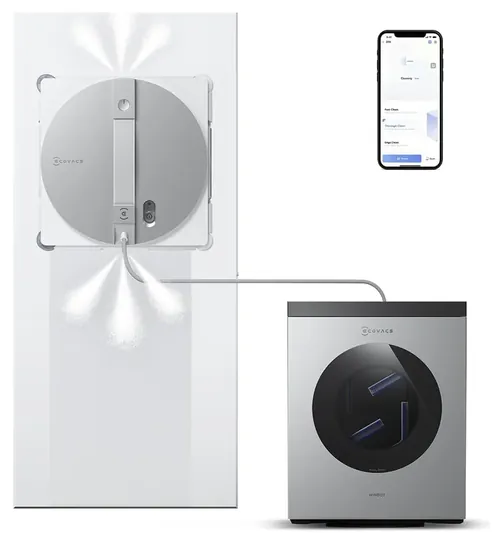
- Use only Ecovacs' solution in the robot; the station's 1.2-liter tank takes clean water, and other cleaners leave the washed pad slippery. p. 14
- Empty and rinse the station's clean and dirty tanks after every job, and let the wash bay dry to avoid odors. p. 22
- Replace each wiping pad after about 30 uses. p. 25
- For glass doors, open the door first so the robot can't drop through the gap. p. 18
From the manual
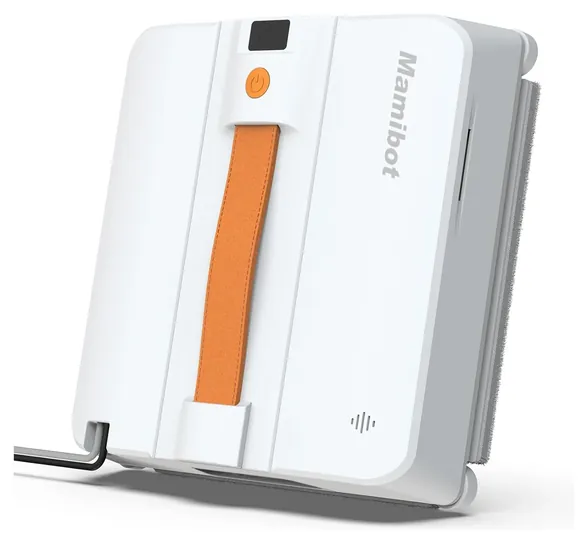
- It works only while plugged in; the backup battery holds it on the glass for 20 to 30 minutes in an outage. p. 3
- The phone app is an optional version that depends on the seller, so check the listing before counting on it. p. 14
- Purified water sets off a false low-water alarm; fill it with clean tap water. p. 17
- The one-year warranty covers units from authorized Mamibot distributors only, and use against the manual voids it. p. 17
From the manual
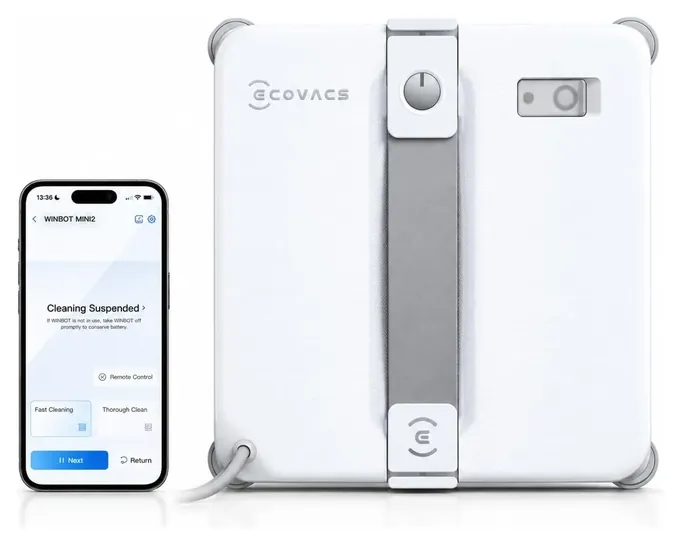
- On big panes, keep the power adapter on the floor; left hanging, its weight can pull the robot off. p. 11
- Wipe the corner brushes and side rollers with a damp cloth after every job. p. 20
- It can jam in gaps near its own height, such as between a window handle and the wall; test the gap first. p. 10
- Ecovacs asks for its own solution in the small tank and rules out purified or filtered water. p. 13
Editor's Notes
November 5, 2026, by Ezvid Wiki Editors:
We read the makers' manuals for seven of the nine picks, added a spec table and a section on why the Ecovacs Winbot W2 Pro Omni leads, and listed setup traps from six of them under their picks. We corrected how these robots find a frameless edge (separate optical or laser sensors, not air pressure), the Hobot 298's minimum pane size and the backup-battery range, and we added outside tests of the HUTT H10, Tosima W5 and Winbot Mini 2 that the October version missed.
October 23, 2026, by Ezvid Wiki Editors:
The Ecovacs Winbot W2 Pro Omni takes the top spot because it can run on its own battery. That ends the cord-and-outlet juggling that makes these cleaners a chore, and its base station carries, charges and anchors it between windows.
Most of the old list had disappeared. The Hobot 388, Ecovacs Winbot W850, Wexbi M189 and Galapara 80W are gone from sale. The Hobot 198 is an older design that now costs more than newer models that sense frameless edges. The Mamibot W120 gave way to the Mamibot W120-DP. The Hobot 298 stays. New picks cover small panes (the Ecovacs Winbot Mini and Mini 2), two-pad cleaning (the HUTT H10 and Tosima X1), a self-washing base (the Ecovacs Winbot W3 Omni) and a well-equipped mid-priced choice, the Tosima W5.
The most useful evidence was a Swiss magazine's test of a Winbot W2 Omni, an Australian review that timed a Hobot 388 pane by pane, and Kärcher's manual on how a safety rope stops a fall. A few newer models still have no outside tests, so their claims are marked as the maker's.
Earlier notes
December 7, 2020:
In our latest update, we removed the Fenrgui R-C901, Ecovacs Winbot W950, Ecovacs Winbot W830, and the Gladwell Gecko due to availability concerns and replaced them with the Galapara 80W, Wexbi M189, Mamibot W120, and the Hobot 388, respectively. For people looking for a multipurpose device, the Hobot 388 is the way to go. It has a powerful vacuum that keeps it attached to various surfaces, even if they’re textured. The Galapara 80W, on the other hand, takes a little longer to clean than some options, but it goes over everything twice to ensure deeply cleaned windows. We also included the Mamibot W120, which has two types of cleaning cloths, one for dry cleaning, and one for wet. This dual action thoroughly cleans glass surfaces in your home.
March 28, 2019, by Brett Dvoretz:
Cleaning windows by hand can be a hassle, not to mention dangerous if you need to stand on a ladder or step stool. These robotic cleaners handle the dirty work for you to make your life easier and safer. Currently, the best option is the Hobot 298, as it is efficient and packed with the most features, like Bluetooth control and a cleaning solution reservoir and spray nozzle. The designers of the Ecovacs Winbot W850 have smartly wrapped it with a soft bumper to ensure it never damages your window's frame, while the powerful Ecovacs Winbot W830 has no problem adhering to frosted or slightly textured glass. If you are tight on storage space, you'll want to take a look at the Gladwell Gecko, Hobot 198, Fenrgui R-C901. Whichever model you choose, get ready for some sparkling clean windows. [2026 update: the Hobot 298 now ranks fifth; the current list puts the Ecovacs Winbot W2 Pro Omni first.]
How They Stay Up, And What Happens When The Power Goes
A window-cleaning robot sticks to glass because a fan or pump pulls air out from under a rubber seal, and the outside air pressure presses it flat.
A window-cleaning robot sticks to glass because a fan or pump pulls air out from under a rubber seal, and the outside air pressure presses it flat. A pressure sensor watches that seal for leaks, while the edge of frameless glass is found by separate sensors: optical ones on the Ecovacs models and two lasers on the Hobot 298. Lose power, and the suction goes with it.
That is why every one ships with a safety rope and most add a small backup battery. The battery is a stopgap. Makers rate it at roughly 20 to 30 minutes, and a Swiss test of the HUTT 10 puts its backup at only about 20. The rope is the real protection. Kärcher's window robot manual says a correctly fitted rope stops a free fall, and it asks owners to check the rope before each use.
For outside or upper-floor glass, tie the rope to something fixed indoors, keep people and pets out of the area below, and plug into a ground-fault (GFCI) outlet. Keep the underside dry, since water under the seal can break the suction, and follow your manual's steps for taking the robot off: Hobot says to lift it off before you switch it off, while Ecovacs has you stop the fan first and grip the handle.
What They Clean Well, And What They Leave
These robots handle upkeep: dust, fingerprints, pollen and rain spots. Heavy grime is another story. In a Digitec Galaxus test of the Winbot W2 Omni, the predecessor of our top pick, the robot left no streaks but did miss a spot now and then, and dried-on dirt stayed, because the robot doesn't notice dirt or go back over it. CHOICE found a Winbot W1 Pro did well on a very dirty outdoor window except for dried mud.
They are also slow. An Australian review of the Hobot 388 timed about six minutes for a pane of roughly 15 square feet, and the reviewer granted that a person with a squeegee is faster. You still move the robot from pane to pane. Square bodies leave a small patch in the top and bottom corners, round pads miss more, and frames, tracks and sills always need a cloth.
Streaks usually come from a dirty pad, not the robot. Ecovacs' support page traces streaking to dusty glass overloading the pad, and its fixes are a firmware update, a clean pad and a second pass. A dry pass before the wet one helps, and so does a lightly wrung pad. Skip rainy or very humid days, when the glass dries with white streaks.
Choosing One: Pane Size, Frames And Power
Start with your smallest window. Each model needs a minimum pane: the Hobot 298 wants more than about 16 by 16 inches, and the Mamibot W120-DP needs roughly 24 by 16. Compact square models such as the Ecovacs Winbot Mini work on panes down to about 9 by 10 inches, which suits narrow windows and glass doors.
Frameless glass, like shower doors and glass railings, needs edge sensing, and the advice conflicts between models and even between reviews of the same model, so check your model's manual before you trust it near an open edge. Ecovacs and Hobot ask you to start the robot about 4 inches in from the edge. Avoid cracked, curved, frosted or textured glass.
Then think about power. Most models must stay plugged in, so measure how far the outlet is from the farthest window. The Ecovacs Winbot W2 Pro Omni can run on its battery, and base stations like the W3 Omni's also wash the pad, at the cost of a heavy box to store. Spare pads are worth buying either way, since a clean pad matters more than the spray. Robot window cleaners have no recalls with the U.S. Consumer Product Safety Commission or Health Canada as of this update.
How we researched this
We compared 16 window-cleaning robots from eight brands and read the makers' manuals for seven of the nine picks: Ecovacs' instruction manuals for the Winbot W2 Pro Omni, Mini, Mini 2 and W3 Omni, the HOBOT-298 user's manual, Mamibot's iGLASSBOT W120-DP manual and a German-language Tosima W5 manual. We found no manual for the HUTT H10 or the Tosima X1, so those two rest on maker spec pages and, for the H10, on Galaxus's test; other outside tests that shaped the list were Galaxus's three-Winbot comparison, Lavelab's Tosima W5 test, CHOICE's Winbot W1 Pro review and GadgetGuy's timed Hobot 388 review. A check of U.S. CPSC and Health Canada recall notices found none for any window-cleaning robot as of November 2026.
Sources (11)
- Digitec Galaxus: robot window cleaner long-term test
- CHOICE: Ecovacs Winbot W1 Pro review
- GadgetGuy: Hobot 388 review
- Kärcher window robot operating manual
- Ecovacs support: streaking FAQ
- Music Photo Life: Ecovacs Winbot Mini review
- U.S. Consumer Product Safety Commission recalls
- Galaxus: Window cleaning robots compared, which Winbot wins?
- Galaxus: Hutt 10 test
- Lavelab: Tosima W5 test (Italian)
- Home Robot Data: CPSC and Health Canada robot recall tracker
Frequently asked questions
Do robotic window cleaners really work?
Yes, for routine dust, smudges and rain spots. They leave a small patch in some corners, can't shift dried mud, and work slower than a person with a squeegee, but they reach glass you can't.
Are they safe on upstairs windows?
With the safety rope tied to something fixed, yes. The backup battery only holds the robot for about 20 to 30 minutes after a power cut, so the rope is the real protection. Keep people out of the area below.
Can they clean frameless glass?
Most newer models have edge sensors for frameless glass, but makers still ask you to start well in from the edge, and some manuals advise against it. Check your model's manual before using it on shower doors or glass railings.
Can I use one in the rain?
No. Wet or humid glass dries with streaks, and water under the robot can break its suction. Wait for a dry day.
Do I need cleaning solution?
It depends on the maker. Ecovacs asks for its own solution in the Winbot Mini, Mini 2 and W3 Omni, with tap water only as a stopgap, but recommends tap water for the W2 Pro Omni. Hobot allows water or its own detergent, and Ecovacs and Mamibot warn against purified water. A clean, lightly damp pad matters as much as what goes in the tank.