The 8 Best Stunt Kites
Updated by · How we research

Foil or framed? Eight dual-line and quad-line stunt kites compared by frame, size, wind range, lines and crash tolerance. The Prism Hypnotist leads. When users buy our independently chosen editorial choices, we may earn commissions to help fund the Wiki.
A frameless foil has no spars to snap, so a crash usually costs nothing but a relaunch, while a framed delta turns sharper and tracks straighter. A stunt kite, or sport kite, is steered with two or four lines, one set in each hand, so it can loop, dive, stall and land on command. Adults and older kids fly them on beaches and open fields.


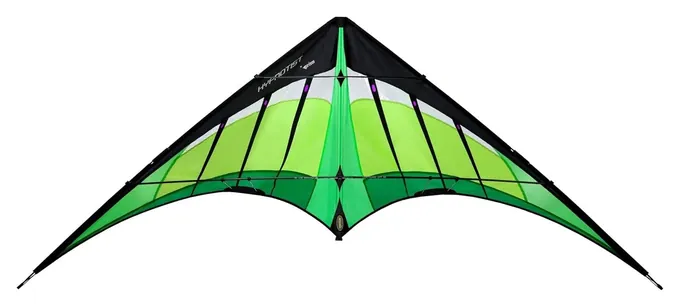
From the manual
- The bridle ships set for 8 to 12 mph; slide the line pigtails toward the nose for light wind, away for strong wind. Bridle Overview
- The stock lines are rated for 5 to 25 mph; Prism advises against launching near the top, where a gust can snap them. Broken Flying Lines
- The warranty promises a complete, defect-free kite on arrival; replacement flying lines are not covered. Our Warranty
- Keep it out of hot car trunks and away from solvents, which can dissolve the adhesive in the sail's seams. Maintenance
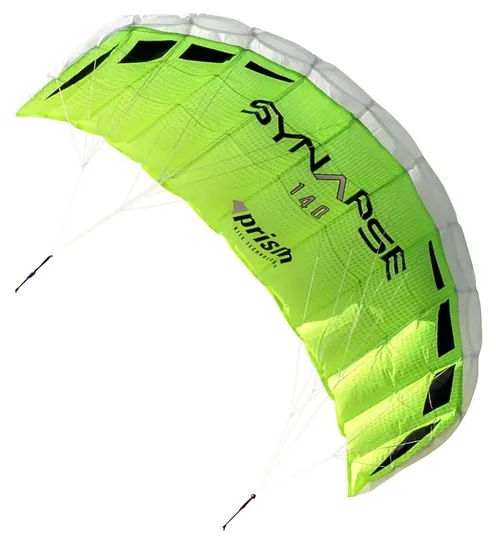
From the manual
- Start in smooth 8 to 12 mph wind; Prism says most people need at least half an hour to get the hang of it. Flight Basics, Tips
- Flying alone, weigh the bottom edge down with sand, rocks or a water bottle to hold it in place before launch. Setting Up Your Kite
- In 25 mph or more it can pull hard enough to break a line; Prism suggests 200- or 300-pound line for such days. Tips
- After about 10 loops one way the lines drag on each other; loop back the other way to untwist them. Maneuvers
Compare the specs
Swipe the table sideways to see every column.
| Product | Type | Wingspan (in) | Maker's wind range (mph) | Maker's skill rating |
|---|---|---|---|---|
| 1. Prism Hypnotist | Framed delta, 2-line | 93 | 5-25 | Some experience to expert |
| 2. Prism Synapse 140 | Foil, 2-line | 53 | 5-25 | New pilot to some experience |
| 3. Revolution EXP | Framed wing, 4-line | 93 | 6-18 | Beginner |
| 4. Prism Jazz 2.0 | Framed delta, 2-line | 62 | 5-25 | New pilot to some experience |
| 5. HQ Symphony Beach III | Foil, 2-line | 51 | 6-31 | Beginner, age 8 and up |
| 6. Prism Neutrino | Mini framed delta, 2-line | 39 | 5-25 | Some experience to expert |
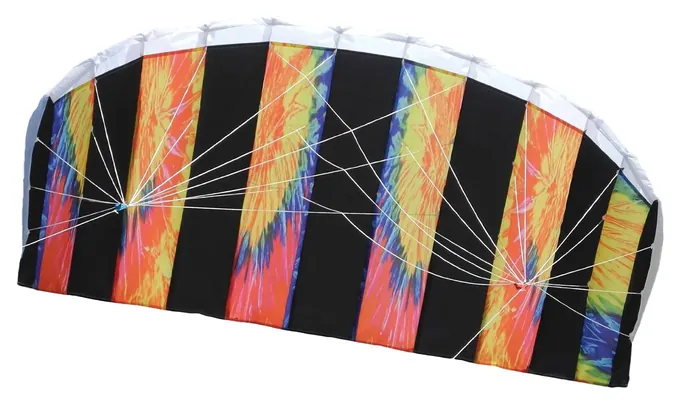
| 7. In the Breeze Tie Dye | Foil, 2-line | 62 | 6-25 | Novice to intermediate |
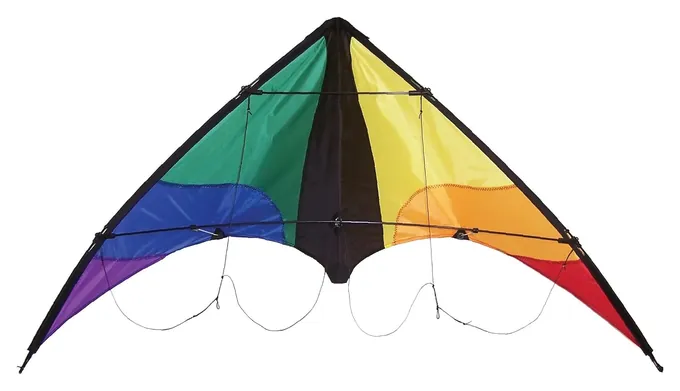
| 8. In the Breeze Colorwave | Framed delta, 2-line | 48 | 6-20 | Entry level |
Wind ranges are the makers' own; Prism's guides give 5 to 25 mph for its four kites and suggest 8 to 12 mph for first flights. Prism's skill scale runs from Just Getting Started to Kite Guru. The HQ row is the 1.3 size.
Sources
- Prism Hypnotist pilot's guide Synapse pilot's guide Jazz 2.0 pilot's guide Neutrino pilot's guide Hypnotist listing Synapse 140 listing Jazz 2.0 listing Neutrino listing
- Revolution Kites Reflex EXP
- HQ Kites Symphony Beach III 1.3 (HQ Kites USA)
- In the Breeze Tie Dye 62 sport air foil Colorwave 48 sport kite
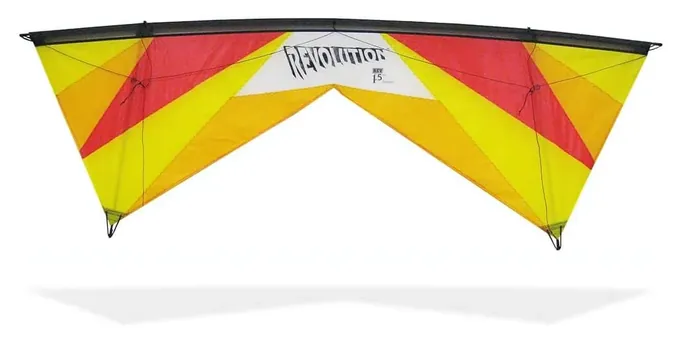
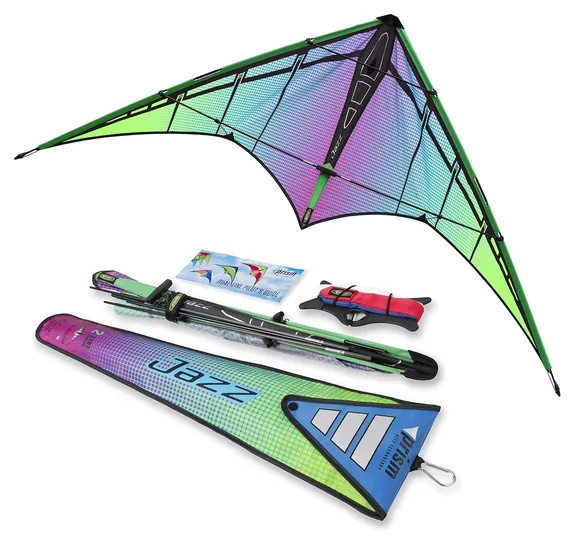
From the manual
- New lines stretch unevenly; the adjustable wrist straps let you even them out to within half an inch. Equalizing Your Flying Lines
- Once you can untwist lines in the air, you can launch with them twisted and spin them straight overhead. Basic Controls
- Beach sand wears lines and fittings: brush it off after a session, and rinse in fresh water after a dunk in salt water. Maintenance
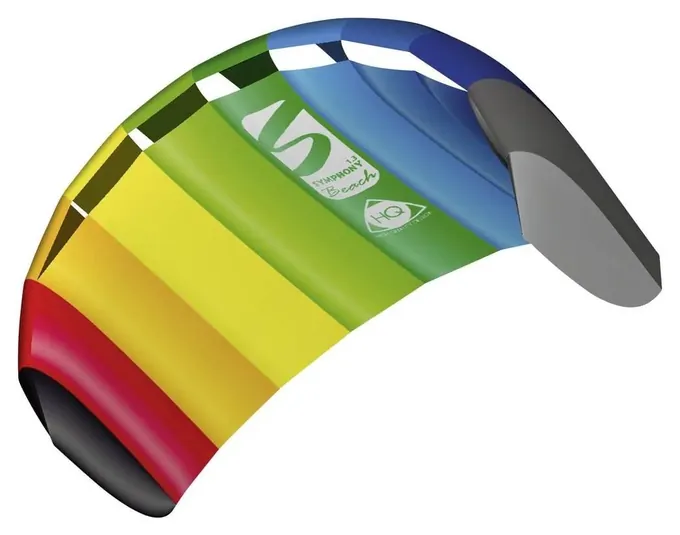
From the manual
- For first flights HQ wants a helper holding the foil, vents up, so it fills with air before launch. p. 1
- In strong wind a landed foil can refill and relaunch itself; let the air out and have a helper hold it. p. 1
- A hard crash can build up pressure in the cells and burst the sail, damage HQ says often can't be repaired. p. 1
- Clean it with lukewarm water and mild soap only, and never leave it packed damp for days. p. 1
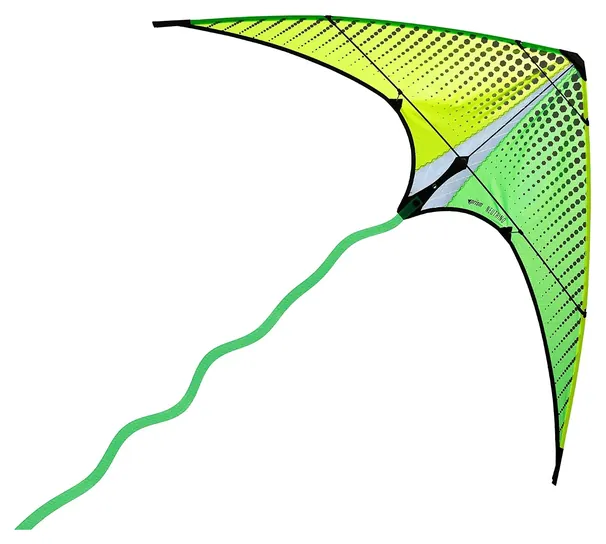
From the manual
- It's designed to stack: four stack lines clip each kite to the one ahead, and no bridle changes are needed. Stacking Multiple Kites
- Stacks pull harder; for more than three Neutrinos Prism recommends 150-pound, 85-foot Dyneema lines. Stacking Multiple Kites
- If it keeps crashing, Prism suggests locking your wrists together and steering with just your fingertips. Troubleshooting
- In the lightest wind you can remove the upper spreader to make the kite a little lighter. Troubleshooting
Editor's Notes
November 16, 2026, by Ezvid Wiki Editors:
The HQ Symphony Beach III is back at its usual price after an October listing glitch, and every kite is still in its maker's lineup, so the picks stay; a new paleonEarth butterfly kite and two pricier Prism models didn't make the cut. We read Prism's pilot's guides for four picks and HQ's Symphony Beach leaflet, and added a spec table and notes from them. We dropped an unsupported HQ warranty claim and a Neutrino age rating Prism doesn't give. CPSC and Health Canada list no recalls for these kites.
October 19, 2026, by Ezvid Wiki Editors:
Adult-size kites that can do tricks are what most readers here want, so the Prism Hypnotist now leads. Six of the ten kites on the old list can't be bought new anymore: the Prism Quantum, Prism Nexus, Prism Snapshot, Flexifoil Big Buzz, PaleonEarth Monarch and HQ Kites Bebop. The Quantum was a favorite; Prism has since replaced it and the Nexus with the Quantum 2.0 and Nexus 2.0.
Four stay: the Prism Synapse 140, the Revolution EXP, the HQ Symphony Beach III and the In the Breeze Tie Dye. The Prism Jazz 2.0 joins as a cheaper framed starter, the Prism Neutrino for fast mini flying and the In the Breeze Colorwave for a tight budget.
We found no lab tests of stunt kites, so we went by wind ranges and line ratings from makers and from shops such as Kittyhawk Kites and REI, owner reports on kite forums, a Recreation Insider roundup and recall checks. The guide now also explains how stunt kites differ from power kites, which some readers were looking for.
Earlier notes
October 20, 2020, by Sheila O'Neill:
Removed the Backyard Stunt 68-Inch due to quality concerns and the Moon Glow Sports Airfoil and HQ Kites Symphony Pro due to availability issues. Added the PaleonEarth Monarch, which has a unique butterfly design. Also added the Revolution EXP, a quad-line model that beginners can use to learn tricks like flying in reverse that can't be done with just two lines. The In The Breeze Tie Dye is an affordable option that's ideal for parents who don't want to break the bank.
Flying a kite can be a great way to spend time outside, learn new skills, and put on an aerial show for friends and strangers. However, there are safety precautions that should be taken seriously. Always stay away from overhead power lines and if you find that your kite has flown into a line, do not try to retrieve it yourself (instead, contact the utility company). You should also make sure that you don't fly in so much wind that you can't control your kite, especially while you're still learning the basics. When flying a stunt kite at high speeds, be aware that the line can be dangerous to passersby. Keep your flying range clear and tell onlookers to watch from behind you.
November 25, 2018, by Brett Dvoretz:
Stunt kites generally come in two main designs — framed and frameless. We made sure to include a good variety of both styles in a range of prices. We also poured over user reviews to identify responsive models that can perform advanced level tricks to keep the experienced pilots engaged, as well as some more stable options that are easy for beginners to learn on.
Special Honors
American Kitefliers Association The American Kitefliers Association is a nonprofit group for kite fliers in the U.S. Its site lists affiliated clubs and kite events, including sport kite competitions, and its safety code is worth reading before a first flight. A local club is the quickest way to meet experienced pilots who can help with setup, line care and first tricks. kite.org
Framed Delta, Foil Or Quad-Line
Air fills its cells and holds the shape, so there's nothing to break.
A stunt kite, also called a sport kite, is steered with two or four lines instead of one (Wikipedia). Pull the left line and it turns left; pull the right and it turns right. There are three main kinds, and the choice shapes everything else.
A framed delta has a carbon or fiberglass spine and wing spars under a ripstop sail. It's the fastest and most precise type, and it's what trick fliers use, but a hard crash can snap a spar. Carbon is lighter and stiffer; fiberglass costs less and flexes more. Kitty Hawk Kites, a North Carolina kite retailer, suggests a delta or a foil as a first kite (Kittyhawk).
A foil, or parafoil, has no frame at all. Air fills its cells and holds the shape, so there's nothing to break. Foils are forgiving and pack small, but they turn less crisply and pull harder as the wind builds.
A quad-line kite flies on four lines held on two handles. Tilting the handles lets it hover, back up and land, which a dual-line kite can't do. Bud Taylor and Sharon Musto, who run the Kite Guys shop in Canada, fly formation routines together and have been kiting for 35 years, write that most pilots can get a basic hover and reverse flight down within an hour of focused practice (Kite Guys). The skill doesn't carry over from dual-line flying, though, and old habits get in the way.
Wind Range, Size And Power Kites
Most stunt kites fly best in about 8 to 15 miles per hour of wind, and the usable range runs roughly 6 to 20 (Kittyhawk). Below that, a kite struggles to launch and stay up. Above about 20, control gets hard and a framed kite can break. Match the kite to your usual spot: a beach with steady sea breezes suits a foil rated for high wind, while a park with light air suits a light framed delta with a low starting number.
Size matters too. Kitty Hawk Kites suggests a wingspan of about 5 to 7 feet for a first kite, big enough to fly smoothly and small enough to handle. Minis steer with tiny hand movements, so they work better as a second kite. Bigger kites pull harder, so wear gloves when the wind picks up.
A stunt kite isn't a power kite. Power, or traction, kites are large foils, often flown on a control bar, built to pull a rider on a board or a buggy (Wikipedia). Their pull is far stronger. If you searched for a beginner power kite, a stunt foil is a gentler way to learn how wind and lines behave.
Lines, Setup And Safety
Before each flight, lay the kite face down, unwind both lines to equal length, and attach them with a lark's head knot to matching points on the bridle, left line to the left side (Kittyhawk). Make sure the lines aren't twisted or crossed. Uneven lines make a kite pull to one side.
Starter kits often come with light lines, rated only for the kite's stated wind range. Prism's Synapse guide says 200- or 300-pound line may be needed in very strong wind, and Prism's warranty doesn't cover replacement lines (Prism). Prism also sells stronger Dyneema linesets for windy days and big stacks.
The American Kitefliers Association's safety code covers the real risks (AKA). Lines conduct electricity, so never fly near power lines or in wet or stormy weather. If a kite snags on a power line, leave it and call the utility, as electric co-ops advise (Tennessee Electric). Stay well away from airports and roads, fly in open space, and keep lines away from people, since a moving line can cut or burn skin. Never use wire or metal line.
How we researched this
We compared 16 stunt kites from Prism, Revolution, HQ Kites, In the Breeze, Flexifoil and paleonEarth. For the eight picks we read Prism's pilot's guides for the Hypnotist, Synapse, Jazz 2.0 and Neutrino, HQ's Symphony Beach instruction leaflet and the spec pages from Revolution, HQ Kites USA and In the Breeze, along with Kitty Hawk Kites' setup advice, the American Kitefliers Association safety code and the Kite Guys' quad-line primer. Searches of CPSC and Health Canada recall notices found no recalls for these brands or models; the kite-related hits were kiteboarding control bars and 1970s orders on metallized film kites. We found no independent lab tests of stunt kites.
Sources (19)
- Wikipedia: Sport kite
- Wikipedia: Power kite
- Kitty Hawk Kites: What is a stunt kite?
- Kite Guys: Intro to stunt kites
- American Kitefliers Association: Kite safety
- KiteLife forum: Prism Hypnotist
- Revolution Kites: Reflex EXP
- KiteLife forum: Quad for a noob
- Recreation Insider: Best stunt kites
- U.S. Consumer Product Safety Commission: Recalls
- Prism: Hypnotist pilot's guide
- Prism: Synapse pilot's guide
- Prism: Jazz 2.0 pilot's guide
- Prism: Neutrino pilot's guide
- HQ Kites: Symphony Beach instructions (PDF)
- HQ Kites USA: Symphony Beach III 1.3
- In the Breeze: Tie Dye 62 sport air foil
- In the Breeze: Colorwave 48 sport kite
- Tennessee Electric Cooperative Association: Play it safe
Frequently asked questions
What is the best stunt kite for adults?
For trick flying, a full-size framed delta such as the Prism Hypnotist, about 8 feet across, with strong Dyneema lines. Adults who want a kite that shrugs off crashes can choose a foil such as the Prism Synapse 140.
What is the best stunt kite for beginners?
A foil or a mid-size framed delta. Foils such as the Prism Synapse 140 have nothing to break, while a starter delta such as the Prism Jazz 2.0 teaches sharper control. Kitty Hawk Kites suggests a wingspan of about 5 to 7 feet.
Should I get a dual-line or a quad-line kite?
Most fliers start with two lines, which are simpler and fly fast across the wind. Quad-line kites such as the Revolution EXP can hover, reverse and land, but they take a different skill.
How much wind does a stunt kite need?
Most fly in about 6 to 20 miles per hour and do best around 8 to 15. Light framed kites start at about 4 or 5 mph, and strong-wind foils such as the HQ Symphony Beach III are rated past 30 mph.
Is a stunt kite the same as a power kite?
No. Power kites are larger traction kites, often flown on a bar, made to pull a rider on a board or buggy. Stunt kites are smaller and built for steering and tricks, though big foils can still pull hard.
Are stunt kites safe for kids?
With supervision. HQ rates the Symphony Beach III 1.3 from age 8, and Prism rates its fast Neutrino mini for fliers who already have the basics. Keep kids away from power lines, roads and other people, and don't fly in storms.