The 8 Best Car Amplifiers With Bluetooth
Updated by · How we research

For motorcycles, UTVs, boats and older cars: eight Bluetooth car amps compared on real power, sealing and controls. The Kenwood KAC-M5024BT comes first. When users buy our independently chosen editorial picks, we may earn commissions to help fund the Wiki.
The big wattage figure on most amp boxes is a peak claim, and few makers publish a CTA-2006 rating, so compare the smaller per-channel RMS number. A car amplifier with Bluetooth streams music from your phone straight to your speakers, with no head unit in between. Riders, boaters, golf cart and UTV owners, and people with classic cars use them most.


From the manual
- The waterproof rating holds only with the dressing panel screwed down; the fader, filter and output switches sit underneath it. p. 6
- It stores five phones but allows two connected at once, though Kenwood's web page says five can connect. p. 10
- Playing it with the key in accessory and the engine off drains the battery, so start the engine first. p. 2
- The one-year U.S. warranty excludes amps not bought in the U.S. from an authorized Kenwood car stereo dealer or a car dealer. p. 12
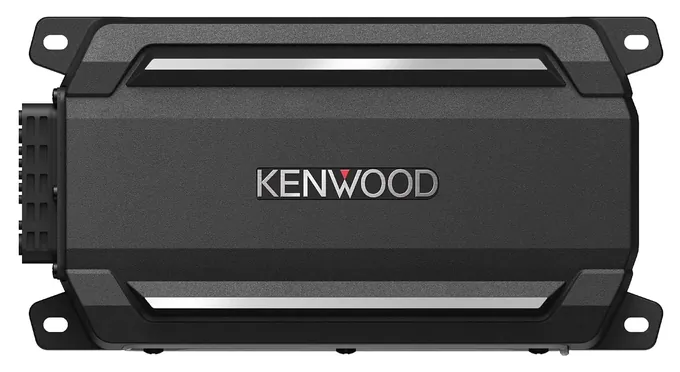
Why the Kenwood KAC-M5024BT is our top pick
Our pick wins on the two things that matter most for an open boat or trail rig: a standard power rating and real sealing. Its 50 watts per channel is published as a CTA-2006 value, continuous into 4 ohms at no more than 1% distortion,3 and the manual repeats that figure at 14.4 volts.1 Our runner-up, the Rockville ATV420 V2, claims 90 watts per channel at 4 ohms, but from its maker's own "dyno certified" test with no standard named.4
Sealing is the bigger gap. The KAC is rated IP67 and IP66, and its maker says it survives 30 minutes under about 3 feet of water,2 as long as the panel over its switches is screwed down.1 The runner-up is IP65, a hose-down rating, and its own safety text says not to expose it to any kind of moisture.4,6
Day to day, our pick's wired remote holds the Bluetooth antenna, a volume knob, seven EQ presets and a level control for its RCA output.1,2 The ATV420 ships with no remote,5 and its level knob is a gain setting, not a volume control.4 The runner-up does win on inputs: it takes RCA and speaker-level signals from a stereo,4 while the KAC's wiring page shows no input of any kind.1
| Kenwood KAC-M5024BT | Rockville ATV420 V2 | |
|---|---|---|
| Power per channel, 4 ohms | 50 W, CTA-2006 value | 90 W, maker's own test |
| Water and dust rating | IP67/IP66, 30 min under ~3 ft | IP65, water jets only |
| Controls | Wired remote: volume, EQ, RCA out level | None; gain set on the amp |
| Wired inputs | None, Bluetooth only | RCA and speaker level |
| Bluetooth | 5.0 with aptX and AAC | Not stated |
Sources
- Kenwood KAC-M5024BT 1Instruction manual, online copy, pp. 3, 6, 7, 10 2Product page 3CTA-2006 spec block (World Wide Stereo)
- Rockville ATV420 V2 4Owner's manual 5Product page
- 6IEC 60529 IP code reference (Netray)
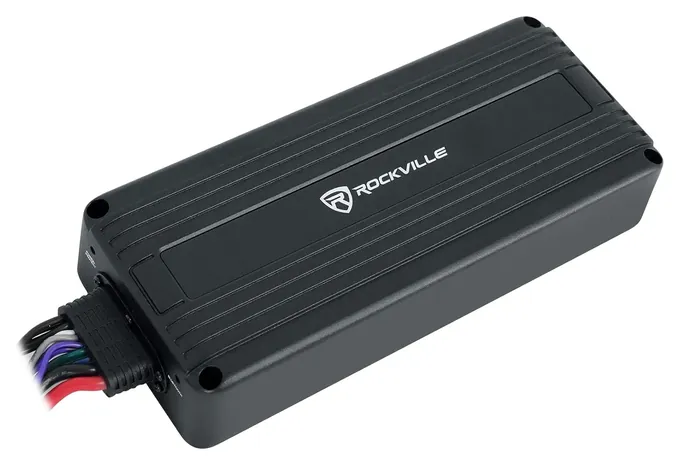
From the manual
- A Bluetooth connection overrides the RCA input; to hear the stereo again you must disconnect the phone. Bluetooth section
- Never run the remote lead straight to the battery: the amp stays on and drains it. Power connections
- With a factory radio, use the included speaker-level adapters and set the input voltage switch to high. Features
- Its safety text says to keep the unit away from moisture despite the IP65 rating, so mount it clear of standing water. Safety instructions
Compare the specs
Swipe the table sideways to see every column.
| Product | Channels | Power per channel, 4 ohms (W) | Power rated to | Water rating (IP code) | Wired inputs | Fuse (A) |
|---|---|---|---|---|---|---|
| 1. Kenwood KAC-M5024BT | 4 | 50 | CTA-2006, 1% distortion | IP67/IP66 | None | 40 |
| 2. Rockville ATV420 V2 | 4 | 90 | Maker test, <1% distortion | IP65 | RCA, speaker level | 50 |
| 3. Rockville PS20 | 2 | 90 | Maker test, <1% distortion | IP65 | RCA, speaker level | 30 |
| 4. Velex VX505 | 4 | 60 max, load not given | Not stated | IPX5 | RCA (AUX) | 15 |
| 5. DS18 NXL-N4BT | 4 | 100 | Not stated | IP67 | RCA | 25 |
| 6. Stetsom HL DSPlayer 400.4 | 4 | 70 | Maker lab, 10% distortion | None published | RCA, speaker, optical, USB | 25 |
| 7. Rockville Atom P20 | 4 | 70 | Maker test, <1% distortion | None published | RCA | 2 x 25 |
| 8. Rockville RXM8BTW | 8 | 65 | CEA, per its manual | None published | RCA | 80 |
Power figures are each maker's own, per channel at 4 ohms; only Kenwood's is published as a CTA-2006 value. Velex lists 60 watts per channel as a maximum, and its manual's power figures conflict. "None published" means neither the manual nor the maker's page gives an IP code.
Sources
- Kenwood KAC-M5024BT Instruction manual, online copy CTA-2006 spec block (World Wide Stereo)
- Rockville ATV420 V2 owner's manual PS20 owner's manual Atom P20/P30 owner's manual (PDF) RXM8BT owner's manual (PDF)
- Velex VX505 Instruction manual (PDF) Product page
- DS18 NXL-N4BT NXL-N owner's manual (PDF)
- Stetsom HL400.4 DSPLAYER user manual (PDF)
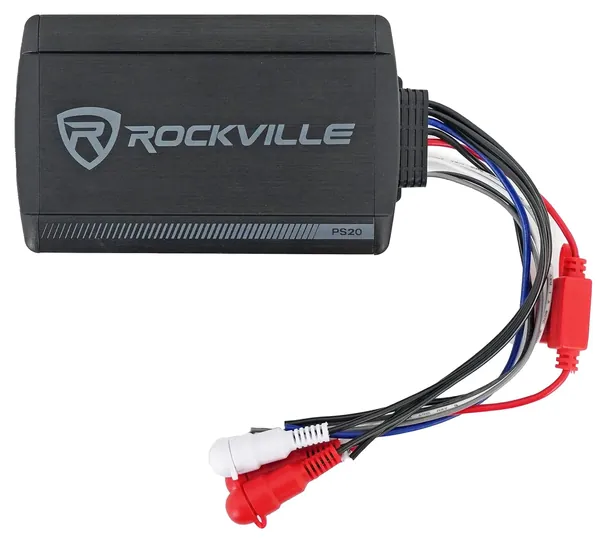
From the manual
- It can drive two or four speakers if no channel drops below 2 ohms, and RCA outputs can feed a second amp. Output configurations
- Speaker-level inputs switch the amp on when they sense a signal, so a factory radio needs no remote wire. High level inputs
- Put the silicone cover back over the control panel after adjusting it; it keeps water and dust out. Adjusting the system
- Bluetooth overrides the RCA input, and pairing works best with the phone within about 5 feet. Wireless streaming; troubleshooting
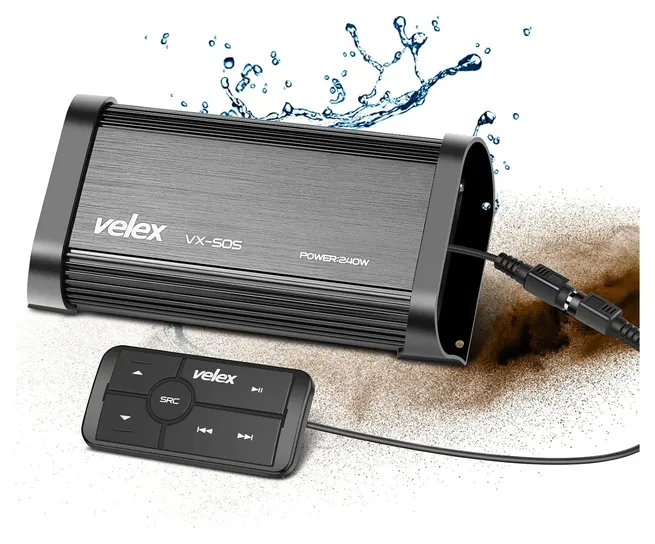
From the manual
- The USB port is labeled a 1-amp charging outlet, and the manual's operating steps cover only Bluetooth and the AUX input. pp. 3, 12
- The AUX input is a pair of RCA jacks, and a 3.5 mm adapter for a phone isn't included. p. 10
- It's weather resistant but must never be submerged, and mounting it with other hardware may void the warranty. p. 2
- Velex says to set the phone's Bluetooth volume to full and use the remote for volume. p. 9
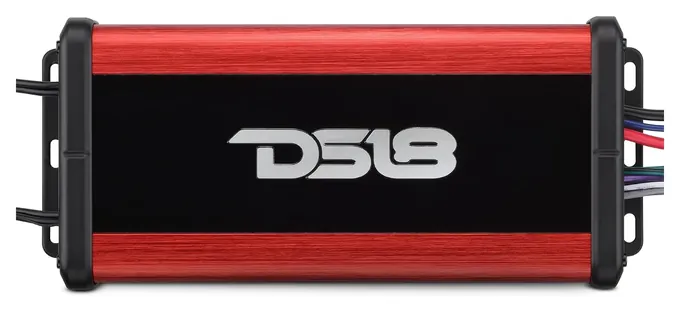
From the manual
- Despite the IP67 rating, DS18 advises a closed, ventilated compartment rather than an exposed spot. p. 5
- Even when it plays from Bluetooth, the remote turn-on wire still has to be connected. p. 6
- Bluetooth is version 5.1 with SBC and AAC but no aptX; the amp shows up as DS18 NXL-N4BT. p. 15
- It shuts down at about 85 C, and DS18 says some installs need an external fan. p. 17
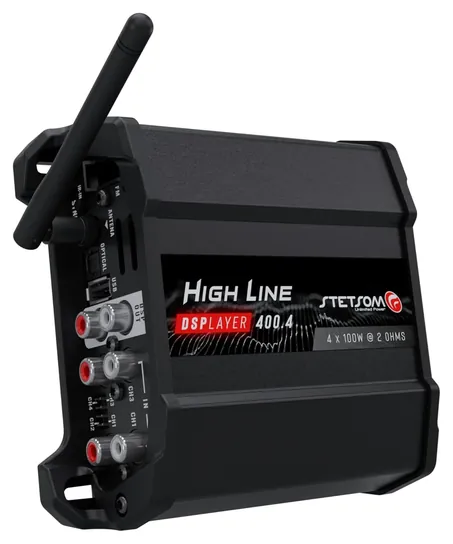
From the manual
- Its watt figures are measured at up to 10% distortion, ten times the 1% limit CTA-2006 uses. p. 58
- Fit a 25-amp fuse within 12 inches of the battery, with 9-gauge power and ground wire. p. 39
- The USB port plays MP3 files from drives up to 64 GB and must not be used to charge phones. p. 35
- The app needs Android 8 or iOS 14, and water damage voids the one-year warranty. pp. 44, 59
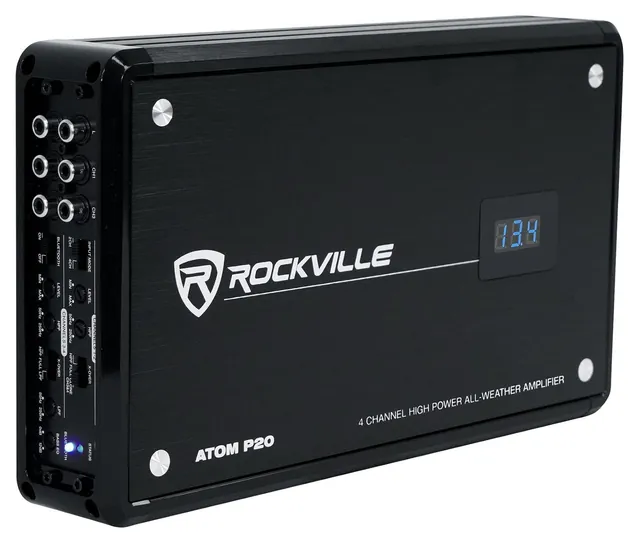
From the manual
- Bluetooth runs from a switch on the amp; to end streaming, disconnect the phone and set the switch to off. p. 14
- The bass boost adds up to 12 dB at 45 Hz, and Rockville warns it can blow small speakers. p. 15
- Use 8-gauge power and ground wire, with an inline fuse holder within 18 inches of the battery. p. 4
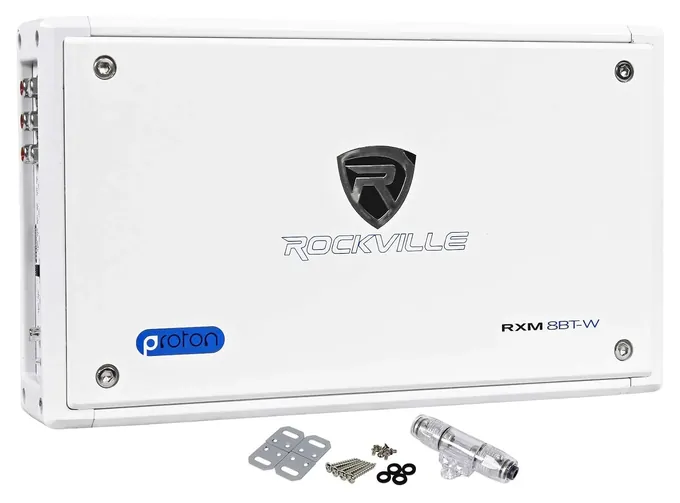
From the manual
- Rockville says not to mount it where rain or moisture can reach it, or in an engine compartment. p. 1
- It takes one 80-amp fuse and needs power wire of at least 8 gauge run straight to the battery. pp. 2, 3
- A button on the panel turns Bluetooth on or off, and the amp pairs as Rockville BT. p. 4
Rockville RXM8BT owner's manual, covers the white RXM8BTW (PDF)
Editor's Notes
November 4, 2026, by Ezvid Wiki Editors:
We read the manuals for all eight picks and added a spec table, a section on why the Kenwood leads, and manual notes for each amp. We corrected the Velex VX505's USB port and water rating, the claim that the Rockville PS20 can't grow past two speakers, and the RXM8BTW's rating label, and fixed an FAQ answer that called IPX5 splash resistance.
October 15, 2026, by Ezvid Wiki Editors:
Most people who land here want to play music from a phone on a bike, boat, UTV or old car with no stereo in the dash, so we rebuilt the list around amps with Bluetooth built in. The Kenwood KAC-M5024BT takes over from its discontinued predecessor, partly because Kenwood is one of the few makers that publishes a CTA-2006 power rating. JVC sells the same amp as the KS-DR2104DBT. New picks include two Rockville micro amps, the Velex VX505, the DS18 NXL-N4BT and the app-driven Stetsom HL DSPlayer 400.4.
The old Kenwood and the Kicker are no longer available, the Pyle Hydra is only sold refurbished and has no Bluetooth, and Velex replaced its VX-502 with the VX505. We couldn't confirm the Massive Audio TX48's power claims. The four small boards that used to round out the list are home-audio amps, not car amps, so they're gone too.
Independent bench tests of these amps are scarce, so we went by makers' spec sheets and power ratings, owner reports on Bluetooth connections and early failures, and recall checks. Watch the wattage on the box: the big number is a peak claim, and the smaller per-channel RMS figure is the one to compare.
Earlier notes
April 20, 2021, by Luke Mitchell:
One of the primary benefits of owning a Bluetooth-enabled amplifier is the fact that you don't need a compatible head unit in order to stream music from a Bluetooth-enabled device, bypassing all the unnecessary functionality along the way. This is particularly useful onboard boats, in trailers, ATVs, and other vehicles that may not have a dedicated stereo built-in.
Many of those ranked here, including the Kenwood Compact Automotive Amplifier, Velex Water Resistant Amplifier, and the Massive Audio TX48 Trident, have the extra benefit of being waterproof, making them extra-resilient when used in exposed environments, such as marine applications and outdoor sports. This feature also makes these amps a popular addition to golf carts, especially given their small size. [2026 update: of today's picks, only the Kenwood KAC-M5024BT and the DS18 NXL-N4BT are rated for brief submersion; the Velex VX505 is rated for water jets, and its manual says never to submerge it.]
When choosing a suitable amplifier, you should be sure that it matches the capabilities of your speakers, and that they are not underpowered enough that your amp is overdriven to the point of clipping. It is also useful to check that it is CEA 2006 compliant, to ensure that the manufacturer isn't making bold and unsubstantiated claims with regard to their power output. When sizing up your amp, prioritize the RMS (root mean square) rating over peak power output, as this is a better indicator of true power at safe operating levels, and is the rating usually considered by industry professionals.
Another thing to take into account is the number of channels you need, and this is determined by the number of speakers you have, and how you have them configured. smaller units, such as the Dutison Mini Audio Amplifier, have just two channels, meaning they are only able to power two speakers or one subwoofer. If you wish to power two drivers and a subwoofer, then a minimum 3 channel amplifier is required. As a general rule, the more channels you have, the more expensive the unit, and the larger it is, so these are also important considerations when buying the ideal Bluetooth amplifier to suit your requirements.
March 27, 2020, by Brendon Hannaford:
The situations in which someone will desire an amplifier that features Bluetooth capability are quite varied, so we've included a wide range of models on our list best suited to several common predicaments.
If you're trying to add Bluetooth to a high-fidelity, high-volume speaker system you're going to want to look at the higher-end models on our list, such as the Kenwood Compact Automotive Amplifier, Infinity K5, and Rockville RXM. They are all on the more expensive side, but they also generally offer a significantly larger amount of RMS watts per a speaker, which is absolutely essential for those trying to drive multichannel systems or large subwoofers at loud volumes while maintaining quality. They're generally design to go between speakers and an existing stereo head unit, but if you're alright with having limited inputs they'll also work by themselves.
Items like the Velex Water Resistant Amplifier and Kicker Bluetooth Amplifier are good for people trying to avoid the use of a dedicated car stereo altogether since they feature things like 3.5-millimeter auxiliary inputs and remotes with transport and volume controls. However, it should be noted that the latter item is a 2-channel unit.
If you want a significantly lower cost, you'll appreciate items like the Dutison Mini Audio Amplifier or Nobsound Lepy, which can simply be mounted to a dashboard or in a more discreet location with just a few screws. These options represent a very affordable way to easily add Bluetooth functionality to an older car, but they won't produce the cleanest aesthetic, and their quality and loudness is definitely lesser than more expensive units.
No matter what item you choose, be aware that most do not come with mounting hardware, speaker wire, or tools, so you will most likely have to provide these things as well as a bit of know-how in order to use them effectively. [2026 update: the current Velex VX505 takes a wired source through RCA jacks, with no 3.5-millimeter adapter in the box. Plan on buying wire and an inline fuse too; Kenwood's and Velex's manuals both list that fuse as not included.]
Real Power Versus The Number On The Box
Almost every amp here has two power numbers, and only one means much.
Almost every amp here has two power numbers, and only one means much. The CTA-2006 standard, formerly CEA-2006, measures continuous power at 14.4 volts into a stated load with no more than 1% distortion (CTA). Compliance is voluntary, and "max" or "peak" watts have no standard definition at all, so makers can print almost anything (Best Car Audio; MTX).
Kenwood's KAC-M5024BT shows the gap: 50 watts per channel as a CTA-2006 value (World Wide Stereo), 600 watts on the box (Kenwood). Rockville's "dyno-certified" ratings for the ATV420 V2, PS20 and Atom P20 come from its own test, and the headline numbers are quoted at 2 ohms, which gives bigger figures than the 4-ohm speakers most people own. The eight-channel RXM8BT is the exception: its manual labels a 4-ohm rating "CEA Rated" (Rockville). DS18 quotes 100 watts per channel at 4 ohms but doesn't claim CTA-2006 (DS18), and Stetsom's manual says its figures allow up to 10% distortion (Stetsom).
Independent bench measurements are scarce for amps this small. When comparing, use the 4-ohm, per-channel figure, and treat anything without a distortion limit as a claim.
Channels, Subwoofers And Controls
Count your speakers first. A two-channel amp drives one pair, a four-channel amp drives two pairs, and eight channels suit big boat systems. Bridging joins two channels into one stronger output, so a four-channel amp can run two speakers, or a small subwoofer, with more power. Kenwood, for example, lists 150 watts per side bridged from a 50-watt-per-channel amp (Kenwood).
None of these is a dedicated subwoofer amp. For real bass, look for a preamp or line output to feed a separate sub amp: Kenwood's and JVC's twin amps have one (JVC), and so do the Stetsom, the PS20, the Atom P20 and the eight-channel Rockville.
Bluetooth in these amps is for music only. They stream over the A2DP profile, and none lists a microphone for calls. Think about volume, too. Some amps leave it to your phone, which is awkward in gloves or on a bumpy trail. A wired remote with a knob, or an app with saved settings, is easier to live with.
Weather Sealing And Safe Wiring
Check the IP code, not the word "marine." The first digit covers dust, where 6 means dust-tight, and the second covers water (IEC). IPX5 means water jets, IPX6 powerful jets, and IPX7 brief submersion, which Kenwood defines as 30 minutes at about 3 feet. An IP65 micro amp is fine for a hose-down but shouldn't sit in a flooded bilge, and an amp with no rating belongs inside the cabin or trunk. Remotes and harness plugs are often the weak points, so mount them out of standing water.
Wire the amp to its manual. The manuals here call for an inline fuse on the power cable close to the battery and a ground wire as heavy as the power wire, run to bare chassis metal (Kenwood; Rockville). Kenwood specifies a 40-amp fuse for its amp, and DS18 calls for 8-gauge wire and a 25-amp fuse. We found no amplifier recalls for any brand on this list in the U.S. Consumer Product Safety Commission database.
How we researched this
We compared about 20 Bluetooth car and marine amplifiers and kept eight. For those eight we read Kenwood's KAC-M5024BT instruction manual, Rockville's owner's manuals for the ATV420 V2, PS20, Atom P20 and RXM8BT, the Velex VX505 instruction manual, DS18's NXL-N owner's manual and Stetsom's HL400.4 DSPLAYER manual, checked them against each maker's spec page, and compared the power ratings with the CTA-2006 amplifier standard. A search of the U.S. Consumer Product Safety Commission's recall database on November 4, 2026 found no amplifier recalls for any of these brands.
Sources (19)
- Kenwood KAC-M5024BT specifications
- JVC KS-DR2104DBT specifications
- DS18 NXL-N4BT
- CTA-2006-D: testing and measurement methods for in-vehicle audio amplifiers
- Best Car Audio: why amps have max power ratings
- MTX: car amplifier ratings
- IEC: IP ratings
- CPSC recalls
- Kenwood KAC-M5024BT instruction manual (online copy)
- World Wide Stereo: Kenwood KAC-M5024BT CTA-2006 specifications
- Rockville ATV420 V2 owner's manual
- Rockville PS20 owner's manual
- Rockville Atom P20/P30 owner's manual (PDF)
- Rockville RXM8BT owner's manual (PDF)
- Velex VX505 instruction manual (PDF)
- Velex VX505 product page
- DS18 NXL-N owner's manual (PDF)
- Stetsom HL400.4 DSPLAYER user manual (PDF)
- IEC 60529 IP code reference
Frequently asked questions
What is the best car amplifier with Bluetooth?
The Kenwood KAC-M5024BT, because its 50-watt-per-channel rating follows the CTA-2006 standard, it's sealed to IP67, and its waterproof remote has a real volume knob. JVC sells the same amp as the KS-DR2104DBT.
Do I need a head unit with a Bluetooth amplifier?
No. These amps receive music from your phone directly, and you set the volume from the phone, a remote or an app. Most also accept a wired stereo, though the Kenwood KAC-M5024BT has no RCA inputs.
Can a Bluetooth amp power a subwoofer?
A four-channel amp bridged to two channels can drive a small sub. For more bass, use the amp's preamp or processor output to feed a separate subwoofer amp.
Are Bluetooth marine amps waterproof?
Only some. IP67 amps such as the Kenwood KAC-M5024BT and DS18 NXL-N4BT survive brief submersion. IP65 and IPX5 both mean water jets, fine for a hose-down but not for sitting in water, and an amp with no rating belongs in the cabin or trunk.
What size fuse does a Bluetooth amp need?
Use the fuse and wire gauge in the amp's manual, and put the fuse on the power cable near the battery. Kenwood specifies 40 amps for the KAC-M5024BT; DS18 specifies 25 amps and 8-gauge wire for the NXL-N4BT.
Can I take phone calls through a Bluetooth amplifier?
No. None of these lists a microphone or a hands-free calling profile; they stream music only, so calls stay on your phone or helmet headset.