The 9 Best Forehead Thermometers
Updated by · How we research

No-touch infrared and temporal-artery scanners compared on accuracy evidence, aiming aids and memory. The iHealth PT3 leads for simple, silent readings at home. When users buy our independently chosen editorial picks, we may earn commissions to help fund the Wiki.
A forehead reading is the gentlest way to check a fever, but it isn't the most exact: rectal, oral and ear readings all beat it, and pediatric advice still calls for a rectal check in babies under three months. These models suit quick checks on a sleeping child, a sick partner or a busy household, with a recheck when a number looks borderline.


Editor's Notes
October 27, 2026, by Ezvid Wiki Admin:
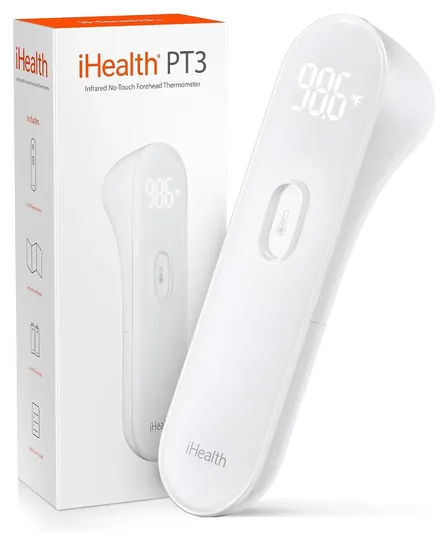
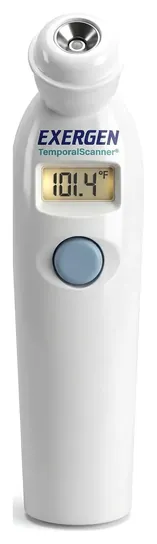
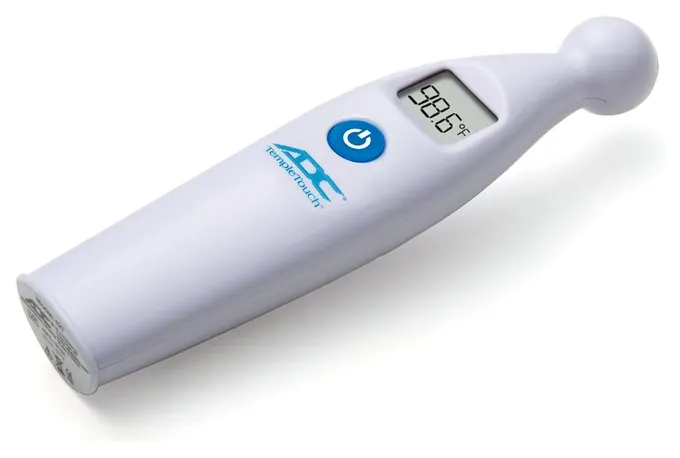
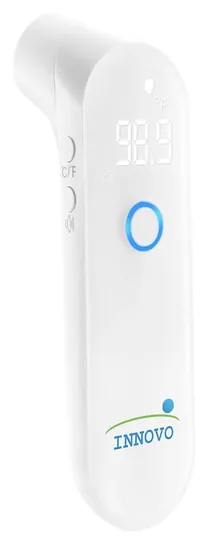
The biggest change here is the arrival of contact scanners. The Exergen TAT-2000C+ and the ADC Adtemp 427 read heat at the temple by touch, and an Australian hospital study found that contact scanners caught fevers no-touch devices missed, though Exergen is the one publicizing it. The iHealth PT3 still leads, because it is simple, silent and cheap, and the Innovo iF100B stays for its aiming light. Five older picks are gone because they're unavailable or no longer sold: the Equinox International Infrared, Novone AET-R1D1, Gekka Non-Contact, Preve Clinical and LPow R1B1. No lab has ranked these models side by side, so we weighed published tolerances against the FDA's advice on infrared thermometers and Seattle Children's guidance on taking a child's temperature.
June 18, 2021:
Most of our previous selections were no longer available, so there's a host of great new offerings. The iHealth PT3 is the simplest and one of the most trusted, although the Innovo iF100B is right there with it. The Equinox International Infrared sports clearly labeled controls and a large, easy-to-read LCD, as does the pistol-grip LPow R1B1. We also really like the Gekka Non-Contact. You can mount it to the wall with a rechargeable 18650 battery in it, and let it take everyone's temperature safely as they walk into the room, without anyone ever laying a finger on it.
December 31, 2019:
The Dr. Madre Digital Infrared joins the selection today, and this lightweight model boasts an ergonomic, curved design that makes it comfortable in the hand. In addition to showing the results on a bright, backlit LCD, it can also be programmed to read them aloud to you in English or Spanish, which makes it handy for anyone who is visually impaired. Like some others on our list, this one features infrared technology, which enables you to take readings without even having to touch it to one’s forehead.
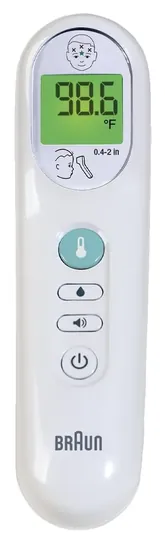
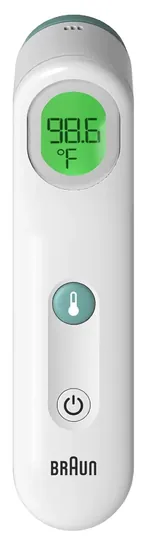
Another new addition is the Braun FHT1000, which offers a lightweight design with a user-friendly, 2-button operation. If you haven’t needed to use it in a while and have forgotten exactly how it works, just take a look at the step-by-step instructions listed right on its front panel (which really comes in handy at times when a child’s fever has come on quickly). For storage purposes, just pop on the protective cap and place it in your medicine cabinet or in a drawer. It’s a good value but there's one caveat: It only provides readings in Fahrenheit, not Celsius.
For the versatility of a model that can provide readings from either the forehead or the ear, look to the QQcute Digital and the Innovo Dual-mode, both of which feature caps that can be removed to reveal the ear insertion piece. For more models designed for ear placement (some of which even conveniently sync with your smartphone for easy data management), see our list of best ear thermometers.
Before using any of these thermometers, be sure to familiarize yourself with proper operation techniques to ensure you’re using them correctly. For instance, the no-touch infrared models need to be positioned within a certain distance of your child’s forehead for accurate results. Also, be sure you’re using the correct mode for your purposes, as many models offer separate modes for checking body temperature and room/liquid temperatures.
No-Touch Or Contact: Two Ways To Read A Forehead
A no-touch model is quicker to learn; a contact scanner rewards practice.
Most models sold as forehead thermometers are no-touch infrared units. You hold one a short distance from the middle of the forehead, press a button and get a number in a second or two. The iHealth PT3, for example, is meant to be held about 3 centimeters (1.2 inches) away and uses a distance sensor to steady the reading. Because they never touch the skin, they suit a sleeping child or a room full of people.
Contact models take a different route. The Exergen TemporalScanner is swept across the forehead to the hairline and then touched behind the ear, reading the heat of the temporal artery, and it adjusts for the temperature of the room. The ADC Adtemp 427 rests a flat tip on the temple for about six seconds, and ADC says it meets the ASTM E1112 accuracy standard for spot-check electronic thermometers.
The trade-off is technique against accuracy. In a 2020 study of 265 hospital patients in Australia, the no-touch devices missed most of the fevers that a contact temporal scanner picked up (HPN). That is one hospital study, reported with Exergen's help, so treat it as a strong hint rather than a verdict. A no-touch model is quicker to learn; a contact scanner rewards practice.
How Accurate Is A Forehead Reading?
Less accurate than the alternatives, but good enough for a first check. Rectal readings are the reference, and oral and ear readings also come closer to core temperature than forehead ones. A 2020 study summarized by Medical News Today found forehead and ear results in the same patients could differ by about 2 degrees Celsius. A systematic review of no-touch devices in children found they flag fevers well but also raise false alarms, and it advised against them for babies under three months.
Seattle Children's counts a fever as 100.4 F (38 C) or higher on a rectal, forehead or ear reading. It says forehead and no-touch thermometers are fine at any age, but rectal is the most accurate, and for babies under three months it suggests confirming a fever rectally. Forehead strips aren't reliable at all.
Be wary of the words on the box. The FDA regulates clinical thermometers, but in June 2025 it exempted certain electronic models from premarket notification, so "FDA registered" says little about how well a specific model reads. A published tolerance, such as plus or minus 0.2 C, is more useful, and the iHealth, ADC and Braun models list one.
Getting A Good Reading At Home
Most bad forehead readings come from the setting, not the device. The FDA advises letting the thermometer sit in the room where you'll use it for 10 to 30 minutes, using it between about 61 and 104 F, and keeping it away from drafts, sunlight and heaters. The forehead should be clean, dry and uncovered: no hat, headband, hair or sweat. Hold a no-touch model straight at the forehead at the distance the maker gives, keep it still and don't touch the sensor.
Someone who just came in from the cold or climbed out from under a heavy blanket needs time to settle. Goodbaby, for instance, asks for a 10-minute wait and 10 seconds between readings. With a temporal scanner, follow Exergen's technique: start in the center of the forehead, sweep to the hairline, then touch behind the ear; if the person is sweating, use the soft spot on the neck below the earlobe.
Take two or three readings and trust the pattern, not a single number. If a forehead reading is borderline or the patient is a young baby, check again with a rectal or ear thermometer. Wipe the sensor with a damp cloth or an alcohol pad, never submerge the unit, and swap batteries at the first low-battery warning, because weak cells can skew results.
How we researched this
We compared 18 forehead thermometers, read the makers' specifications and support pages for the 9 finalists, weighed hospital studies and pediatric guidance on forehead accuracy, analyzed owner feedback patterns, and checked U.S. and Canadian recall notices. No lab test ranks these models against one another, so the accuracy figures shown are the makers' own.
Sources (11)
- iHealth: PT3 accuracy and use FAQ
- iHealth Europe: PT3 product page
- Exergen: TAT-2000C temporal artery thermometer
- ADC: Adtemp 427 Temple Touch
- Braun Healthcare: No Touch thermometer
- FDA: Non-contact infrared thermometers
- Seattle Children's: How to take the temperature
- Medical News Today: Forehead thermometer accuracy
- HPN: Study comparing no-touch and temporal artery thermometers
- Koc University: Systematic review of no-touch thermometers in children
- Popular Science: Best thermometers
Frequently asked questions
Are forehead thermometers accurate?
They're accurate enough for a quick check, but less exact than rectal, oral or ear readings. Contact temporal scanners have done better than no-touch models in hospital research. Recheck a borderline result another way.
Is an ear or forehead thermometer better?
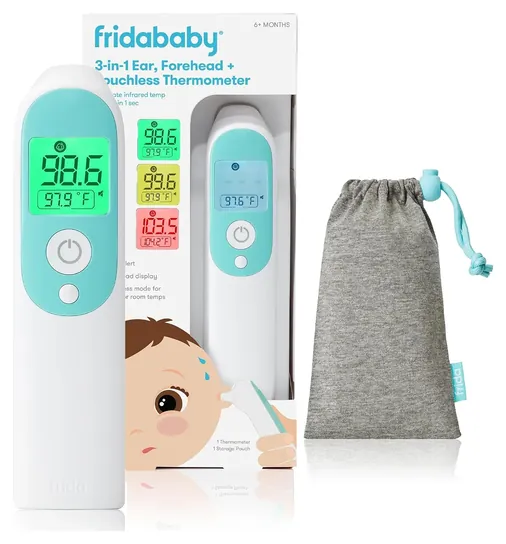
An ear reading is usually closer to core temperature once a child is past six months, if the probe is placed well. A forehead model is gentler and works on a sleeping child. Some models, such as the Frida 3-in-1, do both.
Can I use a forehead thermometer on a newborn?
You can, but for babies under three months, pediatric advice is to confirm any fever with a rectal reading, because a missed fever at that age is serious. Call a doctor for any fever of 100.4 F or higher in a newborn.
What temperature counts as a fever?
Seattle Children's uses 100.4 F (38 C) or higher on a rectal, forehead or ear reading.
Why do I get different readings in a row?
Distance, angle, sweat, hair and room temperature all shift a forehead reading. Let the person and the thermometer settle in the same room, hold it steady at the maker's distance, and wait a few seconds between readings.
How do I use a forehead thermometer correctly?
Aim at the center of a clean, dry forehead, just above the eyebrows, at the distance in the manual. For a temporal scanner, sweep to the hairline and then touch behind the ear.