The 5 Best Jam Pans
Updated by · How we research

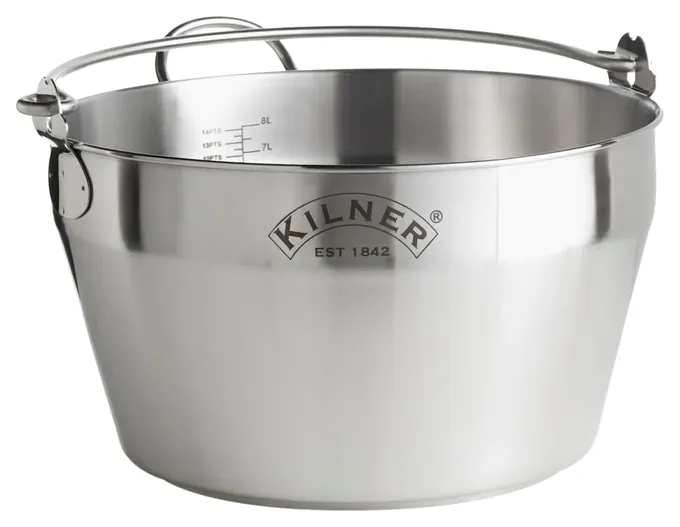
A wide, flared pan lets jam set before it scorches. Five stainless maslin and preserving pans compared by capacity, base and induction use; Kilner 8-Liter wins. When users buy our independently chosen editorial choices, we may earn commissions to help fund the Wiki.
A jam pan, also called a maslin or preserving pan, is a wide, flared pot built to boil fruit and sugar fast, so jam sets before it scorches. Home cooks and gardeners use one for jam, marmalade and chutney. Models differ in capacity, base thickness, induction support, handles, pouring spouts and the measuring marks inside.


Editor's Notes
October 19, 2026, by Ezvid Wiki Admin:
Only two of the old pans keep a place in the main ranking. The Demeyere Resto, Kilner Enamel, CucinaPro Maslin, Ball Freshtech and Pendeford pans are no longer available, the Matfer Bourgeat shows no price, and the Kitchen Craft Mini Maslin now costs more than its big sibling. The Mauviel copper pan moves to our special honors, because the sizes most home cooks want are sold by Mauviel itself.
Both are stainless favorites: the Kilner 8-Liter, which is what most readers come looking for, and the KitchenCraft Home Made, still the classic maslin pan with a spout and helper handle. New picks add a well-priced American option in the McSunley Prep-N-Cook and two small-batch pans from Penguin Home.
We stopped at five. Everything else we found was a little-known import with a thin record, another size of a pan already here, or a canner rather than a jam pan. No lab tests of jam pans turned up, so we read makers' pages and preserving guides, weighed owner reports and searched recall records.
August 17, 2020:
We have reevaluated our selections based on usability, durability, and price, ultimately adding the diminutive Kitchen Craft Mini Maslin for those who do not have ample storage space. At 4.5 liters, it helps you create modestly-sized batches, then tucks away neatly in a small cabinet. The Pendeford Ancillary Range, while a touch larger, is also a good choice for those with space constraints. Both are made well, but neither has a spout, which will be a dealbreaker for some users.
As for larger choices, the 10.6-quart Demeyere Resto still comes out on top, not only because it's durable, but also because it comes with a lid, whereas most do not. The Kitchen Craft Stainless Steel is a good alternative, especially for the price-conscious. If it's not the budget you're worried about, but the amount of work you have to put in, consider instead the Ball Freshtech. It takes much of the hassle out of making jams and jellies, although you'll still have to prepare your canning jars and place the finished product into them.
Finally, we kept two copper choices, the Mauviel M'Passion and the Matfer Bourgeat, neither of which has a lining to prevent the copper from leaching into your finished product. Ingesting too much of this metal can be harmful, but there has been little concrete investigation into how much copper is actually leached into jam when cooked in a copper pot. Most agree that the amount is probably miniscule, and people generally don't eat enough jam for this to be concerning. Nevertheless, if you're the type to worry about such things, you may want to skip these.
November 12, 2018:
Selected the Demeyere Resto and Kilner 8.5 Quart as top selections for a wide range of individuals, from casual cooks to those who are accomplished jam makers. Investigated and added copper models, including the Mauviel and Matfer models, despite claims that cooking jam in these pans leads to ingestion of the metal, as the concrete evidence to support this assertion is lacking.
Special Honors
Mauviel M'Passion Copper Jam Pan Mauviel, a French cookware maker founded in 1830, sells its M'Passion copper jam pans directly in the U.S. The smooth version with brass handles comes in 6.6, 9.4 and 14.4 quarts, and a hammered version comes in 9.4, 14.4 and 17.3 quarts. The copper is 1.2 millimeters thick and unlined, so the maker reserves it for jam and sugar work and says to wash it by hand. It reacts quickly to heat changes, doesn't work on induction and costs several times as much as a good stainless pan. mauviel-usa.com
Size, Shape And Base: What Makes A Jam Pan Work
Thin, light pans heat fast but scorch more easily, so they need steady stirring.
A jam pan is wide and fairly shallow, with sides that flare out. That shape gives the boiling fruit a big surface, so water steams off quickly and the jam reaches its setting point before the sugar darkens or the fruit loses its color (Sous Chef). Width matters more than depth: a tall stockpot holds plenty but thickens jam slowly (Chef's Pick).
For a normal home batch, U.K. buying guides point to 8 to 9 liters, and you should fill the pan no more than half to two-thirds full, because jam foams and can nearly double in volume at a rolling boil (Cookware360). A 4.5- to 5-liter pan suits one small batch. Note the units: a 9-quart pan holds about 8.5 liters.
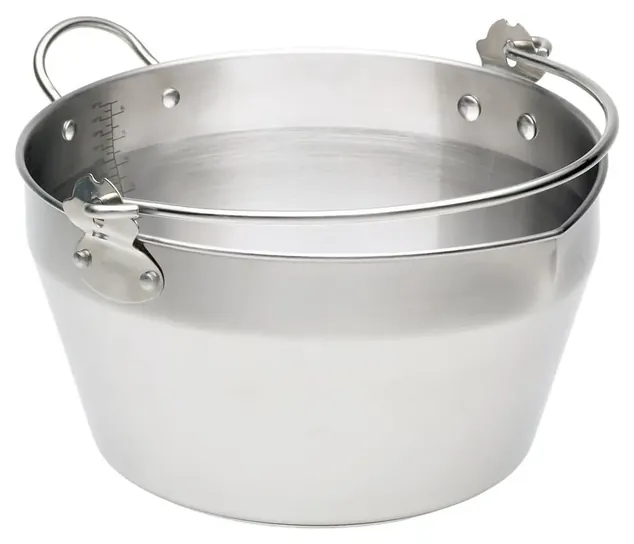
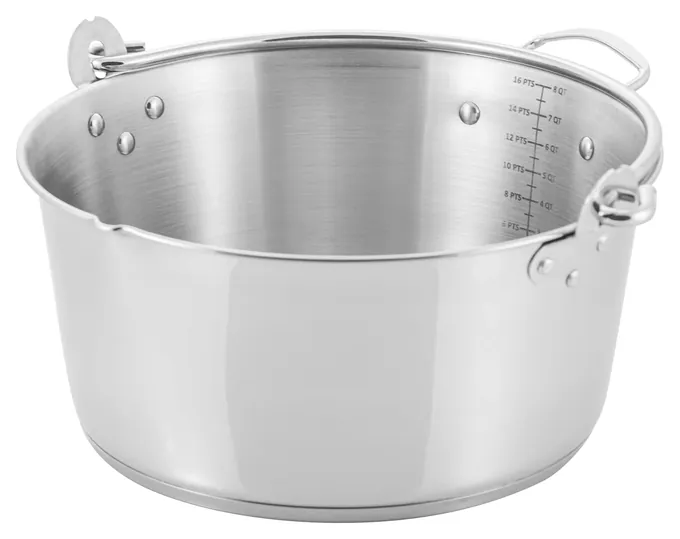
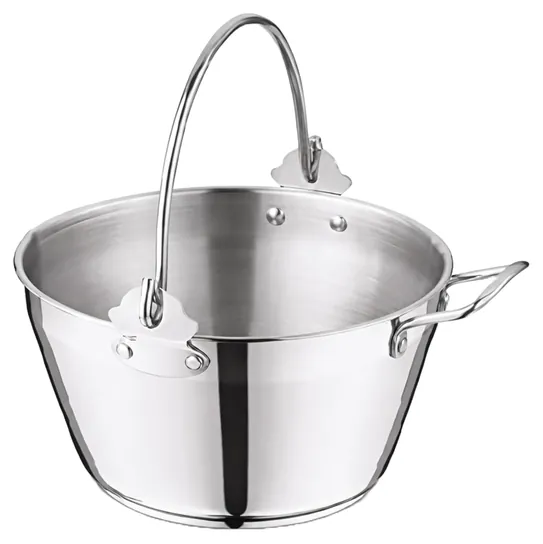
The base decides how often you'll scrape burnt sugar off the bottom. An encapsulated base, a disc of aluminum or copper sealed under the stainless steel, spreads heat evenly and is also what lets a stainless pan work on induction. Thin, light pans heat fast but scorch more easily, so they need steady stirring. Most maslin pans add a bail handle that folds over the top, a small helper handle for pouring, a spout and a liter or pint gauge inside, and those features are the real reason to buy one.
Stainless, Copper Or A Pot You Already Own
Stainless steel is the safe default. It doesn't react with acidic fruit or vinegar, it goes in the dishwasher on most models, and it handles chutney as well as jam (Penguin Home). Enameled steel is also non-reactive, though the enamel jam pans that used to be common are hard to find now.
Copper is the traditional French choice because it responds quickly to changes in heat. Unlined copper reacts with acid, so Mauviel says its M'Passion jam pans are for jam and sugar work only, and that the sugar protects the metal (Mauviel FAQ). Retailers advise mixing fruit with sugar before it touches the copper, never using it for vinegar-heavy chutney, and washing it by hand. Copper doesn't work on induction (Cookware360).
Nonstick jam pans are rare from established makers, and a coated surface is a poor match for long boils of sugar and metal spoons. Avoid unlined aluminum or cast iron too, since they can react with acidic fruit.
You don't strictly need a jam pan. Any wide, heavy, non-reactive pot works, including an enameled cast iron Dutch oven (Chef's Pick). A dedicated pan earns its place if you make several batches a year and want the spout, handles and gauge.
From Pan To Jar: Cooking And Canning Safely
Warm the fruit and sugar gently until the sugar has fully dissolved, then turn up the heat for a hard boil. Skimming, or stirring in a small knob of butter, cuts down the foam. Keep the pan on a back burner when you can, use the helper handle when you pour, and keep children well away: boiling sugar syrup is much hotter than boiling water and sticks to skin.
The jam pan only cooks the jam. For shelf-stable jars, the National Center for Home Food Preservation says to fill hot jam into sterilized canning jars, leave 1/4 inch of headspace, use self-sealing lids and process the jars for 5 minutes in a boiling-water canner, adding 1 minute for every 1,000 feet of altitude (NCHFP). A large, deep pot with a lid can stand in for a canner, as long as water covers the jars by an inch or more.
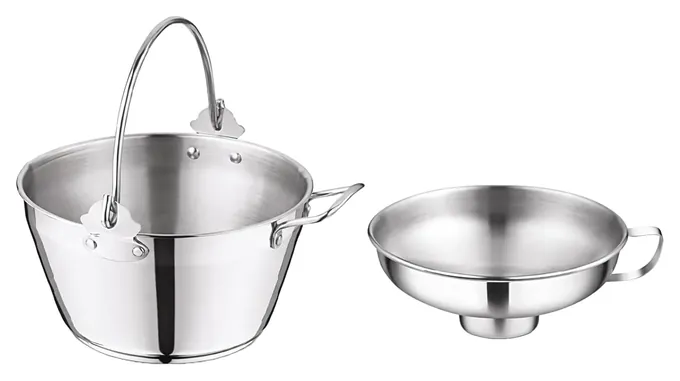
Sugar does part of the preserving, so reduced-sugar jams need tested recipes and pectins made for them rather than standard timings (NCHFP). A wide funnel keeps jar rims clean, which helps the lids seal.
How we researched this
We compared 24 jam pan listings, including every pick from the previous version of this page, read the makers' product pages for Kilner, Penguin Home and Mauviel, retailer spec pages, U.K. buying guides and the National Center for Home Food Preservation's canning guidance, analyzed owner feedback, and checked every brand for recalls with the U.S. Consumer Product Safety Commission. We found no independent lab tests of jam pans.
Sources (10)
- Kilner: Stainless Steel Preserving Pan 8 Litre (0025.413)
- Penguin Home: Stainless Steel Maslin Jam Pan
- Mauviel USA: M'Passion Copper Jam Pan With Brass Handles
- Mauviel: frequently asked questions
- Sous Chef: What is a copper jam pan?
- Chef's Pick: Do you need a preserving pan?
- Cookware360: Best preserving pans UK
- National Center for Home Food Preservation: canning jams and jellies
- National Center for Home Food Preservation: plum jam with pectin
- U.S. Consumer Product Safety Commission: SaferProducts.gov
Frequently asked questions
What's the difference between a maslin pan, a preserving pan and a jam pan?
Nothing. They're three names for the same wide, flared pot. Maslin pan and preserving pan are the usual British terms, and jam pan or jam kettle is more common in the U.S.
Do I need a jam pan to make jam?
No. Any wide, heavy, non-reactive pot works, such as a large stainless pot or an enameled Dutch oven. A jam pan adds a spout, a bail handle and measuring marks, and its width speeds up thickening.
Can I use a jam pan on an induction cooktop?
Stainless pans with an encapsulated base usually work on induction, and Kilner, KitchenCraft, McSunley and Penguin Home all say theirs do. Unlined copper pans don't work on induction.
How full should I fill a jam pan?
No more than half to two-thirds full. Jam foams up and can nearly double in volume at a rolling boil, so overfilling risks a dangerous boil-over.
Is a copper jam pan safe?
Makers say unlined copper is fine for jam because the sugar protects the metal, and they advise mixing fruit with sugar before it goes in. Don't use bare copper for vinegar-heavy chutney or other acidic, low-sugar cooking.
Does a jam pan seal the jars?
No. It only cooks the jam. For shelf-stable jars, process them in a boiling-water canner, 5 minutes at sea level plus 1 minute per 1,000 feet of altitude, per the National Center for Home Food Preservation.