The 9 Best Marine Fuel Tanks
Updated by · How we research

Portable and built-in boat fuel tanks compared on size, venting, fume rules and fit. The Scepter 6 Gallon is the pick for most small outboards. When users buy our independently chosen editorial selections, we may earn commissions to help fund the Wiki.
A boat fuel tank alone won't run an outboard: you also need a hose with a primer bulb and a connector made for your engine's brand. New portable tanks must meet federal limits on fumes seeping through the plastic, so look for the EPA label. These picks suit owners replacing a portable tank or an old built-in one.


Editor's Notes
November 1, 2026, by Ezvid Wiki Editors:
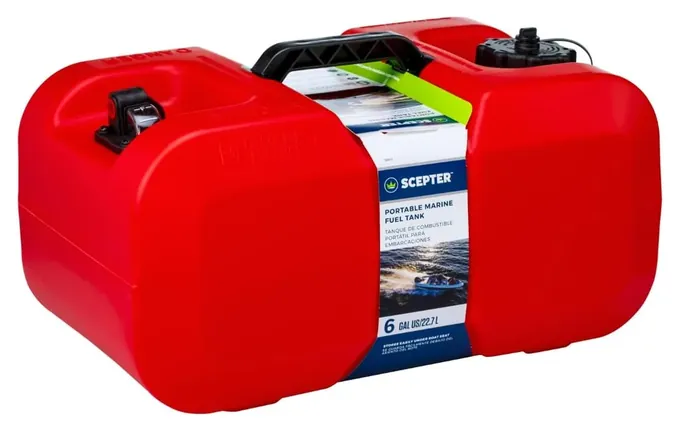
The Scepter 6 Gallon now leads this list. Six gallons is what most small outboards run on, it has a gauge built into the pickup, and it meets federal fume rules for portable tanks. The page now covers both the portable tanks most boaters carry and a few built-in ones.
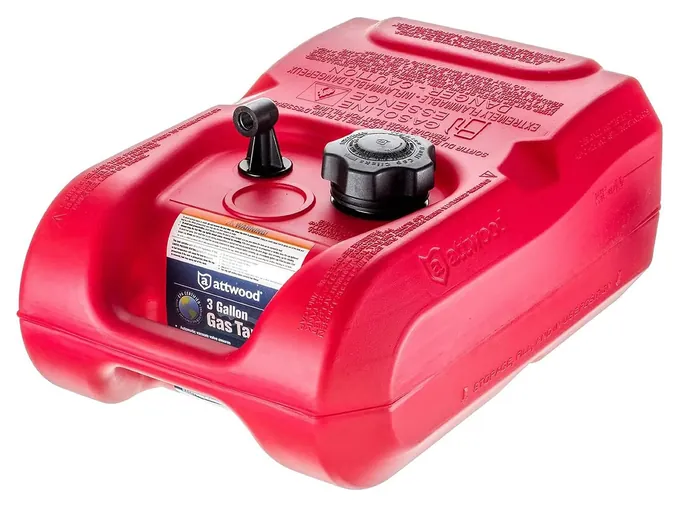
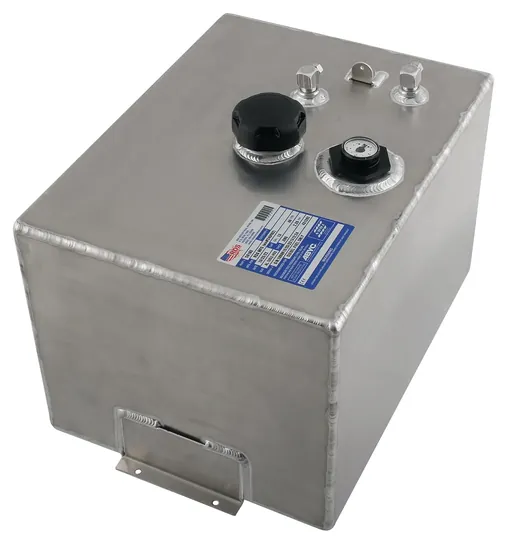
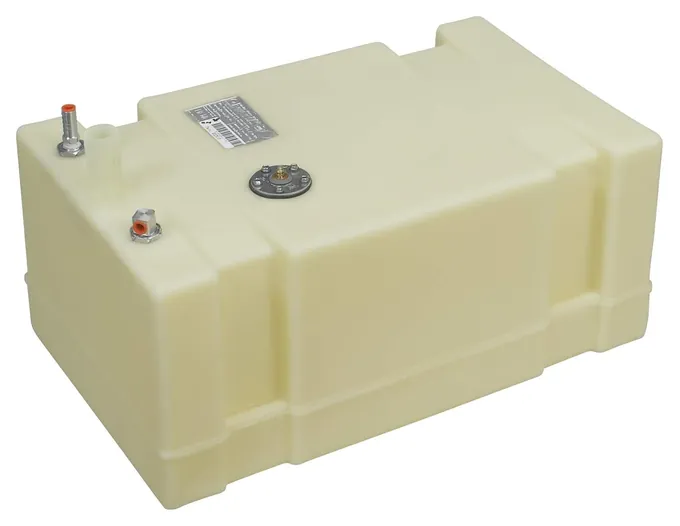
Only two old picks survived unchanged. The Five Oceans 6 Gallon is gone, and the old Attwood 12 Gallon listing now sells a three-gallon tank. We dropped the Scepter Marine OEM, a small tank the Attwood 3 Gallon covers, and the Moeller Topside, which fits only certain older boats. The Moeller Below Deck, the Scepter 9 Gallon, Moeller's portable tank and the RDS aluminum tank stay, some in current sizes.
The deciding evidence was federal law: the EPA's permeation limit for portable tanks and the Coast Guard's test and material rules for built-in ones. Scepter's and Moeller's spec and warranty pages, boating-forum threads and recall records filled in the rest.
Earlier notes
August 3, 2020, by Kaivaan Kermani:
We have a good mix of tanks in terms of capacity - from the Five Oceans 6 Gallon and the Attwood 6 Gallon, the 9-gallon Scepter 08667, the Attwood 12 Gallon and the mighty 18-gallon RDS General-Purpose, with the rest of the models available in a range of sizes – and I’ve only had to replace a couple of models, along with the Seawell 3.2 which was experiencing quality-related issues like leaks and splits.
For convenience, I was initially going to add a larger-capacity model with wheels for ease of transportation, and the Scepter USA DuraMax seemed good at first glance, and it even came with a convenient transfer pump. Upon further inspection however, it appears that the model had little quality control before shipping, with many of the tanks having cracks and/or splits. Obviously, these sorts of outboard marine fuel tanks are not made for larger boats, many of which will have inbuilt - and therefore, fixed - fuel tanks in their inboard engines.
I’m sure you know already, but fuel economy can be influenced by a lot of factors, like the weight of a boat, obviously its speed, and the motor’s HP as well as how deep it sits in the water. Boats like pontoons which have planing hulls sit higher in the water than displacement hulls, and tend to get a slightly better economy, but very broadly speaking, you should get about 1 mile to the gallon on boats that are 8 to 12 feet long.
You might find that older functional tanks are going to be worth their weight in gold in the coming years, as quite a few people feel that the new EPA regulation - which doesn’t allow venting of outboard marine tanks during transport or storage below 5 PSI – is actually creating more issues, since the built-up pressure is ultimately causing tanks to crack at their weakest points.
As a result, pretty much every new tank on the market is made from thermoplastic – commonly high-density polyethylene- which, when heated, expands to relieve pressure. However, it also means that durability is more important than ever with these models, and that high-quality forms of thermoplastic should be sought.
December 31, 2018, by Brett Dvoretz:
First and foremost, marine fuel tanks must be able to stand up to the corrosive salt water environment where they will be used. For that reason, every item on our list is either constructed from plastic or rust-resistant aluminum to ensure they will last a long time for their intended use. After that we looked at the quality of the attached valves and fittings, and how well the gaskets seal the cap and fitting holes.
Special Honors
Moeller Marine Permanent Tanks Moeller makes built-in fuel tanks in many shapes and sizes, along with low-emission versions for newer boats. Its site lists the tanks with their sizes and fittings and explains which federal rules apply, which helps when a worn-out tank has to be matched. moellermarine.com
Portable Or Built-In, And What Size
A built-in tank is bolted into the hull and plumbed with fill, vent and fuel lines.
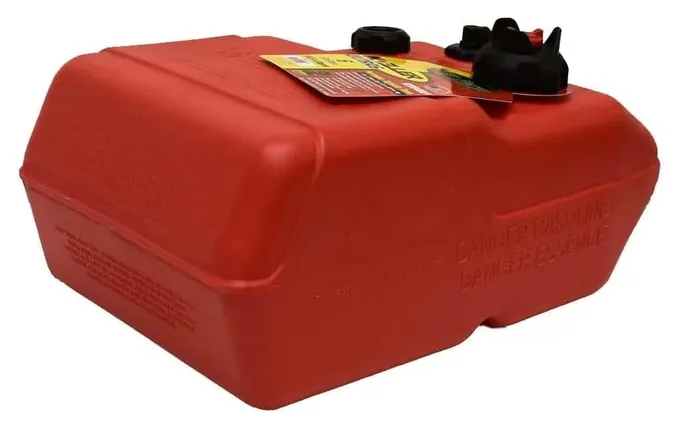
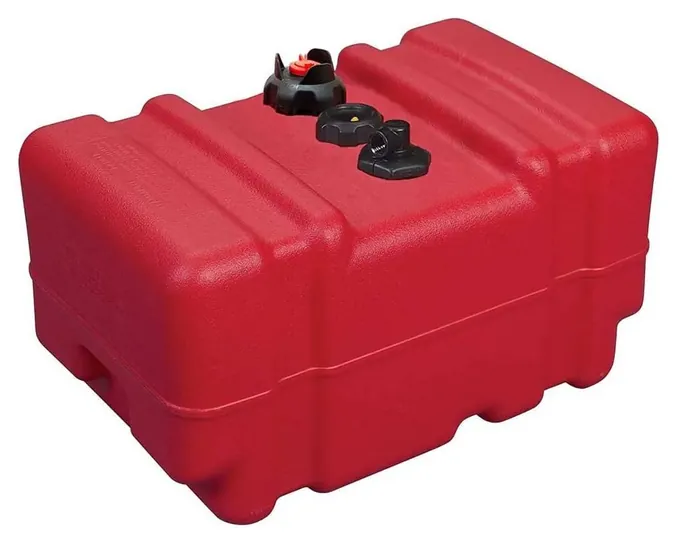
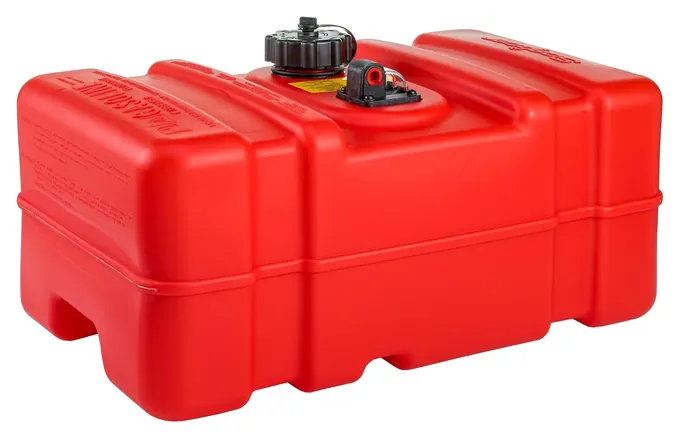
Most small outboards run from a portable tank that sits in the boat and connects with a hose. Six gallons is the common size. Three gallons suits a kicker motor or a small skiff, and 12 gallons covers longer runs. Weight decides more than range, though: gasoline weighs a little over six pounds a gallon, so a full 12-gallon tank is a heavy carry down a ramp. A 9-gallon tank such as the Scepter 08667 is a middle ground.
A built-in tank is bolted into the hull and plumbed with fill, vent and fuel lines. On boats with gasoline engines, U.S. Coast Guard rules require each tank to pass the maker's leak and fire tests (33 CFR 183.510), and they bar tanks made of terneplate or unprotected black iron or carbon steel (33 CFR 183.512). Welded aluminum and thick rotomolded plastic are the usual choices. A replacement has to match the old tank's space and fittings, so measure the bay, not just the tank, before you order.
The Fume Rules And The Label To Look For
Gasoline seeps slowly through ordinary plastic, so the EPA caps how much a portable marine tank may lose: 1.5 grams per square meter per day at 28 degrees Celsius (40 CFR 1060.103). Tanks that meet it carry an EPA label, and many also meet California's CARB rules. Scepter marks its compliant models on its marine products page.
The rules also changed the caps. Older tanks had a vent screw you opened by hand. Newer ones use a cap that lets air in as fuel drains and holds pressure in the heat, which is why a sealed plastic tank can bulge on a sunny day. That's normal up to a point, but store tanks in the shade. Built-in tanks on newer boats face their own emission rules; Moeller explains which apply on its regulations page, and why some of its replacement tanks are sold only for older boats.
Hoses, Fittings And Filling Safely
A tank is only half the setup. You also need a fuel line with a primer bulb, plus a connector made for your engine's brand, since Yamaha, Mercury and Tohatsu fittings differ. Most portable tanks use the same quarter-inch threaded port, so a line from the tank's maker or your engine dealer will fit. Scepter lists its lines and fittings beside its tanks on its marine products page.
Fill portable tanks on the dock or ashore, not in the boat, and keep the nozzle touching the fill neck. Leave room at the top, because fuel expands as it warms. Don't use a regular gas can as a boat tank: it has no pickup for a fuel line. Buy name-brand tanks from the maker's own store page; the CPSC recalled Scepter gas-and-oil combination cans sold by third-party importers in 2025 and 2026. Scepter backs its own products with a one-year limited warranty.
How we researched this
We compared 19 tanks from Scepter, Attwood, Moeller, RDS and budget brands, read the makers' spec and warranty pages and the federal rules for portable and built-in tanks, weighed owner feedback and boating-forum threads, and checked each brand for recalls with the U.S. Consumer Product Safety Commission.
Frequently asked questions
Does a portable fuel tank come with a hose?
Usually not. You need a fuel line with a primer bulb and a connector that matches your engine's brand. Most tanks use a standard quarter-inch threaded fitting at the tank end.
What size portable tank do I need?
Six gallons suits most small outboards for a day out. A 3-gallon tank fits kicker motors and small skiffs. Go to 9 or 12 gallons only if you run long distances and can lift the extra weight.
Why does my plastic fuel tank swell?
Modern tanks hold vapor in to meet emission rules, so heat builds pressure and the sides bulge. Keep the tank in the shade and open the cap slowly. A tank that stays deformed when cool should be replaced.
Can I use a regular gas can on my boat?
Not as a fuel tank. A gas can has no fitting for a fuel line. Use it only to carry fuel, and fill your boat tank on the dock or ashore.
Is aluminum or plastic better for a built-in tank?
Both work. Aluminum is the long-time standard for built-in tanks and won't swell, but it can corrode if it sits wet. Thick rotomolded plastic won't rust. Either must pass the maker's Coast Guard tests.