The 9 Best Inspection Cameras
Updated by · How we research

Nine borescopes and inspection cameras compared by tip size, steering, cable length, screen and recording. The Teslong TD450S leads for engines and walls. When users buy our independently chosen editorial recommendations, we may earn commissions to help fund the Wiki.
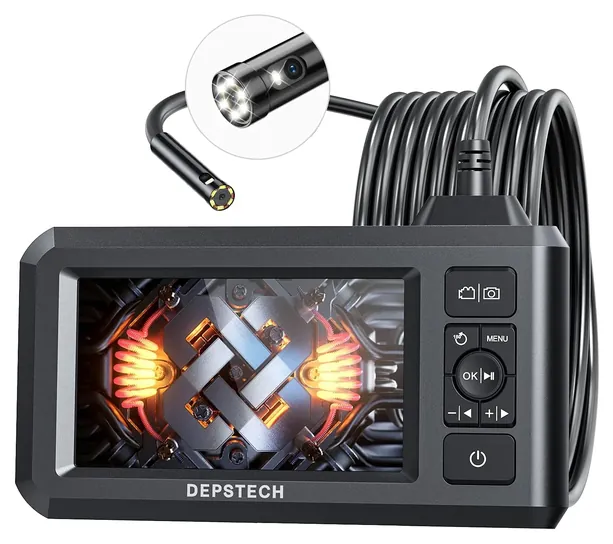
The 1080p on most inspection camera boxes says little: the small screens on these tools show less detail, and each lens focuses sharply only a few inches away. For engines, a thin tip that bends around corners helps most; for drains and walls, a long cable that holds its shape does. These picks suit homeowners, plumbers, electricians, inspectors and mechanics.


Editor's Notes
October 27, 2026, by Ezvid Wiki Editors:
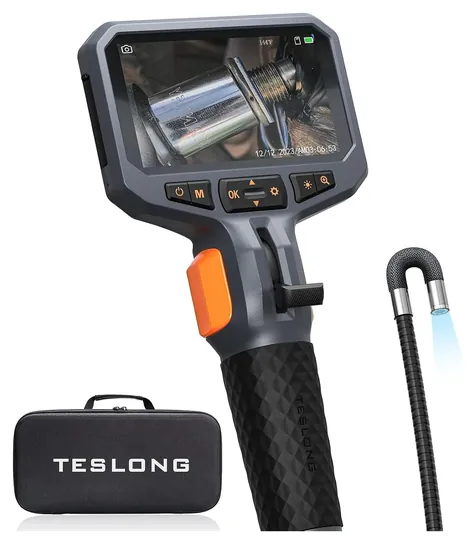
The Teslong TD450S earns first place on the strength of a tip that bends both ways, which does more for an engine or a wall cavity than the extra-long cables most cheap scopes advertise. The Ridgid micro CA-25 is the one survivor from the old list, and the Teslong NTS300 is back in its five-inch, two-camera form.
The Bosch GIC 120 C Professional, DeWalt DCT412B, Extech BR100 and Vividia 9mm Flexible have left the market, while the older Wi-Fi models from Depstech and DBPower have been replaced by scopes with their own screens, which skip the app setup and lag. For the Milwaukee M12 M-Spector 360 and the Ridgid micro CA-350, see the special honors.
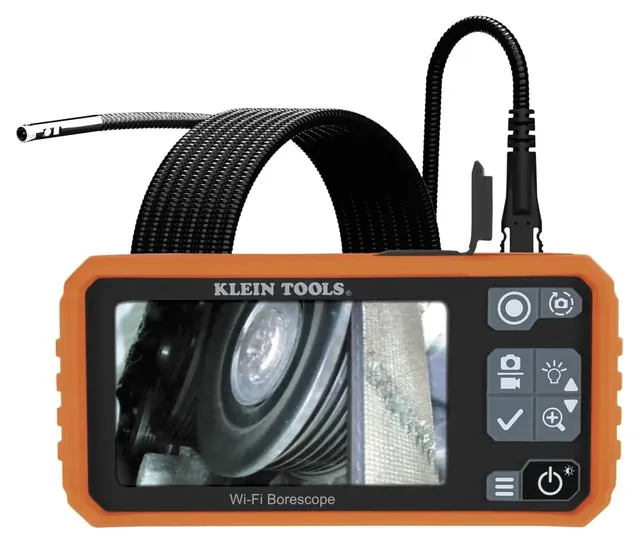
The ranking leans on Bob Vila's and The Drive's borescope tests, a Pro Tool Reviews head-to-head of trade scopes, Klein's spec sheet admitting a 480p screen behind a 720p camera, and repeated owner complaints about loose tips, short batteries and frozen screens. No inspection camera has been recalled.
Earlier notes
September 8, 2020, by Daniel Imperiale:
A lot of the borescopes and endoscopes on the market are starting to look more like the Depstech Borescope and the Dbpower WiFi Endoscope, which both create small Wi-Fi networks you can join with a phone or tablet to use that as your viewscreen. For a large number of consumers, this is a huge convenience, as it eliminates the need to house much extra hardware, and as most people tend to already have a phone on them anyway.
But professionals are still going to need something a little more rugged than that. For example, the Extech BR100 with its hard carrying case and IP67 waterproof rating make it an ideal companion to use in workshops and garages, or on sites where things are liable to get a little messy. Sure, that Depstech model is also rated IP67, but the phone it connects to might have a harder time holding up under adverse conditions.
Ultimately, users will want to look for a camera with good lighting, a high megapixel count, and a clear screen that's bright enough to perform in sunlight. The question of a recording ability is also a big one, especially if you're dealing with clients who want some visual proof of your claim, making this particular feature ideal for car mechanics.
August 15, 2019, by Daniel Imperiale:
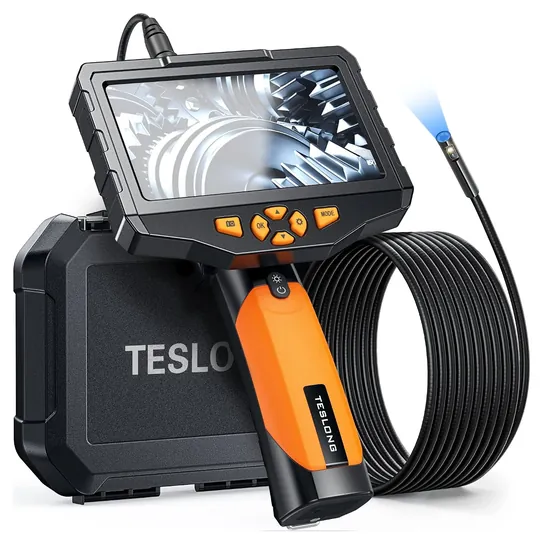
Without a ton of innovation being poured into the sector, we kept a lot of the models from our last ranking, but found it was necessary to reorganize them a bit based on how they'd performed. The Lemonbest model previously at number nine is the only offering that we felt had to go, both for performance reasons and availability problems. In its place, we looked to Teslong, whose exceedingly portable Micro option fell a bit from the fourth to the sixth spot, but whose industrial model came in swinging. That device boasts 720p resolution and a 4.3-inch screen, so it'll be hard to miss any issues under inspection.
We also found some borescopes for our special honors section, one of which may seem comically expensive at first, but you should keep in mind that it's a precision instrument designed for use in things like aircraft maintenance, where missing small details can cost lives.
Special Honors
Milwaukee M12 M-Spector 360 This trade scope runs on Milwaukee's M12 tool batteries and has a 10-millimeter camera head on a 4-foot cable that balances bend and stiffness for drains and walls. The 4.3-inch screen shows a 720p camera image that can be rotated, and it saves photos and video to an included SD card. Milwaukee covers the tool for five years. It is sold mostly through tool dealers. milwaukeetool.com
Ridgid micro CA-350 For plumbers who need records and reach, Ridgid's micro CA-350 saves photos and video to an SD card, runs on a 12-volt tool battery, takes interchangeable camera heads and works with Ridgid's SeeSnake reels for long sewer runs. It costs several times as much as a household scope, so it is a pro tool, not a homeowner's first camera. ridgid.com
Steerable Tip Or Long Cable
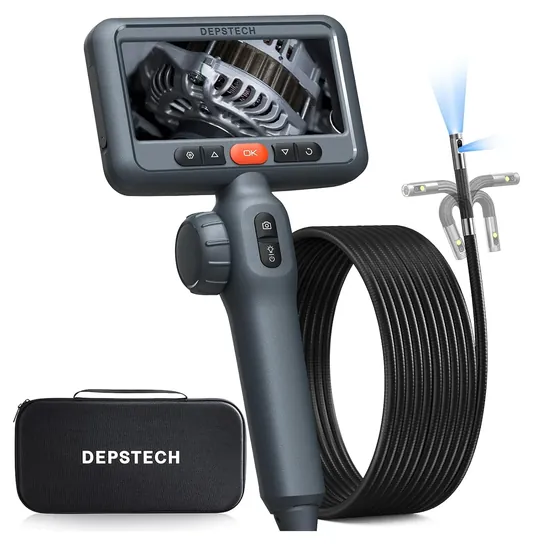
The other kind has a tip you steer with a thumb lever or joystick, bending it up to about 210 degrees each way.
Inspection cameras come in two basic shapes. The common one has a fixed camera on a semi-rigid gooseneck cable, often 16 feet or so, that holds whatever bend you give it. That suits drains, ducts and wall cavities, where you push the camera along a path. The other kind has a tip you steer with a thumb lever or joystick, bending it up to about 210 degrees each way. The Drive picked a steerable Teslong as its best overall for car work, since a bending tip can look back at a valve or around a corner that a fixed camera can't see. Steerable cables are shorter, usually 5 to 10 feet.
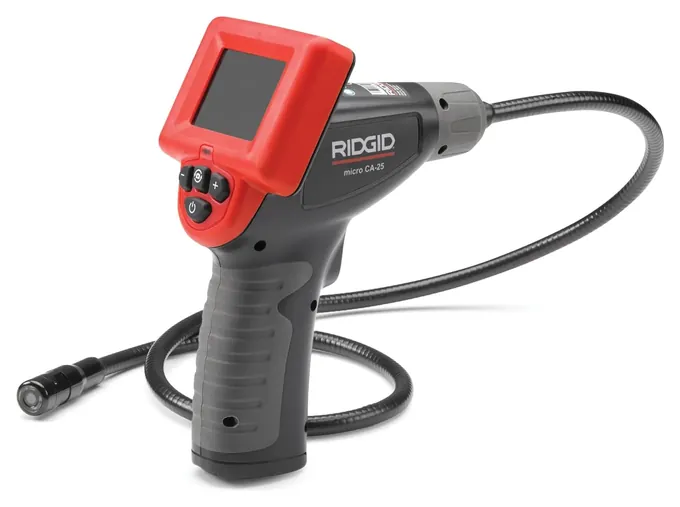
Tip width decides where the camera fits. In Bob Vila's test, the 17-millimeter head of the Ridgid micro CA-25 would not pass a shower P-trap, while an 8-millimeter Teslong went through. Thin is not always better, though: Pro Tool Reviews found that the slimmest probes sagged and had weak lights, while thicker, stiffer cables pushed past obstacles. It also found that none of the handheld scopes it tried could get through a toilet trap without a reel system, so a scope is not a drain snake.
Long cables have a cost. Bob Vila found a 16-foot cable hard to feed with one hand while holding the monitor in the other. For engines and most wall checks, 3 to 5 feet is plenty. Save the long cable for pipes and ductwork.
Ignore The Resolution On The Box
Listings for cheap scopes promise 1080p or even 1920p. The sensors are about 2 megapixels, and the 4- to 5-inch screens show far less. Klein is unusually frank: its ET19 spec sheet lists a 720p camera and a 480p screen. What you can actually see depends more on the lights, the lens and focus distance. Nearly every scope has fixed focus that is sharp from about half an inch to 3 or 4 inches away, so these are close-up tools, not cameras for looking across an attic.
Recording matters if you write reports or send photos to a client or a mechanic. Most mid-priced scopes save photos and video to a microSD card or built-in memory, but some budget models are view-only, and the Ridgid micro CA-25 only sends video out over a cable. Auto Express, which compared seven inspection cameras in 2026, singled out a clear screen, a lithium battery, waterproofing and recording as the features that separate the good ones.
A built-in screen is usually the better choice over a phone app. Bob Vila found the Wi-Fi model it tried slow to set up and laggy, and The Drive noted a buggy app on a phone-screen scope. Apps do make sharing easy, so some models, like the Klein ET19, offer both.
Safe Use: Live Wires, Hot Engines And Water
A scope cable is not insulation. Turn off the breaker before you push a camera into an outlet box, a panel or a wall cavity with wiring, and keep it away from bare conductors. Don't use one in a fuel tank or anywhere with flammable vapor either, since none of these is rated as explosion-proof.
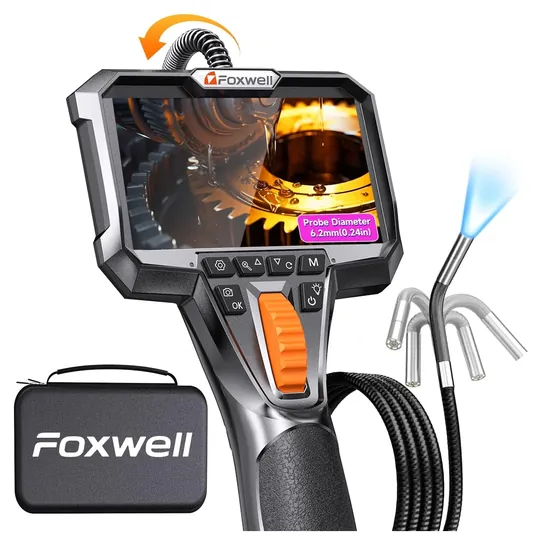
Heat is the other limit. Foxwell's Y400 manual says the camera shuts off at about 158 degrees Fahrenheit (70 Celsius) to protect itself, and Depstech warns against high temperatures too. Check an engine cold or only warm, and stay out of exhaust manifolds and flues. Waterproof ratings cover the camera and cable only: Klein notes that its rating applies to the camera, and the screen unit should stay dry.
Treat the battery like any other lithium pack: charge it on a hard surface and don't leave it charging unattended. Some budget makers say to use a basic 5-volt charger rather than a fast charger. Finally, use a scope only on property you own or have permission to inspect, especially in shared walls and rentals. We found no recalls of inspection cameras in the U.S. Consumer Product Safety Commission database.
How we researched this
We compared 17 inspection cameras, read makers' spec pages and manuals from Teslong, Klein, Ridgid, Milwaukee and Foxwell, weighed borescope tests from Bob Vila, The Drive, Auto Express and Pro Tool Reviews, analyzed owner feedback for repeated faults, and checked every brand for recalls with the U.S. Consumer Product Safety Commission.
Sources (10)
- The Drive: Best Borescopes
- Bob Vila: Best Borescopes
- Pro Tool Reviews: Inspection cameras head to head
- Auto Express: Best inspection cameras
- Klein Tools: ET19 Pro Borescope
- Teslong: TD450S
- Ridgid: micro CA-25
- Foxwell Y400 manual (manuals.plus)
- Milwaukee: M12 M-Spector 360 2323-21
- U.S. Consumer Product Safety Commission: Recalls
Frequently asked questions
Is a borescope the same as an endoscope?
For these tools, yes. Borescope, endoscope, inspection camera and snake camera all name a small camera with lights on the end of a thin cable. Medical endoscopes are a different, regulated device.
Does 1080p on the box matter?
Not much. The small screens on these scopes show about 480p to 720p, and the sensors are around 2 megapixels. Good lighting and a sharp close-focus lens matter more than the number on the box.
Can an inspection camera go through a toilet?
Usually not. Handheld scopes can't get through a toilet trap, and wide heads can stall even in a shower trap. For toilets and sewer lines, plumbers use a camera on a push reel.
Should I get a scope that uses my phone?
A built-in screen is simpler and works without setup. Wi-Fi and USB scopes cost less and make sharing easy, but they can lag or drop the connection, and apps vary in quality.
Can I use an inspection camera near electrical wiring?
Only with the power off. The cable is not insulation, so switch off the breaker before checking an outlet box, panel or wall with wiring.
Do these work for factory or machine-vision inspection?
No. Production-line inspection uses fixed machine-vision cameras with special lenses and software. This list covers handheld scopes for homes, trades and cars.